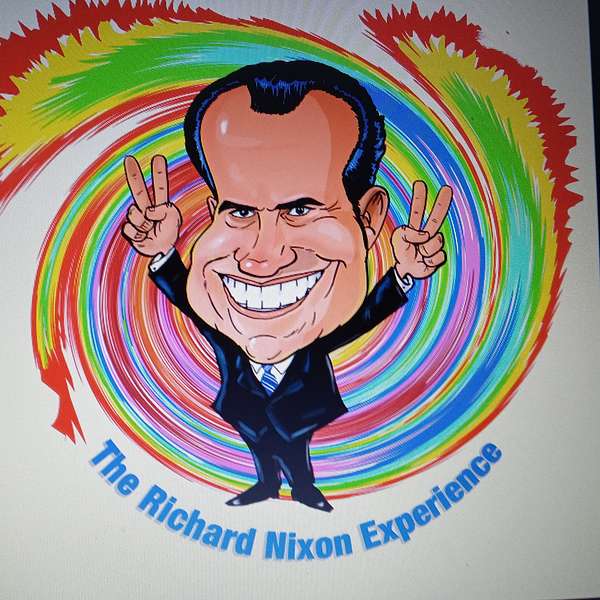
The Richard Nixon Experience
It has been 50 years since the Administration of Richard Nixon. In that time, the left has waged a war on history to define Richard Nixon as a failure as President. For much of the half century Richard Nixon's name was synonymous with corruption and Government overreach. Podcasts, Documentaries, Cable Network specials have all controlled a narrative that cast Richard Nixon as the 20th centuries great American Villain.
But all of that has changed. First in 2013, Geoff Shepard, Richard Nixon's youngest Watergate Defense team member, petitioned the National Archives for access to sealed Watergate materials. What he found was a treasure of exculpatory material that has sent shock waves throughout the world of serious historians and legal scholars. Was there more to the story of Watergate? The documentation he exposed certainly seems to say so and that is not the only area where scholars are finding that there was way more to Richard Nixon's tenure than had ever been appreciated.
Richard Nixon worked to protect civil rights, advance women in government, protect the environment, set new higher standards for workforce safety, share revenues with local government, restructure the inner workings of the Federal Government, with plans to make it work more efficiently and more effectively and he even worked to provide a better healthcare and welfare system some 40 years ahead of his time. He opened up women's sports, lowered the voting age, ushered in an era of Judicial restraint, desegregated the Southern School system, poured millions into entrepreneurial programs for minorities, passed tough laws on organized crime, ended the draft and passed billions of dollars into cancer research that has led to most of the advances against the wide variety of deadly diseases we see today.
And that list does not even get into the Foreign Policy achievements we associate with his incredible five and a half years as President.
We thought it was time to tell that story and over the next year and half we will tell that story on this podcast. The story of the experience of a nation, at war in Vietnam, and often under siege, and at war with itself, here at home. An experience that created a great gash in the body politic that we are still healing from today. It is the story of the man who saved our Union from the growing disaster an upheaval experienced in this era.
The story of the experience of a nation as it wrestled with titanic changes in culture, the experience of a nation ripped from its foundations, and the experience of the historic leader that set that nation back on course to its rightful place as the beacon of light for freedom and prosperity to a troubled world . The experience of the late 1960's and early 1970's, the experience of the most divisive era in American history, other than the Civil War, the experience of the United States of America and the leader who fixed it all.
Welcome to "The Richard Nixon Experience" Podcast
(FAIR USE NOTICE : This presentation contains copyrighted material the use of which has not been specifically authorized by the copyright owner. The use of this footage is for educational and historical commentary. We believe this constitutes a fair use of any such copyrighted material.)
The Richard Nixon Experience
RICHARD NIXON and WATERGATE 1974 Through the Fire (Part 18) Deep Throat and L. Patrick Gray the truly innocent man of Watergate (Special Edition)
Arguably, the most famous story of Watergate, save Richard Nixon's resignation itself, is that of the famous Washington Post secret source, My Friend, Mr. X, or better known thanks to the movie and book "All the President's Men" as Deep Throat. He turned out to be the number 2 man at the FBI, W. Mark Felt. Felt denied it for decades even though he was among the list of suspects and he only came forward due to his family pushing him for what appears to be a payday long after Felt himself was capable of making the decision on his own.
But the decision of Mark Felt and his family to step forward also flushed out another man, also in his advanced years, near death due to pancreatic cancer, who had paid a horrible price for a role in Watergate that he had not asked for, nor deserved to have played. L. Patrick Gray was the Acting Director of the FBI following the death of J. Edgar Hoover. Hoover had led the Bureau for nearly a half century and as his health began to fade a power struggle for who would replace him had emerged. When Hoover died, just a month before the break in, Richard Nixon seized the moment to reign in the Bureau that under Hoover had become a power source for its director.
It was in making that play that Nixon turned to Pat Gray so that a new leader, without a dog in the fight for control of the Bureau, could take control and clean house. Gray however soon found himself not only dealing with intrigue within the FBI but intrigue outside of it as well. He was barely on the job a month before he was mislead by the White House Counsel to the President and was being spied on and undermined by his number 2 man at the Bureau.
In this episode we look at both men and how their stories are intertwined, and also how aggrandizing one man's role in Watergate led to the destruction of the other man. Gray has seen his name sullied as an untrustworthy pawn of the White House, who destroyed important Watergate investigation files by throwing them in the Potomac River.
In reality, Gray was an honest man whose only real crime was in believing in the people around him. He was mislead into destroying documents that were found in Howard Hunt's safe, but the materials were both not related to Watergate , and while forged, had content in them that were actually true. All of this cost Gray his chance to be the Director of the FBI, a job he had done well, and wanted to continue serve in. It was certainly a high price for him to pay.
L. Patrick Gray was, in the end, the truly innocent man of Watergate. In this episode we look at both the story of Mark Felt and Patrick Gray.

Podcasts we love
Check out these other fine podcasts recommended by us, not an algorithm.

BOB DOLE : The Life that Brought Him There
Randal Wallace