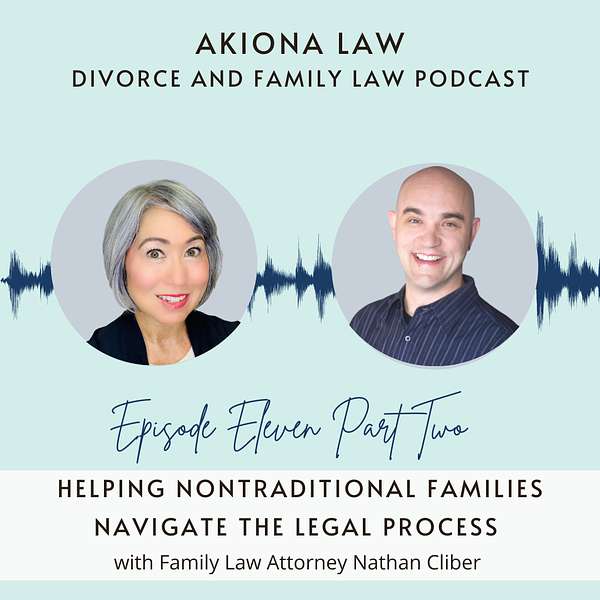
Akiona Law Podcast
Join us as founding attorney Lani Akiona interviews industry experts on everything you need to know about Family Law and Divorce in Seattle Washington. Akiona Law: Caring for You in Your Time of Crisis.https://www.akionalaw.com/**The information in this podcast is general information only and should not, in any respect, be relied on as specific legal advice.
Akiona Law Podcast
011 - Helping nontraditional families navigate the legal process with Family Law Attorney Nathan Cliber – Part 2
How to create structures or legal structures in terms of polyamorous couples, especially when there’s children involved.
Learn more at www.akionalaw.com
Akiona:
We started up again. I'm going to go ahead and do the countdown. Five, four, three, two, one. Hi, I'm Lani Akiona. Welcome back to Akiona Law Podcast, the podcast where we talk about old things that intersect in the areas of family law and divorce.
Today join us for part two with family law and divorce attorney, Nathan Cliber from Seattle Divorce Services. Welcome back to the show, Nathan.
Nathan Cliber :
Thanks, Lani. It's great to be here again.
Lani Akiona:
Where we left off, we were on a very interesting discussion of how to create structures or legal structures in terms of polyamorous couples, especially when there's children involved. One thing that we had touched about too in the first episode was that collaborative law. That is a new area that I think a lot of people aren't necessarily familiar with.
You do collaborative law. I am trained as a collaborative law attorney, but for some reason, I feel like in Snohomish County, it's not really being utilized. I take that knowledge and training and I try to focus on cooperative divorces when it's applicable. Why don't you tell us a little bit of collaborative divorce? How does that work with polyamorous couples or just in general?
Nathan Cliber :
Well, collaborative law speaking generally, the formal collaborative, big C, if this it's mirror right. Big C collaborative, as you know, it's the approach to theoretically it could be any legal proceeding, conceptual at least. I see it because I practice family law, that's where I see it. I think it's actually the most popular place to apply it.
Basically at the beginning of the case, both parties, could be more than two parties without any issues that I can see hires a collaboratively-trained attorney and some other professionals help as a support team. The basis is we sign on an agreement right up front saying, "We're absolutely not taking this case to court."
The court has to sign off on the final documents because that's the only way you get a binding order. We're not going to ask them to make any decisions. We're all promising not to, we're all promising to be completely transparent. We're all promising that we're all going to watch out for everybody's best interests.
We're all promising to talk openly with each other whenever we think it could be helpful. Essentially, taking the litigation out of in this case, the divorce most often. In essence, just saying, "Gosh, darn it. We're all going to sit down in a room like adults and figure this out."
Lani Akiona:
With the help of a certified financial divorce coach with a parenting coach. In fact, you and I were in the same collaborative law training class together.
Nathan Cliber :
It's actually worth noting that specifically is that there are out there people who say they do collaborative divorce who aren't trained in collaborative divorce. I'm not saying that that can't work. I am saying that it is a different thing. There's a specific set of trainings. I think in ideal circumstances, memberships, and local collaborative bar sections and then whatnot.
The notion is that we're going to take this case whatever's going on in this case and we're going to deal with it like humans, like grownups to the degree possible. The professionals are there to help, again, usually two people come to agreements without the scare tactic.
The implicit stick as opposed to the carrot of the courts hanging over our heads. I think it's a fantastic process, but I don't think it's for everybody.
Lani Akiona:
It's not.
Nathan Cliber :
I have been impressed by the degree of conflict and antagonism that a good collaborative team can absorb and redirect, and manage. The outcomes on collaborative overall, I think both statistically and anecdotally the outcomes are way more sustainable. The term that people in the field like to use is durable.
We see less people coming back to court after their divorce, if they did it collaboratively. In part, I think that's because the agreements that they reach for their divorce, they reached them. They worked through whatever issues were in the way of them coming to an agreement and they did it. I think that gives them a little more weight to the individuals involved.
Also, because even if they do have disagreements later, they're way less likely to take it to the courts because they've already had success in this process. A methodology that they've learned for dealing with their disagreements that is way less way risk of becoming nasty and way less risk of becoming absurdly expensive.
Lani Akiona:
Now, do you feel that the life of collaborative case, do you feel like it's shorter or just as equal to the process of the divorce?
Nathan Cliber :
In terms of how long the divorce takes, I don't know. I think there's a huge difference on average. In Washington state, as you know there's a 90-day, minimum time, a divorce isn't allowed legally to take less than three months because we can't file final orders until the case has filed and served on the other party for three months.
Lani Akiona:
91st day the date the service is filed.
Nathan Cliber :
I don't know what your experience has been, but I think most divorces take more six or nine months to get through.
Lani Akiona:
Yes, I do.
Nathan Cliber :
King County, we can't go that long because we get that case schedule right off the bat. I know that Snohomish thing can go on for longer without the court getting impatient with people. In King county, you get 11 months and if you don't seek a trial continuance, you better have something figured out or you're going to trial at month 11.
That's just the way that it is. I think duration for collaborative versus traditional litigation is similar. I've had plenty of collaborative cases wrap up three months, [inaudible 00:07:10]. I've had quite a few go a little bit longer than a year. I think most of them fall in that same six to nine-month range.
Lani Akiona:
You were talking before we resume part two, we were talking about collaborative law and polyamorous couples.
Nathan Cliber :
I touched on this a little bit during our first conversation about this during part one. Polyamory has only recently become mainstream enough that people are living openly enough that they're actually, I think feeling comfortable coming to lawyers or seeking anything with in terms of legal, maybe not recognition, but protections and structure.
To find a point on it, I think not enough time has passed for a lot of the polyamorous relationships that have taken on that more formal approach to have broken up. They're still in the process where things haven't fallen apart and they need to actually be then disassembled and dealt with.
It wouldn't be a divorce because theoretically some of them could be divorcing in a polyamorous relationship. The disillusion process whether it's a disillusion of a marriage or another type of committed intimate relationship, people have to have reason to break up before they need help with those things. Especially, with the pandemic putting a lot of things on hold.
I haven't had occasion to bring a formal collaborative process to bear on a polyamorous breakup because polyamorous breakups, it's not that they don't happen very often, but the small subsection that I've pursued legal structure, and protection that subsection hasn't come back to needing legal support in breakups.
I think that's partly just a matter of time, but I also think it's because and I'm speculating here I think from a guessing educated estimate. Polyamorous, polycule is the term that a lot will use for groups of more than two people.
Lani Akiona:
What's that term again?
Nathan Cliber :
Polycule like molecule, but with poly on. A group of people with connections and relationships. One of the almost comically common traits of polyamorous families or polycules, a tendency to spend tremendous amounts of time talking about the relationship, talking about relationship rules.
Talking about relationship dynamics, talking about scheduling, the calendaring that goes on. These are every single one of them calendaring experts. These people will do things with Google calendars you didn't know were possible.
Lani Akiona:
That seems extremely tiring for me. I can barely keep track of my own schedule and my kid's schedule. My husband basically takes care of the kid's schedule. I can't imagine trying to add one more person onto it. You've got to be extremely organized.
Nathan Cliber :
I think maybe the most common reason that people stop being polyamorous is they can't handle the logistics. It's a huge demand on time. The other side of it is though that however many kids you have imagine having an extra adult, that's just a part of that family. Imagining having your spouse or your partner has surgery or medical care and needs.
All of a sudden there's another other adult is there, they're having a crisis, a mental health crisis, or they're sad. You've got to work so you can't be there with them, but maybe the other partner can. Anytime you're adding people, well, it's additional complexity, so it adds that. I like to think about it a lot like furniture. Have you ever sat on a chair with two legs?
Lani Akiona:
Have I ever sat on a furniture with two legs? No.
Nathan Cliber :
No. How about three?
Lani Akiona:
No.
Nathan Cliber :
No? You haven't sat on a three-legged stool?
Lani Akiona:
A three-legged stool, yes.
Nathan Cliber :
That'll stay up. You're not balancing precariously and you get four it's even more stable. I don't know. Once you get to five, maybe it gets a little weird, but you take my point. The additional people it's harder to put together effectively, but once it's there, I think in a lot of ways it's more stable.
There's more that it can support the weight of whatever's on it. It's a little abstract, I recognize.
Lani Akiona:
I see. I get it.
Nathan Cliber :
Gosh, I think I've dragged this off track for the actual question again though. Why have I not spent time doing disillusion of polyamorous relationships so much? Partly I think it's that people who are doing this long enough and effectively enough to even want to get those more formal legal protections instruction in place are usually extremely practiced.
Often extremely good at communicating and being good at communication, it really good for the longevity of a relationship and also reduces the need for lawyers to be involved if the relationship breaks up. They're more likely to be able to work it out.
Then the other piece of it is I think that, and it's tangential, or at least related to that is in order to get any legal protections or structure at all, polyamorous families have to think ahead. They have to put together the equivalent of a prenuptial agreement or postnuptial agreement basically.
Relationship agreements, "This is what we're doing with our money and our possess and our debt. This is how we want to do parenting. This is how we want it all to work." If the relationship breaks up, they're way more likely than a more traditional couple to have put thought into their breakup towards the beginning of the relationship.
I like to think that the reason I haven't spent significant time doing polyamorous breakups, not because they happen less often, but because polyamorous people put so much thought into their relationships, and so much effort on the front end, they're not as likely to need help on the back end, if that makes sense.
Lani Akiona:
No, that makes sense. What do the polyamorous people need the help of an attorney for then? Is it like how you were saying they need help doing maybe a prenuptial, which is before marriage agreement or post nuptial, which is after marriage agreement? Is that what you're helping them with?
Nathan Cliber :
Yeah. When I get to help polyamorous family is it's on kid stuff like we talked about last session, last episode, part one.
Lani Akiona:
Kids stuff.
Nathan Cliber :
Kids stuff like we talked about before de facto parentage and whatnot. Which is again, bleeding edge stuff in its own. What I've mostly actually ended up doing for people is simple estate planning and property agreements. These three people are getting into a relationship. Maybe two of them are married.
Maybe they're not, maybe none of them are married. Just to be super clear for anybody watching or listening, it's still not legal to have more than one spouse in Washington state.
Lani Akiona:
Thank you for clarifying that.
Nathan Cliber :
You're not allowed to be married to more than one person at a time. There's nothing that says you can't create a private contract between people about how three or more people will share property. I've worked on that a bit. Simple estate planning. I don't do complex estate plans, but I absolutely do simple wills.
I will do durable powers of attorney. That's one of the main things that I end up doing. Not to take the romance out for anybody who didn't know it, but legally speaking marriage is largely an economic arrangement. With simple powers of attorney, three or more people can say, "Both of my partners can exercise control or management of my funds, my resources, my bank accounts, if needed."
Lani Akiona:
Should I become mentally in incapacitated.
Nathan Cliber :
It takes care of the, "How do I visit my partners in the hospital?"
Lani Akiona:
Yeah. Especially with COVID.
Nathan Cliber :
They're a whole another layer there. Nobody can there, but in the before times, if somebody's got your medical power of attorney and saying, "Now, either of these people can, if I'm not able to make medical decisions." It really helps that access aspect of people who are stuck in the hospital. Are you family? Yes, I am. Having these documents really helps with that.
Lani Akiona:
Well, especially in the sense that if the couples, the polycule, if you don't have a marriage or if you have the polycule consist of a married couple and then a third person. That would suck for the third person not to be able to participate in any type of medical decision making or see their critical ill spouse.
Like you said, you can only have marriages defined between two people, that's it in Washington. Just two people.
Nathan Cliber :
The legal marriage is still that. That's exactly it. The third or fourth or fifth or whatever, there's still as much a part of this person's life and this person's in the hospital, how do we deal with that? Those are little ways that we can do it. We can cobble together something, not unlike marriage in a lot of ways, in terms of legal structure and protections.
I don't know if any great drive, I don't think there's a lot of activism behind trying to get plural marriage made legal in Washington state. There's a lot of social baggage there, but I hope one day we'll get to that point.
Lani Akiona:
It just feels like Utah's got plural marriages.
Nathan Cliber :
I don't think they do anymore either. I don't think they [crosstalk 00:18:24]
Lani Akiona:
Do they strike the law?
Nathan Cliber :
I don't know for sure, but I don't think so. It's become stupidly and unfairly the notion of having multiple spouses is I think in a lot of people's minds tied to a polygamy, which is a man with multiple wives, many of whom in the imaginings and there are real instances of this, of course are underage girls.
That's not what polyamory is about at all. It's leans very heavily on very modern concepts of consent, honestly. I know at least as many polyamorous families where there are more men than women and increasingly even that distinction is not particularly relevant or consistent, those non-binary folks.
The polyamory community is extremely diverse in that sense. I think it's really unfortunate that so much of that social awareness has been so colored by the religious cult-y, polygamy circumstance.
Lani Akiona:
Dogma and stigma. I happen to watch Real Housewives of Beverly Hills and Salt Lake City because that's like junk food for my brain. It was really interesting because I realize of Salt Lake City, they're showing this episode and it was an Asian couple, they were from Vietnam and he wanted more children with his wife and his wife was like, "No, I can't do it."
She had 10 miscarriages or something. She was older. She didn't want to start over. The husband said, "Well, why not a sister wife?" It was really interesting because I felt like, "They're from Utah. Sister wives, it's a thing." No, it was a cultural thing. It was because back in Vietnam, that is a cultural thing.
He was saying that his grand father had multiple girlfriends and everybody was happy and everybody got along, and everybody got together well, I guess that shows my naivete. Inside, I'm thinking like sister wives and it's Utah and it's Mormons. No, it's actually a thing for different cultures and it's not a big thing.
I thought, wow, that's so interesting. It just makes me realize in a sense, how much of it is the religious stigma that you have on it, like the Judeo-Christian concept. I don't know, if people can get along and it works, why not?
Nathan Cliber :
That's my attitude about most things, frankly. As long as everybody's on board and everybody is giving informed consent. Do what you wish.
Lani Akiona:
Informed consent, I think that's the key to it. In terms of just going back again to the polyamorous polycules, people will be coming to you to for help with drafting a simple will, medical powers of attorney financial powers of attorney property agreement. Now, would the property agreements include things such as who pays for what?
We should each contribute this much into the purchase, the maintenance, the mortgage of this property?
Nathan Cliber :
They can, absolutely. I've done some like that. Gosh, I hope this doesn't sound too cynical. In general. I think the highest and best use of most relationship property agreements isn't to manage the interior workings of the relationship. I don't know if you do prenuptial agreements at all, Lani.
Lani Akiona:
I do, pre and post.
Nathan Cliber :
When I'm doing those, in fact, I try not to focus on whose income is being used for which things it's a little bit more reasonable to do that with a non-traditional because there's less, there aren't any legal presumptions about community property or whatnot if you don't have a marriage between everybody involved.
Still in the end, I find most people work it out however, they're going to work it out during the relationship. What they need is some structure and protections for when they break up, if they break up. In some ways, I usually have this conversation with people right up front when they come to my office.
It's like, "Listen, I have to proceed under the assumption that at least one of you is going to become a huge jerk in the future. That you will not agree on stuff later on because it's probably not much point in doing this agreement otherwise because if you all agree on stuff later on, you won't even need to look at it. You can do whatever you want." Go ahead.
Lani Akiona:
No, I was going to say that's funny. I have to presume that one of you is going to be a huge jerk in the future.
Nathan Cliber :
Probably they won't and I can't think of a single instance where I've seen them back either in my office, or in the court system, which is not to say it hasn't happened.
Lani Akiona:
Really?
Nathan Cliber :
I really don't. Again, like I said before, I think it's because there's so much planning that goes into it, so much communicating that when the breakups do happen, they just don't need to seek that level of support. Maybe they hated the word I did originally and they don't come back to me and they're talking to somebody else that I don't know about.
Lani Akiona:
I doubt that.
Nathan Cliber :
What was I going to say? When I'm doing the agreements for people, it really is geared towards what happens if you break up? How are we going to divvy up stuff if the relationship fails? Another thing, interestingly, concomitant to me not getting these people back in my office for their breakups.
There's this really interesting open question under the law. You know about the committed intimate relationship doctrine in Washington state.
Lani Akiona:
A case law.
Nathan Cliber :
We don't have common law marriage, but we don't have common law marriage with a wink and a nudge. If you live like you're married to somebody for long enough and that's completely not defined anywhere, and then you break up you can be held to some of the same standards as if you were divorcing somebody. Not all of them because that would also be too simple.
Lani Akiona:
Listen, committed intimate relationship is essentially common law marriage. Minus the fact that you cannot get spousal maintenance relationship because committed intimate relationship is created by case law. The right to spousal maintenance is created by statute.
To me, that's the only difference, otherwise property and debts get divided. You can create a parenting plan, establish child sport.
Nathan Cliber :
One of the interesting, outstanding questions if anybody watching or listening to this wants to be the test case, I'd love to help. I want to find out if I can get a committed intimate relationship case by a person who's not married to someone else who is married to yet a third person.
Lani Akiona:
You've got Bob and Judy in a marriage and then you've got Sue. Sue's in a committed intimate relationship with Bob.
Nathan Cliber :
With Bob and Judy, was that the other one? I don't remember which name-
Lani Akiona:
Judy's the wife.
Nathan Cliber :
Judy and Bob are married. Let's say Judy and Bob are married and we've got Sam. Let's break those gender presumptions about [crosstalk 00:26:41]
Lani Akiona:
Let's break the gender presumption.
Nathan Cliber :
Bob and Judy and Sam. Bob and Judy are married. Sam is in a relationship let's say with both of them. Let's say with both Bob and Judy, commited intimate relationship. They're living together for a decade. Maybe there's some kids, maybe not. Let's leave kids out of it for a minute. Just keep it a little bit simpler.
Lani Akiona:
Yeah, that'd be simpler.
Nathan Cliber :
Bob and Judy and Sam. Sam is in a relationship with both of them. They're sharing their assets, they're buying houses together. They're doing all the things married people do. For whatever reason, Sam breaks up with let's assume both of them also keep it simpler. It's even weird that Sam like only breaks up with Judy, but is still seeing Bob.
Sam's out of the relationship. What's Sam's recourse? If Sam was just in an unmarried relationship with either Bob or Judy, it's easy, committed intimate relationship petition. We treat it a lot of the ways like a marriage. Can we do that? If the other parties are married to each other or married to somebody else? I don't know.
There's nothing in the law that I've ever been able to find that requires committed intimate relationship to be an exclusive relationship. There are really good reasons historically why that shouldn't be the case. Yes, I want this case because I think that it is a really interesting thing to do and it may have happened. This is the other strange thing. As you know, case law comes out of appeals.
Lani Akiona:
True.
Nathan Cliber :
If cases are happening and resolving and everybody's more or less okay or doesn't have the money to take it up on appeal, we won't ever hear about it. It's not going to be unless you're going to go comb the court records for the public records to see, I don't have time for it. I know you don't.
I don't know if anybody has had that circumstance come up, I'd love to hear from them. Please give me a call, I want to hear how it went. If anybody's in that circumstance and you're wondering, I want to say, I think legally speaking is a perfectly good standing to bring a committed intimate relationship case if you're breaking up with a couple or with somebody who's in a marriage.
I think these are the kinds of questions that are, again, this is bleeding edge family law for the real nerds there. My God, I can't believe I just said that out loud. There's just so many things that we just don't know how it's going to play out yet.
Even the ability to publicly approach a question like this through the courts, the social acceptance of non-monogamy has just within the last decade, I think, become sufficiently high that I think people can come out, and try to seek these sorts of remedies comfortably.
Lani Akiona:
The family law nerd in me too is just dying to see how this will play out too. If you have like a Sam out there that comes to you seeking to dissolve a committed intimate relationship on this, please, keep me in the loop.
Nathan Cliber :
Within the confines of attorney-client confidentiality and privilege, I'm happy to. I'd love to tell you how that goes. You know how that goes.
Lani Akiona:
You cannot spill the details, but you can just generally, generalization.
Nathan Cliber :
These things are happening.
Lani Akiona:
Just very generalizations about cases that's what we can discuss. You said simple wills too. I usually consider simple wills a state under a million. You've got like a prop, you've got one home.
Nathan Cliber :
Excuse me. Everybody think I have COVID. I just made poor lunch choices, the simple wills, for me, I'm not an estate planning person. I don't have a lot of experience doing complex stuff. I'm not trying to help avoid estate taxes or anything like that.
Lani Akiona:
Same here.
Nathan Cliber :
One of the other things that comes with marriage is if you die without a will and you're married, your spouse gets most of what you had by default, and that's how that works. That doesn't happen if you're in a relationship with somebody and not married.
Of course, if you're in a polyamorous relationship, at least two of those people aren't married to each other, or at least one of those people isn't married to either of the other people. How do you protect that? How do you protect that sort of in the case of somebody dying? Simple wills are a great way to handle that. In fact, the only way to handle that.
Gosh, I'm giving all these shout outs and plugs for people. For more complicated estate planning, because that can be useful too. I have a person that I refer people out to Zana Gerson. If I got it wrong, I'm sorry. I'm sorry, Zan. Zan Gerson, G-E-R-S-O-N. She's fantastic. She's a very skilled estate planner and I've worked with her on a couple of different cases with polyamorous families.
I really respect her work. She's my go-to person if this is a little above my pay grade for this aspect of things.
Lani Akiona:
Well, thank you so much, Nathan for filling us in on collaborative law and also giving us that basic rundown. What is it what I'm trying to say here, I'm trying to think of the term, just in terms of just polyamorous couples in general.
What are the legal solutions and remedies out there to help them define relationships or rights and duties there's sometimes overlooked within the more traditional standards of relationships is what I'm trying to say.
Nathan Cliber :
Sorry. Go on.
Lani Akiona:
No, go ahead.
Nathan Cliber :
I was going to thank you. Thanks for having me on and asking the question. I appreciate not only the time to get to chat with you, but also I like visibility on these things. I think there's a lot of people out there in non-traditional relationships that maybe doesn't even occur to them, that they could talk to a lawyer or seek that kind of help.
Just raising the profile of that issue I think is great. Thank you for that too.
Lani Akiona:
If you do go to court to get this de facto parentage established for the couple you said, is it four parents?
Nathan Cliber :
It is four parents. Yep.
Lani Akiona:
Gosh, when that is done, maybe come back and let us know how it went.
Nathan Cliber :
I would love to do that. I'll I'll talk to the family. It's rare enough. I think I wouldn't want to act it out somebody just by process of elimination. I bet they love that actually and being able to let me share a little bit of their story, I think would probably please them. I'm happy to-
Lani Akiona:
How about you try and do it in the New Year?
Nathan Cliber :
It's going to depend. Like I said, the weird thing is I don't want to try. Trying and failing is almost in some ways, a riskier proposition than waiting to try. As soon as we can get back in the courthouse in-person, I'm going to be talking to this family, "We're back in the courthouse. Let's go do it." It's not going to get better than that.
Until then, I'm still really, but I'll be honest, I'm a little nervous about when we're going to be back in the courthouse, physically, at least in King County.
Lani Akiona:
I don't get why King County's still not doing in-person.
Nathan Cliber :
I don't know. I won't speculate. We're pretty uptight down here in King County about COVID I think is maybe the right answer. I'm not going to weigh in one way or the other on how I feel about that. I have mixed feelings. I got a young kid at home who can't be vaccinated.
I'm a little bit on the uptight side myself. Systemically, it does seem to be presenting an awful lot more problems than it's solving sometimes, but I don't know.
Lani Akiona:
Wow. That's interesting. I looked it up in the de facto parentage it became statute January 1st, 2019. Yet it hasn't been that long at all. It's not even a year.
Nathan Cliber :
It's been-
Lani Akiona:
I'm sorry, 2019.
Nathan Cliber :
Going on three years.
Lani Akiona:
I got the Moderna booster the other day on Wednesday and I'm feeling the effects.
Nathan Cliber :
I'm sorry. Worth it, good job.
Lani Akiona:
Oh my gosh.
Nathan Cliber :
It's in almost three years, but your point is still extremely valid. It takes time for stuff to happen in the law. People start having problems and it can take a year or several years for them to resolve. Even if they do resolve, we might not have case law about it because nobody appeals.
Then if it does appeal there's another year or two before we get that. This is all really interesting again, for legal nerds or polyamory nerds, I suppose, and cutting edge family law stuff. Again, thank you again for having me come on and help raise visibility about this.
Lani Akiona:
Well, thank you so much, Nathan for your time and tell us so people can get a hold of you at Seattle Divorce Services. Do you want to see the phone number?
Nathan Cliber :
Sure. The Seattle Divorce Services, our office is located in Ballard. We really are doing everything remote. Even if you're not in the area, can't make it to our office. We can do a Zoom meeting. Phone number's (206) 784-3049. If you're watching this or listening to this, and you really like me, this is where I work, but I'll be honest, every single attorney at this office is amazing.
We're a small firm. There are gosh, right now, we have five attorneys. We just hired on a new gal just joined us. I would trust anybody here with my own legal issues. Everybody here focuses on family law. It's just a great crew.
Lani Akiona:
This is Nathan Cliber. Cliber is spelled C-L-I-B-E-R. Nathan, I've got to know, what is your most favorite musical that you've done? [crosstalk 00:37:21]
Nathan Cliber :
God, you're killing me.
Lani Akiona:
What was your favorite performance?
Nathan Cliber :
That I personally have given?
Lani Akiona:
Then, if you could go back if someone said, "Nathan, we need you here to star in this Seattle production." What would it be?
Nathan Cliber :
Wow. I wasn't a lot of good shows in college, but I wast Into The Woods near the end of my time at Western Washington University up in Bellingham. I was in Into The Woods and I got to play Cinderella's prince and the Wolf. That was more fun than anybody should be allowed to have. That was a great time.
Lani Akiona:
That's a production you would do again?
Nathan Cliber :
I'd do a lot of them again, but if I had to pick a favorite, that'd probably be where it was. I also loved, I was in Hair. That was a great one.
Lani Akiona:
You're in Hair?
Nathan Cliber :
Yeah.
Lani Akiona:
Gosh, I love that. For the listeners out there, Nathan just rubbed his shiny head.
Nathan Cliber :
I'm all shaved and bald now.
Lani Akiona:
He's clean shaven like Mr. Clean. Well, if you happen to restart your musical career again, just as a side hobby, please let me know. I love to come out and see you and support you. Thank you so much again, Nathan, for being on the show and thank you for all the listeners out there.
Join us for the next episode of Akiona Law podcast. Where we discuss all things that relate and intersect with the areas of divorce and family law. Until next time, stay safe, and stay healthy. Thank you.