The Company of Dads Podcast
The Company of Dads Podcast
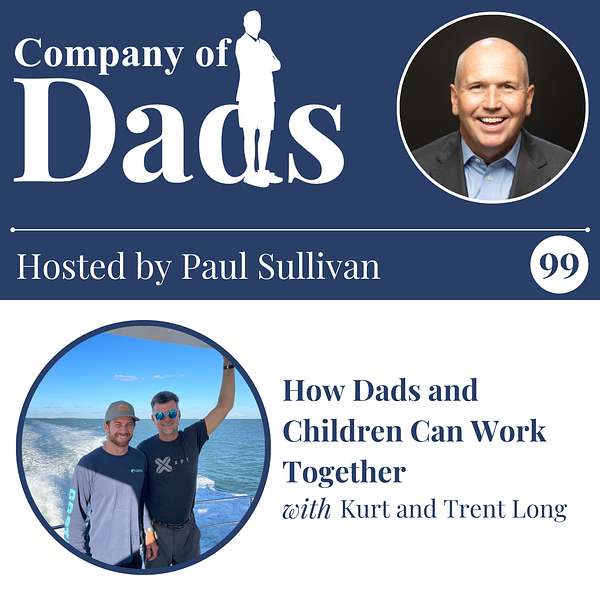
EP99: How Dads and Children Can Work Together
Interview with Kurt and Trent Long / Father-Son Entreprenuers
HOSTED BY PAUL SULLIVAN
Kurt and Trent Long, father-son founders of a company called BUNKR that digitally encrypts your passwords and documents, have lessons for other families looking to work together and build a business. Kurt is a serially successful entrepreneur whose family and friends have always been around his businesses. He recognizes the strengths his children have and leverages them. For his part, Trent knows that at work Kurt is Kurt - not dad - and that's helped them with respect from other employees at work and family harmony outside of the office. Listen to their lessons for parents and children.
---
Get our free newsletter covering all things fatherhood delivered straight to your inbox: https://thecompanyofdads.com/thedad/
00;00;05;28 - 00;00;24;11
Paul Sullivan
Welcome to the Company of Dads podcast, where we explore the sweet, silly, strange and sublime aspects of being a dad in a world where men, where they go to parent, aren't always accepted at work, among their friends or in the community for what they're doing. I'm your host, Paul Sullivan. Our podcast is just one of the many things we produce each week at the Company of Dads.
00;00;24;12 - 00;00;45;06
Paul Sullivan
We have various features, including the dad of the week. We have our community both online and in person. They have a new resource library for all fathers seeking answers. The One-Stop shop to learn about all of this is our newsletter. The dad. So sign up today at the company of dads dot com. Backslash. The dad.
Today my guests are father son team Kurt and Trent Long.
00;00;45;08 - 00;01;05;06
Paul Sullivan
Kurt and Trent are the co-founders of bunker, which is a digital vault that encrypts and stores passwords and documents. We're going to talk today about something a lot of parents who own businesses hope will happen, that their children will want to work with them, and that if they work with them, they'll grow together as a family, not just as business owners.
00;01;05;08 - 00;01;15;16
Paul Sullivan
The logs also have a family foundation focused on mental health, which we'll touch on toward the end. Welcome Kurt and Trent to the Company of Dads podcast.
00;01;15;18 - 00;01;17;08
Kurt Long
Thanks for having us, Paul.
00;01;17;10 - 00;01;18;10
Trent Long
Thanks for having us, Paul.
00;01;18;13 - 00;01;38;05
Paul Sullivan
All right. Kurt, you're the dad. So you're going to get the first question. We're going to dial back into that that Wayback machine. And I want you to tell people not really related or maybe relate to what you're doing now, but you had a pretty cool first job working at the Kennedy Space Center. I mean, next to being, you know, a firefighter.
00;01;38;06 - 00;01;46;09
Paul Sullivan
I think a lot of kids want to hang out with astronauts or be an astronaut. How did that job at the Kennedy Space Center come about?
00;01;46;12 - 00;02;07;28
Trent Long
That is a way back machine. So when I was a child, you could see the Apollo launches, all over the state of Florida. We lived in Florida, and you'd see the launches take place. And, you know, a couple days later, you'd look on television and you'd literally see astronauts, bounding across the moon. And so it was a very real thing.
00;02;08;03 - 00;02;36;15
Trent Long
And I wrote the Space Center when I was 13 or 14, and they wrote back, which meant a lot. You know, it's like, wow. So this is a real place, like, I, I could work there. And so I held on to that. And then over time, as I graduated from the University of Florida, I still held out that maybe I could be involved in, in space in some way.
00;02;36;15 - 00;02;59;19
Trent Long
And and I wound up getting, interview there at the space center, and, I got hired, and, that was probably the most transferred, by far the most transform out of professional experience in my life. And I was lucky enough to be involved with a group of people who treated each other like family. And, that was a long time ago.
00;02;59;22 - 00;03;27;20
Trent Long
And I remained friends with that entire group, you know, for all of these years, all the way till now. So it became, much more than than just a first place to work. It became a pursuit. I had the rest of my entrepreneurial career, which is, could I ever possibly recreate the family, feel that this wonderful group of people at Kennedy Space Center gave me when I when I started out, it transformed the rest of my life?
00;03;27;23 - 00;03;48;19
Paul Sullivan
I mean, no, no pressure on you, Trent. If you've got, you know, recreate a whole bunch of, you know, famous astronauts did, or bars, you do one question, that follow up on I didn't I mean, that experience. I mean, you know, we all have formative experiences in our careers that come at different points. Yours came at the very beginning.
00;03;48;21 - 00;03;56;20
Paul Sullivan
What did that teach you? What did that teach you as as a business leader. But did it teach you anything as a father? You talked about the family feel at the space center.
00;03;56;22 - 00;04;19;14
Trent Long
Yeah. I mean, I had tactically, you know, meaning, stealth space and the individual people, there were men and women in that group that could be both strong, and even tough. But at the same time, kind. You know, so they could be both. They could be both. They could be both tough and kind. And they had the wisdom is to know when to be tough on me.
00;04;19;14 - 00;04;38;19
Trent Long
And I deserved it. I, I deserve to have, some of those leaders ask more of me that I was giving. But at the same time, it never felt personal. And they would also help me. And I think that shaped, parenting a good deal. And as I said, I stayed in touch with those, with those people over the last 30 years and more.
00;04;38;21 - 00;05;00;13
Trent Long
And so they've always shaped me, in that way, strong and kind of the same time. And then as far as lessons learned from entrepreneurship, I'll just give you a couple. There's so many that translate, but I'll just give you two. The first is to have a vision, for something bigger than yourself, something that seems unimaginable.
00;05;00;13 - 00;05;18;29
Trent Long
Separately, we're going to launch Hubble Space Telescope. And, you know, at 200 miles above the Earth, we're going to put it in geosynchronous orbit. And, it's going to stay there and take pictures of the universe for the next 35 years. I mean, it it sounds outlandish. It it was. That's much bigger than any one person can do.
00;05;18;29 - 00;05;40;20
Trent Long
So it's like to be part of a team that we're the vision is way bigger than yourself, but that if we unite together, we can pretty much do anything we dream up. That's the first lesson, that I got out of it. And not just hearing people talk about that, but live it like you have to live it, not just get a lecture on it.
00;05;40;20 - 00;06;02;01
Trent Long
Nobody gave lectures. You lived it. And then the second one is, truth is that, you know, you have to become very comfortable with finding the truth because everything has to be so exact. If you're wrong, things go really wrong. So you can't hide things. You have to reveal what the truth is. Meaning? You know, is this mission ready to go?
00;06;02;01 - 00;06;37;12
Trent Long
Did we do our job perfectly as we worked in the data bank? As the data bank, 100% ready to support that mission? And if it's not, we're going to be accountable to all of our peers across the Space Center. So we better have this thing right. It better. And we got to find the truth. Is it ready? And then as an entrepreneur, I felt like that translated, you know, you can tell yourself whatever story you want, but your business is either working or it's not working and you have to get comfortable, hearing uncomfortable things that are true, you know, so vision bigger than yourself, work as a team and then, you know, truth,
00;06;37;12 - 00;06;41;05
Trent Long
the truth finding process. Those are the two big takeaways.
00;06;41;07 - 00;06;47;26
Paul Sullivan
All right, Trent, your dad growing up tough or kind? Well, you know, that's his time. Which one?
00;06;47;29 - 00;07;13;08
Kurt Long
But both. Yeah. All right. I mean, my obviously, probably like, every, young man, they're going to say their mom was far kinder than their dad. Because, you know, that's that's the reality of it. But, yeah, you know, we definitely, you know, had areas where we had a lot of fun together. And there was other areas where, you know, as a, as a teenager, you know, I deserved to get some tough lessons from, from dad, so that's for sure.
00;07;13;10 - 00;07;26;04
Paul Sullivan
And what do I read in to Trent that your, your first job was was working for a privacy company. Is this we really good at, like, hiding stuff from your dad when you were a kid? How does this how does this come about as your first job out of college.
00;07;26;07 - 00;07;51;17
Kurt Long
Now it's it's pretty funny that you asked that, because, you know, when I was, when I was in college, you know, I was doing various jobs, everything from, working as a dishwasher, to stocking retail shelves at on the 4 a.m. shift. I remember waking up at 330 to go to work, and my roommates were still awake from the night before, and I was going to work.
00;07;51;19 - 00;08;13;15
Kurt Long
And then ultimately, I, I, you know, wanted to, trace, Chase a dream and, become a professional fishing guide and dabbled in that. A little bit, and, and pretty quickly realized that, you know, I wanted I wanted a life that I could provide for my family, be around family, and and really have that be the focus.
00;08;13;15 - 00;08;50;28
Kurt Long
So then, you know, I ended up, working, at fairwarning, which was, a company that was founded from Kurt and, started off, you know, at the, very low totem pole there, and, and, eventually worked my way up, through the business, through you know, hard work and experience to, running a whole team of cybersecurity analysts that, you know, used the fair warning software to, essentially, catch the bad guys, inside of health care organizations, which isn't a whole explosion of, of a conversation I'm sure we can dive into.
00;08;50;28 - 00;09;02;13
Kurt Long
But that's kind of that's kind of how I transitioned from, you know, going through college into, kind of the first career, first career step.
00;09;02;15 - 00;09;20;00
Paul Sullivan
And when you say you work for a company, like kind of your dad back, but that's different from from co-founding, you know, a company to together. So, I'll give you the first question and then we'll, we'll, we'll see if see if your dad agrees. But. Yeah. How did it happen? How did you come? How did this idea come about for bunker?
00;09;20;00 - 00;09;26;00
Paul Sullivan
How did you get guys decide to to to do it together. Tell me the origin story.
00;09;26;03 - 00;09;58;18
Kurt Long
So, it's funny, you know, during Covid, we were all locked down as the rest of the world, was. And we started to, you know, it was at a time where we, as a family, you know, I'll speak for the family. We we were transitioning from, running the business. Fair warning together. The previous business and having a lot of help with administrative aspects, of our lives, people to do, you know, a lot of these, tasks throughout the day, and, and all of that went away.
00;09;58;18 - 00;10;24;23
Kurt Long
And then Covid started, around that same time frame. And so as we were, lockdown and living more or less a digital life, we started to encounter some of these extremely frustrating challenges, that you encounter, you know, just living your life. You know, it could be anything from, hey, let's, I need to find an email attachment, but the thread is 22 emails long, and, hey, this looks like an attachment.
00;10;24;23 - 00;10;49;05
Kurt Long
You click on it, it's a logo, you know? And so as, as the very most basic example, you know, stuff like that, really frustrated us. And we started to think that, you know, maybe there's, there's there's got to be a better way. To save time and give people time back in their day and, and, eliminate those, those tech frustrations and, and protect, people securely.
00;10;49;08 - 00;11;08;13
Kurt Long
Through our, you know, past experience of, of doing that within the health care system. So more or less, you know, that's that's kind of the the origin story of what, inspired us to take on bonkers. We wanted to solve these day to day challenges for people so that they could spend more time doing what they what they wanted to do, whether it's spend time with their families.
00;11;08;13 - 00;11;11;09
Kurt Long
Do you know, whatever the case might be?
00;11;11;11 - 00;11;25;01
Paul Sullivan
And I'll throw it out to either of you, but how did the decision get made that you would would found the company to together and then really become again not just father son but but business partners in in bunker.
00;11;25;03 - 00;11;56;12
Kurt Long
Yeah, that's another great question. So, it's it's pretty funny. You know, we, you know, we actually founded, the business, with, with my brother as well, and, and my brother and I, recruited Kurt more or less to help us, founded the business because, you know, we are, very good at executing, on, on the business aspects and doing the heavy lifting.
00;11;56;15 - 00;12;18;22
Kurt Long
But we knew that Kurt is able to say these sentences that are just it could just be one sentence. But it's a profound sentence. And then we work really well together, to translate that into execution and and create that vision into a reality. So, yeah, we, we, we recruited him into into bunker.
00;12;18;25 - 00;12;25;07
Paul Sullivan
How do you feel about that, Kurt, that that your sons want you to just kind of keep it to one sentence? How does that feel?
00;12;25;10 - 00;12;51;17
Trent Long
A lot of pressure. Like, you have to spend a lot of time thinking and not much time talking, you know, like, apparently. But I would go back a little bit further, Paul, on the origin story of bunker. And that was we started fairwarning when, hobbies, our other son had a huge role in, in bunker. But we founded Fairwarning, while they were in school and that business.
00;12;51;22 - 00;13;21;02
Trent Long
And when I say we, Theresa, who was my mom and, my wife, we founded Fairwarning and that business began growing and we patented, techniques to, to detect, criminal activity around electronic health records. And we got the timing right on that. We're a little bit early, but it took off and the business grew. We had customers all over the world.
00;13;21;04 - 00;13;37;11
Trent Long
And we were building trust in the health care industry and catching bad guys at the same time. But we we kind of translated that to patient care that the more the patient could trust their care provider, the more they could share, the better treatment they could get. And in study after study, that turned out to be true.
00;13;37;13 - 00;13;59;24
Trent Long
And so when Trent and Hobi joined Fairwarning, you know, it was kind of that era after after the housing bubble. And there was in was that 2009, 2010 very choppy time. And I don't think any of us really thought we would all four work together in a business, you know, it just seemed that that did not seem like what would happen.
00;13;59;27 - 00;14;19;27
Trent Long
And but we did. And Theresa ran a really big part of the business. She was super important. And Trent, he's being a little bit humble about his. He did start at the bottom. And then we started a new division. And I remember a very talented first employee with a great education, and she chose to leave at that time.
00;14;19;27 - 00;14;44;03
Trent Long
And you stepped up and said, hey, listen, I'll do it. And you stepped into that role, and that division grew into it to be a very significant part of the business. Hobby had an amazingly important part role in the business. He was more of my partner in and communicating with the marketplace, and he and I were on the same page about everything, and we ran that together for many years.
00;14;44;06 - 00;14;59;18
Trent Long
And so, Paul, when you kind of talk about the good, the bad, the ugly of running a business, I mean, all of us were in there. Then we hired all of our friends like, we you know, we we said, well, gosh, you know, these are some of the best people I know. And, and Trent's friends and Toby's friends and our friends.
00;14;59;20 - 00;15;22;23
Trent Long
So we had the building loaded with family and dear friends and it was a very, amazing and rewarding time. And we kind of pulled that off like we didn't. We stayed friends with all those friends and, and the, the when we did sell the business, it kept, you know, it kept getting bigger and bigger. And that meant more and more pressure and all of our, all the family.
00;15;22;23 - 00;15;37;19
Trent Long
And it put a lot of pressure on our, my relationship with Theresa because she was running a big part of it. And she, you know, they say, I say the one sentence that everybody else makes that happen. Well, you know, I'd come in and say my sentence once or twice a week and, you know, the rest of them, you know.
00;15;37;19 - 00;15;59;12
Trent Long
And then I was off doing some stuff and, you know, the distance grew between what the life I was living and what Theresa and Trent and Toby were living, and it just became time to move on from that business, you know? So we sold it. It had a very, very successful outcome for everybody involved. I wasn't thinking about starting another business.
00;15;59;12 - 00;16;22;05
Trent Long
I was like, wow, I've had a long run here of 25 years of, you know, startup entrepreneurship. And, you know, the last ten of those have been pretty fun because this has a little size to it or make it, you know, doing really well and travel in the world. But that's not how it played out. It's it's kind of the, the they wanted to do another business and, and, we knew what we had done in health care.
00;16;22;05 - 00;16;44;07
Trent Long
We had transformed the industry to make it a safer, more trusted industry. And then to think that we would do that at a larger scale, you know, was in kind of intoxicating to say, well, listen, let's see if we can do that for people around the world. We've seen firsthand the negative impact of cybercrime and and privacy breaches has on human beings.
00;16;44;07 - 00;17;00;15
Trent Long
It's unbelievable how damaging these things are. And let's see if we can protect, you know, whoever wants it. Let's see who we can. If we can protect the world, who wants to be protected while giving them time back in the day. So that's kind of my fuller context of how that came together. Paul.
00;17;00;17 - 00;17;22;25
Paul Sullivan
Yeah. You know, Trent, were you you know, if you're going to work for a company and your parents aren't involved in it and you screw up, they can fight for you, you do something. They'd be really harsh on you. What? The dynamic been like. Because I think this is something that really resonate with a lot of, you know, parent child business is in, you know, you take it over and there's a lot of benefits too.
00;17;22;25 - 00;17;39;17
Paul Sullivan
But there are a lot of, you know, risk because at the end of the day, you love each other. You're not you, you know, and if you were to work at, you know, Microsoft, you wouldn't necessarily love your, your manager. It's just not how it, how it works out. So what are some of the things you think about that that were great things you learned either intuitively or the hard way?
00;17;39;17 - 00;17;47;01
Paul Sullivan
That would be lessons for other adult children who may go and work in a family business.
00;17;47;03 - 00;18;09;10
Kurt Long
What a wonderful question. I actually, one of my best friends, reached out to me, in the last year and asked me, hey, you said, hey, I'm thinking about leaving my current job and and joining, my dad's company, which she's been running for 20 years. You know, what are the pros and cons essentially. And we had a really long conversation.
00;18;09;13 - 00;18;37;27
Kurt Long
But it's essentially the same thing that that you asked us here is you're asking me here is is, you know, you are there are pros and cons. The pros are that you are in an environment where the people who you're working for, whether you're directly working for your, your family or you're just part of the business that you're working for, a leader and a boss who truly want your they have your best interests at heart.
00;18;37;29 - 00;19;00;27
Kurt Long
And that's very hard to find. Because, you know, generally speaking, you know, you're a worker, and your boss is trying to, execute on, on their job, and you're part of that. And, but when you are part of the family business, you know, you can put your whole heart and soul into it, because the harder you work and the more you give of yourself, you're giving it to your family.
00;19;01;05 - 00;19;22;20
Kurt Long
I mean, these, you know, your your mom and your dad raised you and gave so much to bring you into the world that it really does feel good to just pour yourself into the business and and give everything that you can to try to benefit everyone involved. And so there's, you know, there's a great alignment there where they want the best for you.
00;19;22;20 - 00;19;49;18
Kurt Long
And you are truly, wanting the best for, for the business, for, for the sake of your family. And then, you know, there are there are other pros as well, where you know, you are you're you're in a place where you can be pushed and challenged, which is another thing that, you know, is kind of foundational to, having meaning in the, in the work that you're doing is you want to be challenged and you want to be pushed, to your, to your limits.
00;19;49;18 - 00;20;12;16
Kurt Long
And, you know, working with Kurt, I'll just say working with Kurt, you know, he was able to always push me, further than I thought was possible. Maybe that came from, you know, his experience at the at the space Center with him getting pushed by, by his leaders. But then, you know, there are, there are different aspects that are that are challenging.
00;20;12;16 - 00;20;33;21
Kurt Long
You know, you mentioned, you know, you you may make a mistake at Microsoft and get fired with the same thing happen, in the family business. I would I would argue that, you know, the consequences are, are far worse than a family business because first of all, they're. You can't make a mistake like that, you know, you can't, you're going to hear about it, no matter what.
00;20;33;24 - 00;20;55;01
Kurt Long
So, you know, you I always found myself, holding myself to a much, much higher standard, than I would, working at another job, because you care so much more. And you want you don't want to disappoint. You want to have, you know, you you you want to deliver the best results that you can. So, yeah, no mistakes are allowed.
00;20;55;04 - 00;21;20;05
Kurt Long
And, and, you know, it's, you just are put in a position where you are. You know, you just don't want to disappoint. And you, you know, for for some people, maybe they have, a little too much of that, you know, there's, there's and there's a lot of different ways that you can have, you know, a father son relationship.
00;21;20;05 - 00;21;43;10
Kurt Long
I'll just say, in this case, you know, some, some people really want, you know, desperately are seeking for, for approval, and, others are wanting to just push themselves, as much as they can in their own personal career. So there's, there's a lot of different flavors to it. But ultimately, there are there are pros and cons to it.
00;21;43;10 - 00;22;04;08
Kurt Long
And I would say the, the one piece of advice I would have to maybe a young person, considering moving into the family business is, listen, if you have some kind of a family dynamic, that is an underlying issue. You've got to resolve that before you jump in, because that's going to it's going to rear its head.
00;22;04;10 - 00;22;28;03
Kurt Long
And I know that's not maybe painting the prettiest picture, but that's the reality. I mean, you're going to be working with your family every day, and, not every second of the day. Are you going to be talking about work stuff. It's I mean, the personal stuff is going to come up, so you have to have a really solid, foundational relationship with the people that you're working with, in order to wholeheartedly jump into it, in my opinion.
00;22;28;03 - 00;22;32;06
Kurt Long
So, hopefully that answered your question. I was a long winded way of saying.
00;22;32;12 - 00;22;33;08
Paul Sullivan
It is it.
00;22;33;11 - 00;22;33;26
Kurt Long
Is great.
00;22;33;28 - 00;22;46;22
Paul Sullivan
It is a great answer. But but come on, you know, the listeners want to tell you that at any point have you gone to your mom and said, can you believe what dad just did? You know at any point you're like, dad, one sentence this week was it was bonkers.
00;22;46;24 - 00;23;15;05
Kurt Long
Well, it's really funny because, you know, you generally people have a really, segregated work and personal life and for, for us, you know, it's all mixed together. And so you try so hard to not do that at work, you know, mom, what in the world can you believe what you did, what you know, in this meeting? I don't know, you know, but, you know, what we found worked really well for us is to establish.
00;23;15;05 - 00;23;39;02
Kurt Long
And I. And I think this is a really important point, at least for us, there's many different ways to do it. But for us, what we really tried to do is, is, keep the work issues at work and keep the personal stuff at home or at lunch or what have you. And one of the things that I think was really important was I never called, curtain Theresa, my mom and dad at work ever.
00;23;39;04 - 00;24;00;07
Kurt Long
Because what would end up happening is your coworkers would start saying, hey, your dad, hey, your mom. And it doesn't it does not feel right. When you are in a meeting and somebody refers to the CEO of the business and the founder of the business says that your dad, it you have to delineate, that aspect of your life, in my opinion.
00;24;00;07 - 00;24;19;26
Kurt Long
And so we worked really hard on saying Kurt and Theresa and mom and dad at home. And so, you know, with that, you know, we could we could do the complaining about mom and dad at home, but at work it was. Yes, sir. You know, Kurt said something. Let's go do it. Yes, sir. But behind the scenes at home, my mom and my mom and I went to lunch.
00;24;19;26 - 00;24;37;17
Kurt Long
Maybe we could say the other part. So I found that to be a very, And it that was a hard learned lesson of figuring out how to segregate that aspect of your life into Kurt and Theresa and mom and dad. And then how do you intermix? It's it's a strange dynamic, but it's, that's what I found.
00;24;37;20 - 00;24;38;07
Kurt Long
00;24;38;09 - 00;24;49;29
Paul Sullivan
I love this image that that I just painted my head. This is probably completely false, but a view, like, at, dinner with your dad. He said, dad, can you believe what Kurt did today? I mean, that was just not.
00;24;50;02 - 00;24;50;26
Kurt Long
That's good.
00;24;50;29 - 00;25;10;12
Paul Sullivan
Now, let me turn to you, because I've got three daughters there. They're much younger than your sons. They're, six, 11 and 14. But my 14 year old, you know, she's she's a young woman. She she's, you know, as tall as her mom is now. And she's going out a friend. She's having a wonderful time. But I can remember, you know, she's five, six now, five, five and a half or something like that.
00;25;10;12 - 00;25;33;28
Paul Sullivan
But but I can remember when she was born and I could hold her in, in sort of the crux of my arm, like her head would be in the palm of my hand and her legs would be in the bend of my elbow. And and I have that image. I'll never lose that image. And of course, you know, as a dad, you have that that image of friend, you have that image of your sons, and you have all the other things along the way.
00;25;33;28 - 00;25;52;00
Paul Sullivan
You know, it's transit. Perhaps when he was a teenager, he was a typical teenage boy. And he needed, you know, a little tough love. But at what point it's important for sort of, you know, you know, fathers who will become partners or bosses of their children. At what point were you able to say, okay, this is my son.
00;25;52;02 - 00;26;11;17
Paul Sullivan
I love him dearly. I've known him his entire life. He's in his 30s now, but I am now going to look at him as fill in the blank as a worker, as an employee, as a as a as a future, owner of this company. How did that transition come about for you?
00;26;11;20 - 00;26;40;10
Trent Long
It was to be forthright at some age that the, the, let's say the adolescence part goes away. So there mature enough you, you just you can at least view them as an adult, you know, if they're still doing some adolescent things, that complicates it. But let's say let's say they've got to to past that point. And by adolescent, maybe they got in trouble at school or maybe maybe they had this complication in their life.
00;26;40;10 - 00;27;17;00
Trent Long
That's that's immature. So I'm assuming a certain level of maturity that they have to reach before, before, what I'm about to say applies is I, I've always been maybe it's goes back to the space center. I'm not sure, but I've always been kind of purpose driven. And I've loved my profession my whole life. I never, you know, I just loved every almost every single minute of my career, whether it was working at the Space Center, whether it was at IBM for a couple of years, or whether it's been building businesses.
00;27;17;00 - 00;27;41;12
Trent Long
So when I go to work, I mean, I'm there, I'm there with purpose. And so in building a business, you've got a vision, you've got purpose, and then you're just looking for great teammates. It comes down to, I don't care who they are, I don't care what they look like. I don't care who they are. It's where's the talent and how do we combine talent together to accomplish the journey?
00;27;41;12 - 00;28;03;23
Trent Long
And that comes down to can I see the strengths in individual people? Not necessarily their weaknesses. It's always easy to find weakness. I'm interested in strengths because I want to combine strengths with strengths, you know, complementary strengths. So as soon as they enter that workplace for me, I'm looking at my sons, I'm looking at everybody in the building.
00;28;03;25 - 00;28;32;01
Trent Long
Where are your strengths? How can I put you in a position to utilize your strengths all day, every day. And I don't really care about anything else. So it's like all that other stuff washes out, you know, so I could look at Trent and say, wow, this this guy is an incredibly calm person that executes some person. Some people call that, you know, the silent assassin type.
00;28;32;03 - 00;29;07;04
Trent Long
But people respond to him and his teams get things done without any drama whatsoever, and he seems to hire the right people, and he makes it look easy. My other son, visionary, creative, incredibly talented at the written and spoken word, you know, two really different kids to really different adults, I should say, but equally talented. Identify the strength, put him in a position to do execute on that strength, help us get to the mission and all the rest is kind of a detail.
00;29;07;04 - 00;29;20;23
Trent Long
I really don't care. In fact, if it's a distraction from what we're trying to do, I have to be snapped out of it and and go work on that. Paul. So that's how I that's just how I think about things. And I've always been like that. I've always loved what I do.
00;29;20;25 - 00;29;37;10
Paul Sullivan
It's been great, guys. Thanks for your time today. You know, one last question. I'll I'll throw either of you can answer. You both can answer. But you know, I've read you know, that you talk about business as a force. A force for good, which is inspiring and kind of bring seven together. But how did the family Foundation come about?
00;29;37;10 - 00;29;44;25
Paul Sullivan
Focus on mental and spiritual health. How did how did that start? And what's what's the goal for the foundation?
00;29;44;27 - 00;30;11;22
Trent Long
Yeah, I'll start the goal. First goal is to obviously have an impact on really we focus in on. It's going to focus in usually on young kids, you know, so it could be a thing like, feeding Tampa Bay Metropolitan Ministries. And as an example, Metropolitan Ministries, takes care of homeless families where you could say whatever you want about homeless people, but a homeless child, they didn't do anything.
00;30;11;22 - 00;30;29;22
Trent Long
I mean, they they've not they didn't make that decision. They didn't. They just got there. So you're kind of like, wow, they they need a helping hand, you know, or inspiring children out of Las Vegas or big change out of, the UK that we work with. All those organizations are focused in on trying to help kids get off to a great start.
00;30;29;24 - 00;30;58;13
Trent Long
And obviously we're going to want to have the biggest impact we can and in some cases, limited cases participate in that impact with their own time and effort. Usually it's financial contribution. And the way I got started is this is several years ago. I was observing, you know, say five, six years ago, you kind of had this idea that Sustainable Earth was a really big deal and that we better figure out how we sustain the planet.
00;30;58;15 - 00;31;19;03
Trent Long
And, you know, Paul, my my view on that changed. Not to say that that's not important because it remains important, but human beings have like the biggest impact on Earth. And if we're not, well, if human beings aren't well, we're going to make bad decisions and we're going to impact each other and we're going to impact this planet.
00;31;19;05 - 00;31;42;03
Trent Long
So it kind of became more basic than that was. Well, gosh, let's see if we could contribute to human beings being, well spiritually and mentally. And that would lead to better decisions and, and make the world a more sustainable place. And that was that was the thinking, process that we went through. And that happened over time.
00;31;42;06 - 00;31;50;28
Paul Sullivan
Fantastic. Kurt and Trent Long, thank you again for joining me on the Company Dad's podcast. I thoroughly enjoyed our conversation.
00;31;51;00 - 00;31;57;00
Kurt Long
Thanks for having us, Paul. Hopefully this, paint a picture of what it's like to work together a little bit for somebody out there.
00;31;57;03 - 00;31;59;07
Paul Sullivan
It's it's certainly. Well, it's been great.
00;31;59;09 - 00;32;01;28
Trent Long
Take care. Paul, thanks a lot. Is great.
00;32;02;00 - 00;32;19;23
Paul Sullivan
Thank you for listening to another episode of the Company Dads podcast. Really appreciate you tuning in week after week, trying to use this moment here to thank the people who make it possible. Number one, of course, held a mirror who is our podcast editor. We also have Skip Terry home to many of you know from Lead Diaries.
00;32;19;23 - 00;32;45;20
Paul Sullivan
He's taken over our social media. Terry Brennan is helping us with our audience development. And Emily Serban is there, each and every day helping with the web development akin to any of this, without, an amazing board, of advisors. So I just want to say thank you to all of you who help. And I want to say thank you to everyone who listens and, hopefully you'll tune in again next week.
00;32;45;20 - 00;32;46;08
Thanks so much.