The Company of Dads Podcast
The Company of Dads Podcast
EP101: How Fatherhood Is Changing - From Our Team
Behind The Scenes Of The Company of Dads
HOSTED BY PAUL SULLIVAN
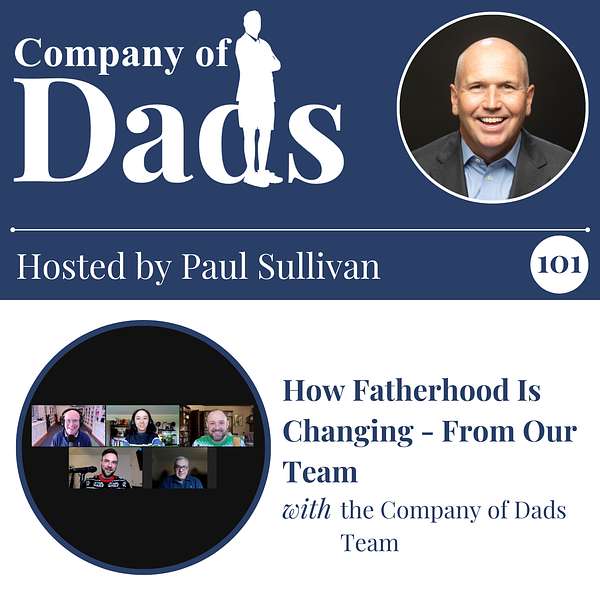
This is our holiday episode and we’re sitting down with The Company of Dads itself – the people who make this possible: Helder, Emily, Terry and Skip. We talk about the best fatherhood moment in the past year and why so much has changed.
---
Get our free newsletter covering all things fatherhood delivered straight to your inbox: https://thecompanyofdads.com/thedad/
00;00;05;25 - 00;00;24;16
Paul Sullivan
Welcome to the Company of Dads podcast, where we explore the sweet, silly, strange and sublime aspects of being a dad in a world where men where the go to parent aren't always accepted at work, among their friends, or in the community for what they do. I'm your host, Paul Sullivan. Our podcast is just one of the many things we produce each week at the company dads.
00;00;24;18 - 00;00;47;03
Paul Sullivan
We have various features, including only days of the week. We have our community both online and in person. We have a new resource library for all fathers called the Lead Dad Library. The one stop shop for all of this is our newsletter, The Dad. So sign up today at the company of dads.com backslash. The Dad.
Today is our holiday episode and we're doing something a little different.
00;00;47;03 - 00;01;22;23
Paul Sullivan
We're talking about the company of dads itself, as in the people who make all of this possible. So today, in order of seniority, I'm going to list those people who are integral to what we do every single week. We have held a mirror who produces the podcast and sports a very fine Christmas sweater. Emily Servin, the web master, Terry Brennan, who oversees our audience strategy with the newsletter and handles member relations and skip cherry homes around her social media.
00;01;22;24 - 00;01;55;22
Paul Sullivan
But some of you may also recognize him from the Lead Dad diaries. He also seems to be competing with holder for Best Holiday Sweater. I'm psyched to talk to them today, but I also want to give a shout out to our phenomenal advisory board, who I lean on a lot, and alphabetical order. We have Lisa Alvarez, Calderon, Marvin Alveolus, Ross Buck Mueller, Nigel Good Deer, Hablan, Pete Hunt, singer, thorn, Perkin, Kerry Schwab, Pomerantz, Emily Porro, Iraqi, and Jeff Stewart.
00;01;55;25 - 00;02;04;17
Paul Sullivan
Welcome, Heather, Emily, Terry and skip to the company dads podcast.
00;02;04;19 - 00;02;07;04
Paul Sullivan
Happy holidays.
00;02;07;07 - 00;02;08;02
Speaker 2
To you.
00;02;08;04 - 00;02;09;18
Speaker 3
Happy holidays to you, too.
00;02;09;20 - 00;02;24;12
Paul Sullivan
All right. Good question. Easy question. What's the best thing that happened this past year to you? As a father, if you are a father or with your father. Terry, why don't you take that one? First.
00;02;24;14 - 00;03;00;23
Speaker 2
You know, I would say that, in my case, the best things that happened, in the past year in terms of fatherhood, they're the same with my kids as with my father. I'm kind of in the, you know, in the generation right now where I sort of, help my father out and also raise my, my, my twin daughters and, any moment where, where my daughters come to me, you know, with their problems.
00;03;00;25 - 00;03;21;06
Speaker 2
And, you know, asking for my help. Is is the best, you know, the best moment for me, because, those those are the times when we really connect and, you know, when I really feel like I can. I can help them. And it's the same thing with my father. My mother passed away about two years ago.
00;03;21;06 - 00;03;36;09
Speaker 2
And, and so he's sort of on his own. And, I try to be a support to him as well. So whenever he comes to me with a problem where I can help him. That's the most rewarding time as a son as well.
00;03;36;12 - 00;03;50;29
Paul Sullivan
Yeah. Emily, I'm going to go to you next. We've heard a lot about your dad over the past year in our weekly meetings. I understand he's a national treasure. This is also a big year for you as something that perhaps your dad, was involved in. So to talk about your dad.
00;03;51;01 - 00;04;13;01
Speaker 3
Yeah. So, so I got married, and I moved none that order this year. So it was. It was a lot. Dad, being the very supportive person he is. We, We're moving. Right? I'm expecting all of my friends who are like, also in their 20s to just, like, be here. Be ready to lift some boxes. First person.
00;04;13;01 - 00;04;31;13
Speaker 3
There's my dad. He's like, all right, put me to work. And he was there the longest out of everybody until it was time for everybody to just, like, kick back. So that was just, that was just fantastic. And now my sister expects the same thing. Good luck. Dad.
00;04;31;15 - 00;04;35;04
Paul Sullivan
How did he become a national treasure? That that that's the that's the question. We have that.
00;04;35;07 - 00;05;00;28
Speaker 3
Oh, he's just a he's just a great human being. He's just wonderful to talk to. He's he's a great conversationalist. He's always taken interest in even the, the stuff that won't get me a job. He's always been very cool about learning more of, like, I get the robot figures in the back here. He's always been very supportive of that stuff and would even watch a bunch of the Japanese animation shows with me, so I always appreciate that.
00;05;01;00 - 00;05;12;26
Speaker 3
And because he's seen some, he gets, my friends and I had a friend tell me to tell him that he was thankful for my dad this year. So that's why everyone, everyone just loves Lawrence.
00;05;12;28 - 00;05;26;20
Paul Sullivan
Elder, I've known you probably the longest by far on this call, and I have these recollections of you telling me wonderful stories about your dad. And it's the did I remember? Scott was his best friend, a priest at some point, or just a good friend was a priest to tell us about your dad.
00;05;26;23 - 00;05;48;19
Speaker 4
So my dad immigrated here in the 70s from Portugal. So he's been here, you know, the majority of his life, actually. So he's become as much of an American as he is a, Portuguese resident. So he kind of, like, tends to live here. And, he's also, you know, proud, raised Catholic and is a devout Catholic.
00;05;48;19 - 00;06;16;20
Speaker 4
And we have a, our parish that he's very active in as a priest from Angola, where my dad had spent some time as well. So the two of them over the, over the past, you know, time that my father, the parish priest, has been here have become pretty tight friends. So they would come over. He brings them over every so often to my house to like we'll have sit by the fire and have a scotch or so and and talk different stories.
00;06;16;20 - 00;06;31;10
Speaker 4
And they usually have some crazy anecdotes that they tell back and forth. So yeah, that's been one of his like, ways to, to get back into life after losing my mom, at the start of the pandemic. So.
00;06;31;12 - 00;06;32;00
Paul Sullivan
And, yeah.
00;06;32;01 - 00;06;48;06
Speaker 4
And renowned and beloved on my block is as much a member of of my story as he has his own neighborhood. So people here walk by thinking he actually lives here because he usually outside doing some yard work or something, and dog whispering to the to all the local dogs.
00;06;48;08 - 00;06;54;01
Paul Sullivan
That's wonderful. Anyway, every year you take a trip with him back to Portugal, right? Are they surpassed?
00;06;54;04 - 00;07;10;08
Speaker 4
Well, the last two years we've gone back since we were able to start going back. So he. They have a house there that they built. Excuse me? They have a house that they built there. So my dad goes there and all of his, several of his siblings are still there, as well as nieces and nephews and lots of family.
00;07;10;08 - 00;07;18;14
Speaker 4
So he, goes there for a couple months, and I'll go either at the beginning or the end to just sort of hang out and catch up with the family. So.
00;07;18;17 - 00;07;26;01
Paul Sullivan
Yeah, with his puttering around outside your house, it sounds like you need to connect them with Emily's dad. I mean, I kind just kind of do all kinds of work together.
00;07;26;03 - 00;07;29;04
Speaker 4
That would be great. You could always use an assist.
00;07;29;07 - 00;07;49;22
Paul Sullivan
Skip. A lot of people know you from the Dad Diaries, but you've got a son or daughter, but you're also very close to your dad, and he's you guys. He's really close. He's always you toured with him and you were a musician early on in your life. Tell us about, you know, the best things that come to mind this past year about you as a dad and also maybe with your dad?
00;07;49;24 - 00;08;20;18
Speaker 2
Yeah, definitely. Some amazing moments this year being, you know, for those who have been following along, obviously, the biggest changes of my life, have occurred this year and, and working from home and being home, being very, very prominent, part of my, my children and, and their education, their upbringing and just the precious moments to, has, has held so much joy for me.
00;08;20;18 - 00;08;48;22
Speaker 2
Just, I think that that whole anytime something happens that I'm so glad I didn't miss out on. And I think about times in, you know, in my touring life when, okay, I, I, I experienced something similar to this over a FaceTime call previously, you know, which I'm so thankful for. I mean, FaceTime has only been a thing here in the, in the last, you know, decade.
00;08;48;25 - 00;09;16;17
Speaker 2
But, you know, there's something about actually being able to be present and being a part of these moments and not having to experience them from thousand miles away. That is that has been so enriching for me. And, and and like, Terry said, you know, especially when it comes to, hey, my, my kid has something that they're dealing with and I'm the person that they want to go to to help them.
00;09;16;19 - 00;09;47;21
Speaker 2
That's that's heavy for me because it's like, you know, you you recognize that I am I hold or potentially hold a solution for you or I'm just a comfort somebody that you can go to for something. It's there have been so many moments like that in this, in this past year that have been, huge. But being able to spend time with my dad, especially here at the, at the back half of the year, you know, I, I talked about it.
00;09;47;24 - 00;10;24;18
Speaker 2
You know, in this last hour, in the coming months of, late dad diaries. But my dad came out for a visit and I was with my dad and my son when we got the call that his dad had passed away. And so out of all the places that my dad could have been in the world, he was with me, and I was with him and and all of that, I felt like was a really strong, powerful moment, with everything that he was going through.
00;10;24;20 - 00;10;52;22
Speaker 2
And, the being that my son too, is, is just such a bundle of joy and, and brings a smile to anybody's face who, who, he runs into, it was a, you know, if you want to pinpoint a specific moment of seeing my son kind of cheering my dad up, and, you know, his grandson is is just you giving giving him that, that boost, as as both the father and the son in the situation.
00;10;52;25 - 00;10;56;02
Speaker 2
It was it was a powerful moment for me, for sure.
00;10;56;04 - 00;11;26;24
Paul Sullivan
Yeah. You know, people listening to the podcast engage with the content of the, you know, we call the company dads, but our goal is to help families fulfill their full potential. We talk about, you know, families in a more broadly how dads fit into that. I'm uncertain that kids fit in that, how extended families, you know, parents fit into it and how we can sort of, you know, work differently in this idea really came out of out of the pandemic when when, you know, personally, I saw my life going in a, you know, being pulled in all kind of different directions.
00;11;26;24 - 00;11;52;12
Paul Sullivan
And there wasn't, a resource that I could go to. So, you know, we created the Company of dads. When you think about, you know, yourselves, either your own families or just as you observe your friends and your families, how do you see, you know, families operating differently today than were when we were growing up? And I want to talk about, you know, high performing families that deeply dysfunctional families.
00;11;52;12 - 00;12;03;28
Paul Sullivan
But, Amy, how do you see those families, you know, performing differently today? The perhaps when we were all kids and I don't know, a kid. Same. Or I'll shoot this or not to Terry.
00;12;04;00 - 00;12;24;22
Speaker 2
Well, I think, you know, in terms of my own story, when I was growing up in the 70s and 80s, you know, I think, you know, my family today, versus my family when I was growing up. You know, there's a lot that's the same. The values are the same, and I think that's the most important thing.
00;12;24;24 - 00;12;49;00
Speaker 2
But, pretty much everything else is different. I was a stay at home dad for about five years. And then and now I'm. I kind of bring in the secondary income in the family. And so in that sense, I kind of, took on the role that my mother had when I was growing up. So there's that kind of reversal.
00;12;49;03 - 00;13;17;13
Speaker 2
But I think the most profound thing that's different about when I was growing up and, and now and my daughters, my twin daughters are, 11 years old. The most profound difference is definitely the fact that, you know, my parents were the exact same kinds of parents that that me and my wife are. They were, you know, my, my, I was very lucky with my parents.
00;13;17;13 - 00;13;42;13
Speaker 2
They were were outstanding parents. And that's what me and my wife aspired to be. And, the main difference is that my parents did not have the luxury of being around all the time. They had to be out of the house making money. So, my wife and I both work from home. And it's enabled us to do much more hands on parenting with with our daughters.
00;13;42;13 - 00;14;05;16
Speaker 2
And I think you can kind of see it, in my daughters, and how they are, that they've, they've always had a parent in the home with, which is not a luxury very many people have when I was growing up. It's even not a luxury that a lot of people don't have today, but it's it's a it's a blessing that we have with my family.
00;14;05;18 - 00;14;19;23
Paul Sullivan
That's greater in the Emily when you had says, don't start off by saying what you grew up in the 70s and 80s because you know, you're the youngest member of this team. But when you think about, you know, growing up and now, I mean, you're starting your own family, you just got you got married and your dad is is symbol.
00;14;19;26 - 00;14;30;00
Paul Sullivan
Now have, you know, do you see any shift in in how you know, families operate today as opposed to, you know, when you were growing up 20 years ago?
00;14;30;02 - 00;14;52;08
Speaker 3
So it's interesting because I was, when Terry was talking about working from home being a thing. Now, I kind of started thinking because of the pandemic, I started working from home. Right. And at some point, I got laid off from the job that I was coming into the pandemic with, and I was like, they were going to force me back into the office at some point anyway.
00;14;52;08 - 00;15;21;02
Speaker 3
I do well working from home. Let's find something that's better. So at some point I got my the the next job, which was solely remote, no office whatsoever, no expectation of going back into an office. And everyone was based in all the different parts that it was not going to just happen. My parents also ended up getting remote jobs at some point, and then my sister got a hybrid.
00;15;21;02 - 00;15;48;17
Speaker 3
But it was interesting because now the whole family has remote. So I would, once Covid kind of it ended. My dad and I will we'll go out to, like, a co-working space, nearby once in a while. Just to kind of, you know, get out of the house and, see different places. And it's been nice because, so my husband doesn't really work a job where he has an office.
00;15;48;17 - 00;16;20;00
Speaker 3
He's a home inspector. So we'll go to different places. But when he's not at someone's house inspecting it, then he'll be at home doing his report or something else. So it's been really nice to just be like, oh, I can just walk up and just be like, hey, Dan, what's up? You know, and just little interactions in the middle of the day, are just such a nice thing to just kind of a, a boss at my first job said something about how you spend more time with people at work than you do at the, than you do at home.
00;16;20;00 - 00;16;50;08
Speaker 3
And he sounded really proud of it. And it just it felt wrong to me. I'm like, I didn't choose to be with you people in the same way I choose to be with my people. There's something, not right about that. So, just from observing people at work that where I work now, which is fully remote. It seems like everybody's so much more able to be involved with their kids, and and, like, we'll hear stories about what they were able to do or like, sorry, my partner's not feeling well, so I kind of have to take over today.
00;16;50;08 - 00;16;57;22
Speaker 3
I'll be out from this hour till this hour, but I'll be working later. And everyone's like, hey, man, take take your time, take your time. Do it. You have to all human.
00;16;57;24 - 00;17;05;18
Paul Sullivan
I just love that part of the story where you and your dad sometimes go to a co-working facility. Yeah, that's that's really sweet. Also, it's really nice. Yeah, that's really awesome.
00;17;05;20 - 00;17;19;08
Speaker 3
Yeah, it's fun because we both work now, so you can do that and we live close by. Like, actually, I moved and I ended up closer to my parents somehow. Which isn't a bad thing. Very convenient, because they talked to them a lot. So, it's just how it is.
00;17;19;10 - 00;17;44;19
Paul Sullivan
That's great. You know, how they're, you know, one of the things besides your own sort of interesting, your own family you've worked at colleges for, for decades now, when you think about, like, what you've observed, you know, not you can talk about your own life, but you can also talk about what you've observed with interactions among families at the different colleges where you worked, you know, how have you seen things, you know, evolve?
00;17;44;21 - 00;17;55;28
Paul Sullivan
This is so ironic that Helder, who is our ace podcast producer, has muted himself as he was about to answer the question. This is a moment that we want to make sure doesn't get edited out of the podcast.
00;17;56;00 - 00;18;07;20
Speaker 4
That can go into the blooper section. It's kind of, So what have I learned from observing families at colleges, over the last decade.
00;18;07;22 - 00;18;15;05
Paul Sullivan
Or so and how everyone. Yeah. Or what you've just seen and, you know, the good and the bad of it, our families have changed.
00;18;15;08 - 00;18;57;22
Speaker 4
It's kind of I mean, the bad of it is, is seeing, you know, unfortunately, seeing how some students, inherit some of the worst qualities of their parents. But then there's also the flip side of that, which is finding students that have, like, really, dedicated themselves to studying and to learning and to, taking in everything that they can from growing from parents or being raised by parents, or families, you know, some kids are raised by full families and foster parents, and adoptive parents to see how they've grown and brought that humanity and empathy that they learned from their families to campuses and are trying to make the world a
00;18;57;22 - 00;19;24;25
Speaker 4
better place, and learn everything to honor, their families. One of the things I love to see a commencements, especially, is, people that students that have like, graduates, graduates that have, decorated their mortarboard with, messages to their parents, like some great ones, like, you know, thanks, mom and dad and, you know, we're here because of you and thanking their ancestors and family members that have been there.
00;19;24;28 - 00;19;55;10
Speaker 4
And having been able to see some of those students grow over four years is really telling. And then seeing them with their parents at the end. And I've been there so long, sometimes I've seen them arrive with their parents and see that kind of joy when they come onto campus for the first time with their family and get dropped off, and seeing the tears that some of their families are and themselves are doing, are some of the tears that they have when they're dropping their kids off and leaving and then seeing them with the same joy at the end of a four years?
00;19;55;10 - 00;20;02;18
Speaker 4
It's been kind of fun. I just saw that happen a few times. The last two commencements, having seen students arrive.
00;20;02;20 - 00;20;21;05
Paul Sullivan
That's fantastic. I had such a vivid memory of being dropped off, at college and, you know, pretending that I knew what I was doing, and, and it was only sort of, you know, an a day or so afterwards, I'm like, I, I where am I going? Am I doing I because by that point I had dirty laundry.
00;20;21;05 - 00;20;25;12
Paul Sullivan
I'm like, how do I do this? I had to figure this out. Like, how many coins do I need?
00;20;25;15 - 00;20;42;24
Speaker 4
Like, how up with my parents always coming to visit. We were so close that they would come every other weekend or so to visit, and my mother was always insistent because she worked in a laundry to want to help with the laundry, so that was embarrassing. But also helpful. So. And she always bring like cake, freshly baked cakes that we would share with the with the dorm.
00;20;42;28 - 00;21;03;01
Paul Sullivan
So you know get getting a package of of course the most exciting thing when you're away at school. And my roommate, he only lived about an hour away and his parents would come often and get his laundry, and then they would mail it back to him, and he at first, the first time he opened the packet in the mail room, he were like, are those those your clips?
00;21;03;01 - 00;21;28;19
Paul Sullivan
And to after that he learned not to open the packet. And so you'd be carrying like a giant package back would be like wow, his parents and a dog. And so, Skip, I mean, you have been family has been so integral to your life, to who you are. I mean, I don't know, I say more so than the rest of us, but as, as many people know, I mean, your family at one point was, an accomplished, a band aid.
00;21;28;23 - 00;21;48;21
Paul Sullivan
Obviously, you called country home to a bluegrass group, and then you, of course, went and formed your own group sideline. But family is, you know, how have you seen it as you've you've grown up in a a super tight knit family that literally traveled together, lived together, you know, home schooled together to, you know, as you created your, your own family.
00;21;48;21 - 00;21;53;22
Paul Sullivan
What are some of the big things that the stand out is, you know, similarities and differences.
00;21;53;25 - 00;22;20;16
Speaker 2
So, you know, going back, you know, prior to when I was playing music with my family, I mean, we were very, very structured. We lived in Los Angeles. My dad was a carpenter, worked for the Los Angeles Unified School District. So he worked on schools all through the county. My mom was full time mom, homeschooler.
00;22;20;19 - 00;22;48;18
Speaker 2
Did, you know, did the any household, everything. So, you know, it was your traditional mom handles the household, dad handles the the heavy work that, you know, one income home. My dad was very structured. You know, he'd come home from work, and then he had this workout routine that he would go into his home gym in the garage and do, he's like powerlifter.
00;22;48;18 - 00;23;21;29
Speaker 2
So, you know, just really intense individual, you know, when he was in his 40s, you. And so there was a whole lot of when I was growing up that there were, you know, there would be several days in the week. The only time I would really see my dad was dinner time. And, you know, between work and then extracurricular activities that were always going on, that was kind of, you know, dinnertime was my time with my dad.
00;23;21;29 - 00;23;46;27
Speaker 2
And it wasn't until we started traveling around together that I actually saw him more, and I was most certainly more involved. He was more involved with my life, I was more involved with his life, etc., etc.. So kind of looking at where I'm at here, it's like I, I was on the road. It's kind of the reverse.
00;23;46;27 - 00;24;13;24
Speaker 2
I was on the road seeing my kids less because I wasn't traveling with my kids, and it took me coming off the road to be at home more. And so it's kind of the, you know, kind of the backwards effect. But like Terry was saying, you know, the the important thing is, is that the values were there. I feel I feel that me being home, being with my wife, you know, it's not too different of a situation.
00;24;13;24 - 00;24;38;00
Speaker 2
She she has some stuff that she does, but it's most certainly secondary income. But she also, you know, is, you know, the point person when it comes to the schooling, and kind of, you know, helping take care of the household while I'm doing what I do. But it doesn't have to be all on her either, because I can take breaks to help with a little laundry, or I can take the kids out.
00;24;38;00 - 00;24;57;16
Speaker 2
You know, we we try to take a couple of days a week and split up, and she'll go out with, with one of the kids, and I'll keep the other at home. And that way, you know, nobody has to, to to strain too much on any point there. But also, it's good for the kids to kind of break it up and, and change the routine a little bit.
00;24;57;16 - 00;25;23;09
Speaker 2
But then, I don't have the commute at the end of the day either. As soon as I'm done with work, I'm there. I'm, I'm with my family. It's time to go jump into something else and, or, you know, handle something else or, you know, I think, like, Emily was saying is you know, if you've got something that you've got a handle, the the beauty of the remote situation is that you can be like, hey, I'm going to work a little bit later, but I got to take a break in the middle of the day to handle this, or I just want to.
00;25;23;09 - 00;25;26;22
Speaker 2
Hey, I want to take a long lunch with my kids, you know, like.
00;25;26;22 - 00;25;30;15
Speaker 3
I'm tired or I have something to do, I just. Nope. Not now.
00;25;30;18 - 00;26;11;19
Speaker 2
You're right. Yeah, yeah. And in the way that that I think that the culture has, has embraced the value of family because they actually are getting to experience it. I know that there's a lot of, and I'm not speaking for everybody. I'm just kind of the, the vibe that I get in the various outlets that I mess around with is that, you know, yeah, there's there's the workplace culture, but you wouldn't trade that for time with your kids if given the choice, I think you could you would trade it on selective days when things are a little bit crazy at home and you're like, man, I could really use a day out of
00;26;11;19 - 00;26;37;06
Speaker 2
the house. But if you want to look at the long term investment and you, you know, you get the little cats in the cradle playing in your head every once in a while, when you're away. And now you're like, hey, you know what? It's not so bad. You know, I'm I'm I'm actually pouring more of my time, more of my life into the investment that, that I am entrusted with, is a lot more fruitful.
00;26;37;08 - 00;27;12;15
Speaker 2
And, and so I see I'm, I'm just glad that there has been such an adaptation to accommodating parents who either hybrid or, you know, fully remote or whatever the case is, when it comes to how it affects kids and how it affects their, their interaction with kids, I think there's so much more potential for parents to have more in common with their kids and more connections than just, oh, I saw you at dinner.
00;27;12;20 - 00;27;24;18
Speaker 2
You know, I might, you know, it's just a there's a lot more there to to be enjoyed. And I there definitely has been for me anyway.
00;27;24;20 - 00;27;52;13
Paul Sullivan
You know, I'm sitting here instead of just our last question and I'll kind of share any other thoughts. But, you know, this is our, our fourth holiday season, with Covid and, and I think back to five holiday seasons, I got five for us. And we celebrate Christmas. Five Christmases ago, we were planning this trip. We went on it to Hershey, Pennsylvania, to go to, you know, the Hotel Hershey, which is where the chocolate is, is made.
00;27;52;13 - 00;28;12;27
Paul Sullivan
And it was awesome because it's everything there has chocolate there. You go to dinner, the chicken has chocolate on it. The steak has chocolate on it. I'm sure you could get chocolate on mashed potato. That seems a little gross to me. And that was just such a different time where we just planned the trip. We didn't worry, if if somebody was obviously going to be sick as kids, people get sick around the holidays.
00;28;12;27 - 00;28;39;25
Paul Sullivan
And, you know, fast forward to where we are now. And, you know, the five people in my house, one of them has has Covid right now. She's, you know, bouncing around doing fine. But now I'm like, okay, can we see my elderly aunt? Can we see my elderly dad? And it's, you know, in some ways, you know, there are obviously there are many downsides to this, but we think differently about about family around the holidays than perhaps we did, you know, five holiday seasons ago.
00;28;39;27 - 00;28;56;05
Paul Sullivan
You know, broad question like, you know, how do you think the pandemic has changed things for our families? And then, you know, to end on a positive note, you know, what is the best thing that's come out of that, that change. So, Terry, why don't you take that first?
00;28;56;08 - 00;29;33;07
Speaker 2
I think that, you know, as in a certain way, it, it the, the Covid situation in 2020 and 2021, I think it made our kids, it contributed to them being more adaptable. You know, that it's amazing how resilient kids are, but that that, that Covid situation for a few years there, it really kind of forced them to, to learn to be adaptable.
00;29;33;09 - 00;30;09;28
Speaker 2
I think that on the negative side, it, it sort of see, my kids were in elementary school at the time, and it sort of interrupted the natural process for all the kids in the elementary school where my kids went. It kind of interrupted the natural process of like developing friendships. And so now, like, all of that was sort of interrupted, and now it's being resumed, at a later age than it normally happens.
00;30;10;01 - 00;30;35;18
Speaker 2
So, I think that was the main negative to it. But in terms of, in general, it probably, you know, we don't worry about Covid nearly as much as we did. We worried about it a lot in 2020 and most of 2021. But it you know, being at home together, during the lockdown and all that, it brought us closer together as a family.
00;30;35;18 - 00;30;51;13
Speaker 2
We were already a pretty close family, but, you know, going through a weird situation of hardship together, I think kind of brought us even closer together as a family unit.
00;30;51;15 - 00;31;02;16
Paul Sullivan
Yeah. Thank you. And Emily for you. You know, how has the pandemic change thing for for families, for your family. And also, you know, the best thing that's come out of it?
00;31;02;18 - 00;31;23;06
Speaker 3
So it was interesting because we were living in an apartment, and so, and our roommate wanted to leave and go somewhere else, which totally fine. But then we had to find a roommate during the pandemic. That was not fun. Ended up working out, but like, that was. That was a little experience. That was just not that fun.
00;31;23;08 - 00;31;49;10
Speaker 3
But, yeah. So because I was out of the house, after everybody got their vaccinations, like, or so a little bit worried about things, but my grandmother kept insisting she'd really just rather see us than anything else. So at some point we were like, okay, I guess, I guess my family's our Covid pod now. So we were deliberately like, we have very deliberate plan to go and see them.
00;31;49;12 - 00;32;10;19
Speaker 3
So it wasn't. Oh. And we're very friendly, so I'm pretty sure we would have seen each other anyway, but it just felt like it was more of a thing because it's like, all right, guys, guess we're risking it now. You know, we're all in this together. But it's, I know it's just interesting to see how that all ended up.
00;32;10;19 - 00;32;33;29
Speaker 3
And my sister lives in a completely different area, so we had to communicate with her a little bit differently because I think she was across time zones at that point. But, yeah. Positives. I mean, we're all working from home now, and that's kind of what we wanted. So, I am happy about that. Not really all that much changed in the end for us, though.
00;32;34;01 - 00;32;57;13
Speaker 3
We did good. Didn't have. No. Don't have kids. Aren't having kids. Is so, you know, there's only so much that we had to worry about outside of ourselves. But I can tell, I mean, to Terry's point about social things being, difficult for people. I know a kid who prom got canceled. My sister couldn't go on her study abroad.
00;32;57;15 - 00;33;12;17
Speaker 3
Even my friends were having. We're kind of upset because they couldn't, you know, enjoy their early 20s and go out and meet people and stuff. So, I mean, it's just, you know, similar things to, for everybody, no matter the age. Yeah.
00;33;12;20 - 00;33;23;27
Paul Sullivan
Thank you. The hell. Helder. Same thing, you know, the big changes. But then, you know, and on the positives that have come out for you and I put it here on the holiday season.
00;33;23;29 - 00;33;53;00
Speaker 4
You know, the big changes were just, you know, obviously we couldn't travel as much. And our family is kind of spread out around the world. So it was a little bit difficult to go see them. So we ended up my dad. We, we started a little thing where my father would come over every weekend and, I mean, pretty much comes over every day, but like, he would come over every weekend and we just kind of FaceTime with different family members, to connect with them and updates and see what was going on.
00;33;53;00 - 00;34;14;14
Speaker 4
And then over just the course of, we had our, our special pods of family members that were around that we would be with, for the holidays. We were able to do that. So, you know, it's sucked for a long time, but at the same time, we brought the families together a little bit differently. It did still.
00;34;14;16 - 00;34;40;25
Speaker 4
But then there has been a point where people have moved away and, my family has gone a little bit smaller in the area. So we're still doing our best to, like, just maintain those connections. In one way or another, our families were always very close and family oriented. So even though they're spread out across two continents and two, 3 or 4 coasts now, we still try to do our best to, to get in touch as often as possible.
00;34;40;25 - 00;35;01;04
Speaker 4
There's a messenger group. I mean, that's the nice thing about all the different technologies and messages is that there's different ways that we can all stay connected. There's a one family group here, one family group there. So, yeah. And and with the holidays, we still find ways to reach out and get together, even if we're again spread out so far as we are.
00;35;01;04 - 00;35;25;18
Speaker 4
But like my godson was born during pandemic and I was recovering from from, Covid, literally the first day I tested positive was the weekend. That was his baptism when they came up from Texas to be able to have the baptism here. So that was fun, to be able to be part of that, even if I was like coughing and wheezing still a little bit and fatigued.
00;35;25;18 - 00;35;45;05
Speaker 4
But and then now he's last year we got to go travel with them to Portugal for the first time, and he and I got to go see a soccer game together. And you know, as a one year old getting to like experience soccer with him for the first time. And yeah, so now he's, he's here as a two year old and we're gonna have Christmas again.
00;35;45;05 - 00;35;46;19
Speaker 4
So be fun.
00;35;46;21 - 00;36;04;20
Paul Sullivan
That's awesome. And skip the pre and post pandemic. Skip is, totally different guy. But talk about in terms of, you know, families and again the most positive thing that come out of it as you think about the holiday season, you're on mute unmute to get.
00;36;04;22 - 00;36;36;25
Speaker 2
I'm competing with Helder on more than just the sweater and I'm trying to, you know, follow suit here. So when it came to the the pandemic as a whole, obviously my viewpoint personally, specifically, personally is that that the positives have outweighed the negatives massively. Just in, in terms of how it is affected, my life path, obviously there was a lot of tragedy that surrounded it.
00;36;36;25 - 00;37;03;04
Speaker 2
I'm not making light of that in the least. But I think it gave us a lot of perspective to, you know, in the I think it was late June, maybe early July of 2020. Stephanie's grandfather was diagnosed with cancer, and he had he had been ill for a little while, you know, about a month or so of kind of a weird illness.
00;37;03;04 - 00;37;35;18
Speaker 2
But the whole doctor situation was weird in itself. So it was hard to kind of pinpoint what was going on. And we finally realized it was cancer. And at that point, it kind of for, for the family here, it kind of threw into to realization or effect. It's like pandemic or not, you know, Stephanie's in 76 at the time, 75, 76 year old grandmother or, sorry, 80.
00;37;35;20 - 00;38;04;24
Speaker 2
Anyway, older grandmother, is not physically or emotionally able to just kind of push through this on her own. We need to be there for her. We need to be there for each other. We need help. So if we, you know, obviously taking precautions, if you're if you are feeling feeling ill, we don't need to take somebody who's already riddled with cancer and, and expose them to something that is, going to make the problem even bigger.
00;38;04;24 - 00;38;53;13
Speaker 2
But we also need to pull together. We need to, to support, you know, run, run, grab groceries and and you kind of we took the whole concept of what was going on and said, okay, I understand, take precautions, but we have to look after each other and that, you know, when, when, when he passed away, which was about a year and a half later, so early 20, 22, we, you know, have looked back several times and thought, I'm so I'm so thankful that we have been able to all be there for each other through all of this, because I can't imagine how hard those, especially last several months, would have been on,
00;38;53;15 - 00;39;26;01
Speaker 2
Gigi, if if we hadn't been around and or or or just, you know, with everything that's gone on with that it and and I had a friend who she had gotten Covid and so she did a 14 day quarantine. And this was, you know, this was, I think, December of 2020 or maybe January of 21. And on the last day of her quarantine, her husband went out to the grocery store and got in a car accident and died.
00;39;26;04 - 00;39;49;27
Speaker 2
And so she, you know, even even taking that into perspective, and she took the last 14 days not spending any time with him. And and then that was it, you know, and it's, it's it's sad. But again, if you want to you know, I'm always looking for the, the positive message or the silver lining and it's, it's an eye opener.
00;39;49;27 - 00;40;19;27
Speaker 2
It's an eye opener that, you know, whether it be, a virus or whether it be, you know, anything else, you your time is short. And that's one of the reasons why spending time with my family has been so amazing for me is because, I don't know, I could be the guy going out to the grocery store and not come back, you know, that's soaking up every second with, with my kids has been, a joy from that perspective.
00;40;19;27 - 00;40;52;10
Speaker 2
But it's also, I think it just it's heavier when you fall like, like you were saying that when you've all been through something that big, it really shows you what you mean to each other. And and so I find that a positive. Obviously there's all the other stuff. There's work from home and there's, all of this, getting it and we, we, we had Adeline in the summer of 21.
00;40;52;10 - 00;41;21;24
Speaker 2
So, you know, I think she'd be considered a Covid baby. But she, being able to pretty much being pushed into a position of being there through my wife's pregnancy, helping take care of Aiden, so that she could deal with some of the things because she she had a really rough pregnancy with with Adeline. So, I was thankful that I was actually home.
00;41;22;01 - 00;41;47;22
Speaker 2
And I was able to be there, and that was part of the eye opening thing for me that she said, hey, I want to be home more. I want to, I want to, I want to do this more. So, again, all, all tragedy aside, I see many positives in the way that it's affected people's perspective of life, respect for life, respect for each other, and just an overall value for your direct family.
00;41;47;25 - 00;42;14;00
Paul Sullivan
Thanks, Kip, and thanks to all of you. I want to close out by just thanking, you know, every one of you because you make this part. So thank you Helder. Thank you Emily. Thank you Terry, and thank you Skip. And I also want to thank my wife Laura, who's been, unfailingly supportive, since I left this column writing gig at this place called The New York Times, two years ago, and launched The Company of Dads.
00;42;14;00 - 00;42;42;11
Paul Sullivan
So, without her, literally, I would not be doing this. So I am deeply grateful and deeply grateful to all of our listeners. And so whatever holidays you celebrate, please have a happy holiday and let's have a safe and happy 2024. Thank you. Thank you for listening to another episode of the Company Dads podcast. Really appreciate you tuning in week after week, trying to use this moment here to thank the people that make it possible.
00;42;42;11 - 00;43;06;26
Paul Sullivan
Number one, of course, Elder Mira, who is our podcast editor. We also have skipper Terry Homes for many of you know, for the lead diaries, he's taken over our social media. Terry Brennan is helping us with our audience development. And Emily Servant is there, each and every day helping with the web development and can't do any of this without, an amazing board, of advisors.
00;43;06;26 - 00;43;15;23
Paul Sullivan
So I just want to say thank you to all of you who help. And I want to say thank you to everyone who listens. And, hopefully you'll tune in again next week.
00;43;15;23 - 00;43;16;11
Speaker 5
Thanks so much.