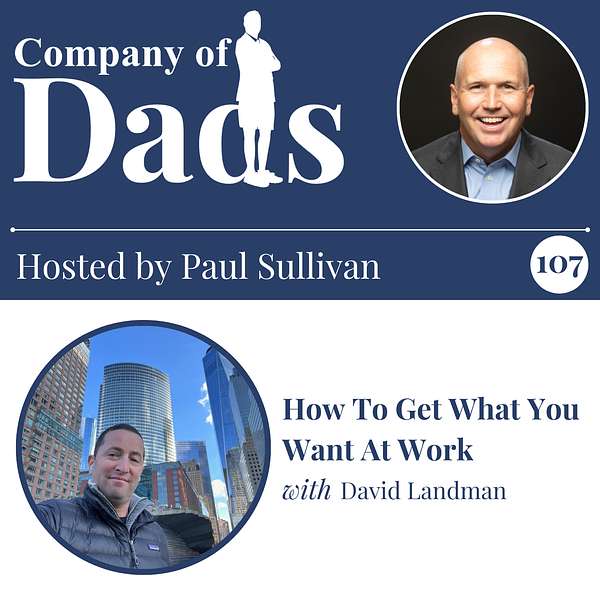
The Company of Dads Podcast
The Company of Dads Podcast
EP107: How To Get What You Want At Work
Interview with David Landman / Goldman Sachs HR leader, Workplace Advocate
HOSTED BY PAUL SULLIVAN
After a 20-year career as a human resources leader at Goldman Sachs, David Landman recently left and has launched a consultancy that is working to bring more fulfillment, belonging and connection to the workplace. Armed with experience from one of the top Wall Street banks - a firm that has been more rigid than most on working in the office - David is a wealth of strategies on how both managers and workers can get what they need out of work. Listen to his tips on discussing life issues with managers and hear what managers want from working parents.
---
Get our free newsletter covering all things fatherhood delivered straight to your inbox: https://thecompanyofdads.com/thedad/
00;00;05;13 - 00;00;25;07
Paul Sullivan
Welcome to the company of dad podcast, where we explore the sweet, silly, strange, and sublime aspects of being a lead D&D. In a world where men with a go to parent aren't always accepted at work, among their friends, or in the community for what they're doing. I'm your host, Paul Sullivan. Our podcast is just one of the many things produced each week at the Company of Dads.
00;00;25;08 - 00;00;48;20
Paul Sullivan
We have various features, including the lead dad of the week. We have our monthly meet ups. We have a new resource library for all fathers. The one stop shop for all of this is our newsletter, the dad. So sign up today at the company dads.com. Backslash. The dad.
Today our guest is David Landman, a longtime human resources executive at Goldman Sachs.
00;00;48;22 - 00;01;13;12
Paul Sullivan
He now runs Elevate Work Advisory, which aims to bring more fulfillment, belonging and connection to the workplace. He's also an advisor to Semper Barron's, an early stage venture capital fund investing in technology, transforming health care work and financial wellness. David has a PhD in organizational psychology. He's a husband and is a father of two children, ten and 13.
00;01;13;19 - 00;01;16;22
Paul Sullivan
David, welcome to the company Dads podcast.
00;01;16;24 - 00;01;18;20
David Landman
Good to be here, Paul. Thank you.
00;01;18;23 - 00;01;46;23
Paul Sullivan
You know, there's always been a tension between, you know, what employers expect and employees want. Now that we're coming on, you know, four years since the start of the Covid 19 pandemic, you know, what were some of the big disconnects that you saw at Goldman, you know, while you were there? And I'm not asking nothing good or bad, but just like, you know, when the expectations were not aligned.
00;01;46;23 - 00;01;54;14
Paul Sullivan
And how did you help, you know, both sides see the other person's point of view.
00;01;54;16 - 00;02;42;29
David Landman
Maybe I'll start with something perhaps unexpected, which is now more than ever. Employees want to believe that they're growing in their roles, that they're developing new skills and prioritize personal and professional development more than the things that motivated people in the past, for example, compensation. So an important part of my role over the years at Goldman, I was leading much of what people experience across the talent lifecycle was around figuring out how to reframe the different things that we were offering to the 45,000 employees of Goldman Sachs to help them actually feel like they were part of their reward, or part of the employee value proposition was that they were going to come to Goldman.
00;02;42;29 - 00;03;06;25
David Landman
They want to learn a ton, a ton of stuff they were going to develop in, you know, both broad based ways, but also bespoke ways that are unique to them. And then when they left or when they moved on to different jobs, they would leave better than when they came. And I think from from a disconnect perspective, I think a lot of people think particularly in financial services, that people are there for the money.
00;03;06;27 - 00;03;32;24
David Landman
And I think there was a time that that was, you know, partially true. I'd say it's still true. People work really hard, you know, in a lot of industries, including financial services. And part of the deal is you get paid for it. But money's not the only answer, particularly not with this generation and helping people bridge the gap to figure out how to give people that perspective of growth that's going to keep them, and it's going to keep them performing well.
00;03;32;26 - 00;03;52;10
David Landman
To me, that was one of the disconnects that I, you know, had a good time trying to solve for. And it was interesting, you know, having been in the workforce for 20 years, seeing the pivot of, you know, it's all about comp promotions and moving up to, you know, the broadening horizons of it's a lot more it's about a lot more than that.
00;03;52;13 - 00;04;14;06
Paul Sullivan
You know, what was the moment when that that changed? What was it about? You know, if you think of like, you know, 20 years ago when you began at Goldman, what if that was still the era of people focused on can't be with Goldman because they paid well? The famous name, I mean, was it was it Covid that started changing or had it started to change before Covid, that where people's expectations around what they expected from their their time at work were, were evolving?
00;04;14;08 - 00;04;56;17
David Landman
I think I like that term evolving. I think it was actually a gradual evolution, but I think that Covid accelerated a lot of things, including people questioning what they were putting into work versus what they were getting out of work. And from my experience, that was the moment that accelerated. And actually, I think gave employees more power and voice in articulating what's really important to them and making decisions that perhaps they wouldn't have made otherwise to prioritize either things other than work or prioritize balance a lot more than perhaps previous generations did.
00;04;56;20 - 00;05;10;26
Paul Sullivan
You know, you're a former going to play is not an advertisement for Goldman, but, you know, financiers in general, you know, you've got to be careful. You know, some listeners are going to hear this and say, what is this guy talking about? These people aren't going to work for, you know, Memorial Sloan-Kettering, trying to cure cancer.
00;05;10;26 - 00;05;29;06
Paul Sullivan
These are not, you know, going to work for a nonprofit trying to feed the poor. When you think about, you know, but I also know from having been a journalist, a business, there's tons of intellectual rigor that comes with working from financial services, tons of challenges that can happen. You're solving, you know, complex problems for companies, for people, what have you.
00;05;29;08 - 00;05;48;29
Paul Sullivan
But when you think about, you know, when people would come to you in your role and say, you know, I'm unsatisfied, you know, with X post Covid, what, you know, what was X, what are the top three axes that they would say, I'm unsatisfied with? And how would you help them solve those things?
00;05;49;01 - 00;06;29;29
David Landman
So post Covid, I'd say it's work life balance. Return to office. You know that whole basket? I'd say it's learning and stretch assignments. And then lastly, I think it's career progression. And maybe I'll go in reverse order. Because I actually think it's easier to solve in reverse order from a career progression perspective. Look, I think, you know, a lot of us work with a lot of, high achieving people who are always looking for the next promotion, looking to feel rewarded and recognized and getting a better understanding of what makes people feel appreciated.
00;06;30;02 - 00;06;58;12
David Landman
And that might be a title promotion, but it might just be. Come join me in this meeting and present your work. It might be acknowledgment and recognition, in a public way, understanding what are those things that motivate people and make them feel recognized and like they're progressing and in a very highly specific and targeted way, give that person what they need from a what they need from a recognition perspective.
00;06;58;15 - 00;07;19;10
David Landman
So I think, you know, and in many cases, that might be career progression and coaching that person and working with them both to help them demonstrate their core strengths, put them in the stretch opportunities that will enable them to thrive. And then also, a lot of times it's about patience. It's around like keep on, you know, keep, keep at it.
00;07;19;10 - 00;08;05;22
David Landman
It's going to happen. If you do A, B and C on the, you know, stretch side. A lot of people now are looking for more frequent shifts in their roles than in the past, and looking to experience a lot of different things across the workplace. And then the last big thing that I did at Goldman for the organization was I built a new team that was specifically focused on helping to change the mindset, the technology, the scope of opportunities, that people see when they think about how do I stretch and how do I progress in my role and a lot of that was around trying to understand what skills people possessed and helping to
00;08;05;22 - 00;08;35;27
David Landman
match those skills, as well as their aspirations to all different career paths in the organization. You know, a lot of us in the HR field hear that people feel like it's easier to find a job outside their company than it is inside. I think part of the reason is there's a lot of tools that make it very easy for you to see jobs and how they align to your skills, you know, whether it's LinkedIn or otherwise, outside a company and stuff gets pushed to you.
00;08;35;29 - 00;09;18;01
David Landman
And internally, companies generally have not invested as much in internal mobility, but it's something that people really want now. They want that from a strategic stretch perspective to help them develop. And, you know, we I led a transformation and we've invested a lot since then in helping people see that. And then lastly, you know, the auto debate and, you know, work life balance and flexibility now, happy to dig into that one that's, you know, at times that can be a tougher one to solve, particularly where managers have a different view than perhaps the executive team, the CEO, and what employees actually want and need.
00;09;18;03 - 00;09;31;28
David Landman
And you know that certainly for me, in my 20 years at Goldman was one of the harder challenges, you know, both personally as a working parent, but also as a manager and a leader. One of the harder challenges to bridge.
00;09;32;01 - 00;09;53;21
Paul Sullivan
You know, the first two you went into detail with, it seems to me it's a sort of resources, but it's really like communications. It's you. Like once you communicate that, yes, there is a possibility for you to be stretched. There is a possibility if you have some patience to move on. But in some ways, you know, the return to office, you know, work life, hybrid debate can seem, at least from the outside of an organization, as very binary.
00;09;53;27 - 00;10;20;20
Paul Sullivan
Some organizations are perfectly fine with you working hybrid. Some organizations are are not. You know, we have all kinds of, you know, sort of a continuum of, you know, organizations that some of them have gone from, you know, 2080 to 8020 in terms of in office and remote, you know. But again, tell me I'm wrong here. It seems to be really the sort of, the provenance of of the most senior leaders at a firm.
00;10;20;20 - 00;10;39;25
Paul Sullivan
If this is what they want, this is what's going to happen. If that happens to be the case, whether it's Goldman or, another company, what is the employee to do? What is the employee to do? If he or she is a great worker but would like to work, not going to work as hard, would just like to work three days in the office and two days, remotely.
00;10;40;00 - 00;10;56;17
Paul Sullivan
We talk about working care shifts here at the company of dad where, you know, there maybe is a dedicated 9 to 330 where they're working, and then the return and emails at night or in the morning. What what do they do if they want to work differently? But senior management says, no, we need you all in the office five days a week.
00;10;56;20 - 00;11;19;16
David Landman
I mean, look, I think the answer in the end is vote with their feet. And I hope that starts to happen. Look, I think the first step is having a conversation with your manager and figuring out kind of what can your manager do to help you bridge the gap between what you want and need and what the company policies are allowing?
00;11;19;16 - 00;11;39;22
David Landman
Look, I think people can advocate for themselves. I think people should be honest when they share feedback with their employer, whether it's in their employee feedback survey, which a lot of people are doing on a very regular basis now or otherwise. But in the end, I actually don't think anything's gonna change until people start voting with their feet or actually not coming to begin with.
00;11;39;22 - 00;12;04;04
David Landman
And companies who are not being flexible, starting to have a problem attracting great talent. I look, I think it's the right of the executives also to decide how they want people to work. I think that they are misguided, and I think that they are thinking of it from their own unique lens. Particularly to get to the top, you need to be hard driving work 24 over seven.
00;12;04;07 - 00;12;29;06
David Landman
But not everyone is like that, and that doesn't mean they're less valuable. And I think it's within their obvious rights to dictate those policies. But I think when they do over time, I think those who are being less flexible and being very binary around five days a week in the office, over time, I think it's going to erode the employee value proposition, and I think they're gonna have a hard time attracting great talent.
00;12;29;08 - 00;12;45;25
Paul Sullivan
You know, one of the things you said that really resonated with me and that, you know, it's obviously leaders, right? But, you know, a lot of leaders look and say, hey, this is how I got here. And so therefore this is how you get here. Now, if anyone is even, you know, skimmed a behavioral finance book, you'll know that that is, you know, anchoring bias.
00;12;45;25 - 00;13;13;22
Paul Sullivan
It's confirmation bias. These are sort of, you know, behavioral finance for dummies. They sort of walk through, you know, why these are sort of detrimental to to clear thinking. And I often think like, because you started your career in the 88 or 90s and you've now gotten to the point where you're leading, a company, you didn't get there the same way that the person who started his or her career in the 60s or 70s and was leading that company when you joined it, how do we help?
00;13;13;28 - 00;13;29;27
Paul Sullivan
You know, I don't I'm not want to blow up, established company. There's institutional memory there. There's processes way of doing things. But obviously, you know, startups are able they don't have that bag at startup chambers. Okay, we're going to work this way. This is how we're going to operate. We may not, you know, have the prestige.
00;13;29;27 - 00;14;04;16
Paul Sullivan
We may not have all the advancement opportunities. We have to pay you as well. But you can work in a different way versus, boy, I've always wanted to work for fill in the blank, you know, JP Morgan, Goldman Sachs, you know, whatever. And they have a certain way of working. Is it does it is it going to take a sort of leadership change for these firms to think, okay, people can be as successful as I was 40 years ago, working in a different way, or is it really going to be, you know, this top 30% of employees, as you well know, from your your all your various HR roles, they always have options.
00;14;04;16 - 00;14;11;06
Paul Sullivan
They have tons of options. Is it they're just going to have to go. And then in crisis these firms are going to have to rethink what they're doing.
00;14;11;08 - 00;14;49;11
David Landman
So I think it depends on the firm. I think for the more established institutions who have really, dug their heels in to this idea that work only happens in person. And creativity and mentorship and team building and all those things require you to be physically present. I think it's going to take time and yes, I think it's going to, over time, take time for them to realize the effects of the policies they're setting today and how they're going to impact people's company's ability to attract and retain talent.
00;14;49;14 - 00;15;18;17
David Landman
I also think as that time elapses, pressure from boards, pressure from other stakeholders, employees clearly voicing their preference and their needs. I think those things will also help move the needle in the right direction. But I think the the change will come gradually. And, you know, we entered a period where the change happened immediately when Covid came to work, work remotely.
00;15;18;20 - 00;15;38;20
David Landman
It actually took a lot of time for CEOs to get people back into the office five ish days a week. They're still not in the office five days a week. But I think as we revert to whatever the happy medium is, my guess is it's going to take years, and I think it's going to take some kind of crisis.
00;15;38;28 - 00;15;45;00
David Landman
We can't deliver to our clients. We can't attract and retain the best people anymore. And now we have to pivot.
00;15;45;03 - 00;16;16;28
Paul Sullivan
Andrew, let's pivot to to your your personal story. You know, your wife also worked at at a Goldman. You have two children. You know, think about your lives pre-pandemic and then you know, your work lives, you know, post-pandemic. What were some of the ways that you were able to make to you know, incredible careers, work for yourselves for for your kids, you know, for for the company that employed both of you, how did you how did you do that?
00;16;16;28 - 00;16;25;12
Paul Sullivan
And how did this sort of, you know, strategies you employ, differ pre and, and post pandemic?
00;16;25;14 - 00;16;54;26
David Landman
It was really hard. Look, I'll admit we over time develop strategies. But I'd say early on we kind of were figuring it out day by day. And it caused a lot of stress in our lives, particularly as we're both trying to manage our careers and a time that we were looking to continue to get more responsibility to progress our own careers and climb the corporate ladder, while at the same time being really good parents.
00;16;54;29 - 00;17;29;01
David Landman
So I'd say early on, we did a lot of experimentation and landed on, I'd say, a few strategies that really made a difference for us. And, you know, they're actually quite basic, but sometimes they take a little time to learn and how to adapt them and implement implement them for yourself. I'll share. Three. One is calendaring. It used to be a daily discussion that sometimes led to an argument about who is doing drop offs and who's doing pickup, because we always knew that we had to split up those responsibilities.
00;17;29;01 - 00;17;47;02
David Landman
Yeah. And at a certain point my wife said, like, this is silly. Let's for a full month ahead, put in the calendar, who's doing drop off, who's doing pickup, and let's organize our schedules around that. And of course, it wasn't black and white. There were times that something important came up and we had to, you know, ask each other to cover.
00;17;47;04 - 00;18;14;10
David Landman
Yeah, but setting a really firm calendar about who's doing what and when, that actually made a really big difference for us. So that's strategy number one. The second one is, you know, more broadly division of labor. Like there are certain things that over time became my wife's department. So for example, she deals with school and camp. There are certain things that became my department finance, doctors and dentists.
00;18;14;10 - 00;18;43;22
David Landman
That was another thing that my department very clear division of labor. But actually taking it a step further, one of your previous guests was talking about mental load, and we it was really hard for both of us as, like, very Type-A, controlling people to, for the things that we delegated to each other, to totally get that out of our mind, to just know it's being taken care of, and even if it's not taken care of exactly how we wanted it to be, it still wasn't our responsibility to think about it anymore.
00;18;43;25 - 00;19;07;17
David Landman
That actually made a big difference when we figured out that we just need to let go of certain things. Yeah. And then lastly. This is an interesting I don't know if you call this a strategy, but being really transparent with our teams, with our bosses, this is the hardest one about where our priorities were and what our responsibilities were.
00;19;07;20 - 00;19;41;15
David Landman
And it didn't always go as you know you'd want. I've had some really receptive managers and some much less so, but being transparent with my team, with managers and, and also being good role model for other parents and helping to support each other as a parental community. That's something that really helped as well. There was somebody years ago, honestly, before this was as widely accepted as it is now, who was a very successful senior leader in my department.
00;19;41;17 - 00;20;16;09
David Landman
And when they came into my department and kind of shared some of their working styles, one of the things that she said was, at 5:00, I walk out the door to get my kids and it's non-negotiable. And she said, don't get in my way. Don't stop it. Don't stop me to ask me a quick question. You can email me, but I'm leaving at 5:00 and being transparent about that actually really helps both the team and helps the parent reduce at least some of that stress.
00;20;16;11 - 00;20;31;16
Paul Sullivan
And I'd also argue that it helps people who would have reported in to that woman because it was, okay, she's modeling, a work life balance right here. She's modeling way she's doing it. And perhaps I could do, you know, the same thing.
00;20;31;18 - 00;20;55;28
David Landman
Absolutely. And also not only modeling balance, but also modeling the transparency. Like not feeling that there are some people who feel guilty or feel like they are choosing favorites. If they say, I need to go take my son or daughter to a school event, and that means that they're not being loyal and committed to their work. It's obviously not true, but it's an insecurity that people have.
00;20;55;28 - 00;21;28;26
David Landman
And when you have senior successful people saying, sorry, I'm not going to that important meeting because this afternoon I'm volunteering in my child's classroom. That actually is I think that role modeling aspect is super important and it helps others, as you said it also others both feel comfortable but also be more transparent about their lives outside of work, which then creates more connection between people, more understanding, and just creates a more open and welcoming environment for us to be in.
00;21;28;28 - 00;21;45;21
Paul Sullivan
I mean, that transparency is is key, and I think about that because, you know, we'll just like you said, like what's good for that, that individual person is good for that individual person. But the ripple effect that it has within the organization. I, I was guilty of this, you know, when I was at the New York Times.
00;21;45;21 - 00;22;04;11
Paul Sullivan
I've, I've told the story many, many times of, of sitting out in front of my daughter's ballet studio, and my dad had another daughter at the pediatric, and I was talking to a, you know, former cabinet official in the white House. And, and I didn't know what to do because the pediatrician started to call and I didn't feel like I could tell her, hey, this is really important.
00;22;04;11 - 00;22;19;29
Paul Sullivan
I got to take this call. So I hung up and then and then I mid-sentence, I hung up, and then I call a call and I kind of fumbled through that couldn't lie. And so I couldn't really isolate you know, very sorry. Bad cell phone reception. My town where we're in, you know, super senior people, they just keep talking.
00;22;19;29 - 00;22;34;23
Paul Sullivan
They don't really need you there. And so she's got pick it up, but is that, you know, it would be so different now I would say. Well, please hold on one second. I'll take this and I'll, I'll come back to you. The examples you've given, though, are examples of, you know, more senior people that that resonated with you.
00;22;34;26 - 00;23;01;16
Paul Sullivan
If you are a person who super good at his or her job, eager to advance, but happens to also be a human and has caregiving responsibilities, it's children. It's aging parent to. And they want to be transparent, but they don't have the power of the managing director or the senior vice president. How do you, you know, have help them advocate for themselves?
00;23;01;16 - 00;23;21;00
Paul Sullivan
Like what advice would you give them as like, here is an example of a good way to go about, telling people that you are indeed a human and not just a worker. And what are some of the bad ways that that you remember people going about, you know, asking for things that had they asked for them in a better way would have been perfectly normal and acceptable?
00;23;21;03 - 00;23;47;05
David Landman
I would start by telling them, and I've done this many times. They have more power than they think. If you have really good people on your team who are committed, they care about their work. They have built up institutional knowledge as a manager and a leader. Those people are extraordinarily valuable. And I always have said to people, I'd rather know 80% of you than 100% of somebody else.
00;23;47;06 - 00;24;12;20
David Landman
And by the way, that it might be 50%. Sometimes it might be 120% other times. So I think starting with, you know, I think we all have these insecurities and fears that if we say that we need to do something other than be fully committed to work, then we'll be written off as, not committed, but that as somebody who's managed hundreds of people over the years, it's it's so not true.
00;24;12;22 - 00;24;47;21
David Landman
We as leaders are so dependent on those great people and honestly would bend over backwards at least manager should, let's just say good managers do, bend over backwards to help make it work. So I would start with giving that person confidence that they're not asking for something unreasonable. In fact, then having an honest conversation with their manager, one that will help them be able to fulfill both their personal needs and their professional needs is actually a good thing for all parties.
00;24;47;24 - 00;25;11;04
David Landman
And look, it's easy to say it's harder to do, but as you do it in particular and get a good response, it becomes self-reinforcing. And then the second thing is like it's be honest, I so many times I've had people, skirt around like the real issue or seen people think that they're asking something, but in a very passive way.
00;25;11;04 - 00;25;42;00
David Landman
And it just didn't. It went over somebody's head. So I think being transparent, being honest and being specific is also really useful. So it's getting up the bravery to say something. And then when you do, making sure that you're explicit enough that the person understands what you need, and then working with them and asking for feedback along the way, like figuring out how to make that thing work and look, there's a lot that we can do to help managers engage in those conversations and in the right way, take a longer term view of talent.
00;25;42;02 - 00;26;01;10
David Landman
But I do think, like as a leader, as a manager, you don't know what people need unless they tell you and you should be asking that question, but you need those people to come to the table with some level of candor and honesty so that you know what they're asking for. For me, it was always like, what do you need?
00;26;01;10 - 00;26;02;29
David Landman
Like, tell me, let's let's work it out.
00;26;03;02 - 00;26;11;16
Paul Sullivan
Right? But they need to feel that if they actually tell you what they need, that you'll be receptive to what they're saying and not say, well, we can't do that. Correct.
00;26;11;19 - 00;26;30;20
David Landman
Totally. And that's, you know, as an HR professional, that's part of what we need to do to help managers, to help upskill managers, for them to have those conversations in the right way such that not only does that one person feel that they're receptive and open and supportive and care about them, but also there's a ripple effect.
00;26;30;20 - 00;26;43;14
David Landman
You know, you have one bad conversation with a direct report. They tell their friends, and very quickly, you're labeled as somebody who doesn't care about supporting employees, and people are scared to talk to you.
00;26;43;16 - 00;26;53;29
Paul Sullivan
Yeah, this is great, David. Tell us, what do you do now? What's elevate work advisory? Tell us, you know, what you're doing to to further the mission.
00;26;54;01 - 00;27;21;21
David Landman
So so okay. You said it in the year, if I spent 20 years at Goldman Sachs in a whole bunch of roles related to ultimately helping people feel more fulfilled in the workplace, and I decided, you know, after two decades, it's time for me to scale that more broadly. So my mission, my purpose for being right now is to support our progress towards a future of work that's more inclusive.
00;27;21;21 - 00;27;51;26
David Landman
It's more understanding that helps each person feel like they belong and can thrive. And I'm doing it in a few different ways. One is by sharing my learnings over 20 years and hoping to inspire others. And the other one. Another way is by supporting the founders and the companies who are building products, technology solutions that actually help upskill the workforce, our managers, and solve the big problems that I was trying to solve when I was at Goldman.
00;27;51;26 - 00;28;21;24
David Landman
Because without great technology, we can't scale great solutions and we can't help make the workplace better. And having sat on the buyer side for many years, having sat on the side of wishing things existed to help support ideas, I'm now happy to be able to give back, to these companies and work with them to share perspective on product, on go to market strategy, make introductions as needed and help them, thrive.
00;28;21;24 - 00;28;30;28
David Landman
Because when these companies thrive, they're going to help. Ultimately, employees thrive and help progress us towards a better way of working for everyone.
00;28;31;01 - 00;28;55;15
Paul Sullivan
Yeah, but this has been great. Today, I want one last question coming out of that. And what are you doing now? If there was, you know, blank piece of paper and you could sort of design, you know, the, the workplace or the company, you know, culture that would best support employees, but also, you know, make money, fulfill the mission of the company, do do all the good things that a company needs to do to be a for profit company.
00;28;55;17 - 00;29;11;00
Paul Sullivan
What would that look like? What are the, you know, three, 4 or 5 things that you would make sure that, you know, companies starting to novo would have to support as employees but still be, you know, profitable and be a going concern?
00;29;11;02 - 00;29;45;18
David Landman
I think it's honestly like back to the basics and simple to say, but hard to execute. So I'd say the umbrella is we need more humanity in the workplace. We need managers who are more. We need a culture in which managers are more empathetic and know how to have conversations with their employees. Beyond just delegation. We also need managers who are able to deliver feedback and help people set their own goals, and then work with them to enable them to achieve those goals and beyond.
00;29;45;18 - 00;30;15;26
David Landman
To me, it's about humanity, empathy and enablement that creates connection, that creates belonging and that inspires people. And when you have, you know, those elements, that's actually what drives business performance. In a much more sustainable and human centered way. And for me, if I was if I was going to design a culture and look, I did I had a, you know, microcosm, at least in the teams that I managed at Goldman.
00;30;15;29 - 00;30;31;04
David Landman
That's the culture that I think we need to move towards. And that's what's going to create the next generation of workers and the right relationships between work, personal life and your employer.
00;30;31;06 - 00;30;37;03
Paul Sullivan
David Lerman, thank you so much for being my guest today on the Company That Is podcast. I thoroughly enjoyed it.
00;30;37;05 - 00;30;39;09
David Landman
Thanks for having me, Paul.
00;30;39;11 - 00;31;08;03
Paul Sullivan
Thank you for listening to the company podcast. I also want to thank the people who make this podcast and everything else that we do. The company that possible, Helder Mirror, who is our audio producer Lindsay Decker, handles all of our social media. Terry Brennan, who's helping us with the newsletter and audience acquisition, Emily Servin, who is our web maestro, and of course, Evan Roosevelt, who is working side by side with me on many of the things that we do here at the company of D&D.
00;31;08;03 - 00;31;22;12
Paul Sullivan
It's a great team. And we're we're just trying to bring you the best in fatherhood. Remember, the one stop shop for everything is our newsletter, the dad. Sign up at the company of dads.com backslash. The dad. Thank you again for listening.