OTs In Pelvic Health
Welcome to the OTs In Pelvic Health Podcast! This show is for occupational therapists who want to become, thrive and excel as pelvic health OTs. Learn from Lindsey Vestal, a Pelvic Health OT for over 10 years and founder the first NYC pelvic health OT practice - The Functional Pelvis. Inside each episode, Lindsey shares what it takes to succeed as a pelvic health OT. From lessons learned, to overcoming imposter syndrome, to continuing education, to treatment ideas, to different populations, to getting your first job, to opening your own practice, Lindsey brings you into the exciting world of OTs in Pelvic Health and the secrets to becoming one.
OTs In Pelvic Health
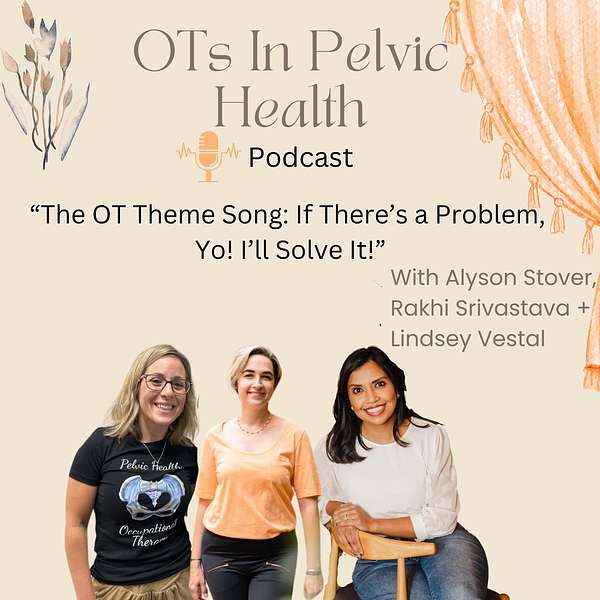
The OT Theme Song: "If You Have a Problem, Yo, I'll Solve It" with Alyson Stover + Rakhi Srivastava
- Tickets for the 3rd annual "OTs in Pelvic Health Summit" (Aug 17-18, 2024) go on sale Feb 1! Visit here for details.
- More about my guests:
Rakhi Srivastava, MOT, OTR/L (she, her, hers)
Rakhi has been an OT for over 13 years. In April 2022, Rakhi established Queen City Pelvic Health and Wellness, LLC, where she treats all genders holistically from head to toe and believes that “nothing is TMI.” She treats in Anderson Township near Cincinnati, OH and has a second location in Fort Thomas, KY. Rakhis experience includes 11 years at The Christ Hospital, where she worked in inpatient rehabilitation and acute care prior to outpatient pelvic floor therapy. In her last 4 years at Christ, Rakhi planned, developed, and executed the hospitals pelvic floor therapy program. From 2015-2019, she was also an Adjunct Professor of OT at Xavier University. She was a speaker at the OTs in Pelvic Health Summit, has been a guest on the OTs in Pelvic Health Podcast, and was part of the small group of pelvic health OTs who established the Pelvic Health CoP through the AOTA. She was the Co-Chair of the Post-Dobbs Task Force. Rakhi was recently an author of the “AOTA Societal Statement on Reproductive Health. Where to find Rahki: www.queencitypelvichealth.com
Alyson Stover
A childhood family trauma introduced Alyson Stover, MOT, JD, OTR/L, BCP to the power of occupational therapy. A subsequent lifetime of study and practice convinced her that patient advocacy was every bit as essential as her technical practice of occupational therapy. That would be a pretty full slate for most OTs, but it doesn't begin to describe all of Stover's accomplishments. Stover founded and owns Capable Kids, a private outpatient pediatric practice north of Pittsburgh that provides physical and speech and language therapy services in addition to occupational therapy. She's also an associate professor in the Department of OT at the University of Pittsburgh School of Health and Rehabilitation Sciences. In July 2021, she will begin a four-year term as president-elect/president of the AOTA, representing over 100,000 OT practitioners.
____________________________________________________________________________________________
Pelvic OTPs United - Lindsey's off-line interactive community for $39 a month!
Inside Pelvic OTPs United you'll find:
- Weekly group mentoring calls with Lindsey. She's doing this exclusively inside this community. These aren't your boring old Zoom calls where she is a talking head. We interact, we coach, we learn from each other.
- Highly curated forums. The worst is when you post a question on FB just to have it drowned out with 10 other questions that follow it. So, she's got dedicated forums on different populations, different diagnosis, different topics (including business). Hop it, post your specific question, and get the expert advice you need.
More info here. Lindsey would love support you in this quiet corner off social media!
Lindsey Vestal What an incredible episode I have in store for you. I have been joined by our national president, Alyson Stover, and my dear friend and colleague, Rakhi Srivastava, who is a pelvic floor occupational therapist and owner of Queen City. Pelvic Health and Wellness, which she launched in 2022 in Cincinnati, Ohio. I have had Rakhi and Alyson on in the podcast for four separate occasions. The first time I had Alyson Stover on was when she shared her six top priorities for her term as presidency. Spoiler alert one was women's health with a special call out to Pelvic health. I absolutely adore that episode. The title of it was If the pelvic floor is not Healthy, there is no occupation we Can perform. And that was a quote from Alyson. It was episode number 52. Now, I've had Rakhi on before when she shared with us episode 23, which feels like a lifetime ago. She was joined by her student, Abby, and they shared that after Abby had been working with Rakhi in a field work placement, Abby went on to receive seven job offers, which is absolutely incredible. I adored having these two powerhouses back on the podcast, this time talking together. I don't want to give too much away in this introduction. I just invite you to join me for an incredibly inspirational listen. And it has everything to do with Vanilla Ice.
Intro New and seasoned OTs are finding their calling in Pelvic health. After all, what's more ADL than sex? Peeing and poop? But here's the question. What does it take to become a successful, fulfilled and thriving O.T. in Pelvic health? How do you go from beginner to seasons and everything in between? Those are the questions and this podcast will give you the answers. We are inspired, OTs. We are out of the box OTs, we are Pelvic health OTs. I'm your host Lindsey Vestal and welcome to the OTs and Pelvic health Podcast.
Lindsey Vestal I am sincerely so grateful, Rakhi and Alyson, for spending a little bit of time with me today to talk about a little bit of behind the scenes of what we will see at Inspire AOTA 2024 during Alyson's presidential address. And so thank you for taking the time to chat with me, both of you today.
Alyson Stover Thank you for having us.
Lindsey Vestal It's going to be super fun behind the scenes peek. And so let's kick it off with this. Alyson, you so a little bit behind the background is you recently observed Rakhi in a pelvic health treatment session at her private practice. First of all, can I just say how much I admire your commitment to traveling around the country to see what OTPsps are doing day in and day out? First of all, your are national president of or national organization. You own your own clinic in Pennsylvania. You're still seeing clients. You are teaching as an adjunct professor at the University of Pittsburgh. And I just think it's amazing how much curiosity and support you have in learning more about what we are doing boots on the ground. And so with that being said, I am so curious. Why did you decide to visit Rakhi?
Alyson Stover So great question. So I'm actually an associate, full time associate professor at Penn. So, yeah, I, I do more time than adjunct, so it adds a lot. But so when I the first day of my presidency, July 1st of 2022, the very first day we had really experienced just a few months before that, the leak regarding Supreme Court decision that was going to reverse 50 years of right to health care that had been granted, that had been fought for and granted, and it was going to reverse that. And, you know, I had to make a statement. I didn't have to make a statement. I should rephrase that. I had to think about with the association what the impact of that ruling would have, not just on me and my life as an occupational therapist, but on the life of every single individual who practices occupational therapy, who receives occupational therapy, who should receive occupational therapy, but isn't really. I had to think about what would be the statement of the profession. Before that, I had a very active new mom who really believed that we needed to make a statement about this and offer support and resources to our occupational therapy professionals, particularly those in Pelvic health. And that was Rakhi. And so she really was, I would say the first the first person to introduce me to The passion of Pelvic health and to the recognition of its value within our profession. So because of her advocacy and saying, hey, when are you going to say anything about this? Hey, when do we get some support? Maybe some different words. But essentially that was her message. We were able to hold some listening sessions in which Rakhi attended and then even stayed afterwards and had a really authentic and meaningful conversation. She also gave us a list of resources. This is how I really came across you and Z and all of the incredible work that you're doing. And and as I have grown over the past year and a half and had opportunities to have conversations and really be present in some of the spaces where pelvic health and pelvic floor care is being talked about, taught about being able to listen to your podcast, read the resources that are coming through. I recognized that although I had an appreciation for what pelvic floor and Pelvic health was, and although I could recognize and authentically and confidently speak that it is the foundation of occupational therapy, I had never seen it and I thought, why not go to the pro? And so I asked Rakhi if I could come see her, do what I knew. She did incredibly well, and she was gracious enough to receive me into her practice. And I have to say, there's not a day that goes by that I haven't been there, that that I have. Haven't relived either a component of a conversation or part of the treatment session. I was able to observe seeing it in my own practice, seeing it in my own daily life and seeing it in my roles far beyond. Alyson Occupational Therapist or Alyson AOTA President.
Lindsey Vestal You really hit the ground running on July 1st with attending that meeting and then sort of it seems like your ability to really be present and hear what was happening, feeling that responsibility of the statement to our profession set off this trajectory that is still thankfully continuing as I think occupational therapist role in Pelvic health just continues to be more deeply understood. Alyson through your innate curiosity. And I am we are so grateful for that because I think that it's a misunderstood area. As you know, I always refer to it as double unicorns. Not many people know what Oti is. Not many people know what Pelvic health is. Put it together. And Deanna, we're having to really get our elevator speech dialed in because. Yes, I'll have lots of I have lots of follow up questions for you about your experience, But thank you for giving us that overview and helping us to understand this road trip that you were on. Rakhi, I would love to know a little bit more about the client that Alyson observed. What interventions did you use with her? What did you share?
Rakhi Srivastava Yeah. So the client I chose to have and actually I was supposed to have two, but one of them came down with Covid, so she had to cancel. But the client that Alyson was able to see is somebody I chose because she's actually known me for a long time. She was a client who came to have an evaluation done with me when I was still working in my hospital job. So she had the evaluation. And at that point, you know, there was still scheduling me new clients, even though I had already put in my notice and I was going to get ready to start my practice. So I had told her that I wouldn't be here any longer and I considered somebody else. But she was like, I'm going to come with you. Where are you going? Where are we going? Is what she said. Because after that evaluation, I think we just clicked. And I think she felt heard for the first time. And and I think she was like, okay, this person might be able to help me. So I started my practice and then she came along and it is just so so. Great, but sad that I mean, within 4 to 5 sessions at the beginning of 2020, like spring of 2022. She felt great. She felt amazing better. And she had had issues that she had lived with for. Decades her whole life, Really? So this is a client. And you've seen you've seen this client, right? Like she has diagnoses of interstitial cystitis and a pretty aggressive version. History of endometriosis, vulva vestibulitis. But she actually had a vestibulectomy years ago. She also is a mom and had a C-section and her son is ten. She is a client who works full time. She her son has special needs, so he is autistic. So at age ten, he still requires help for toileting. So it's just, you know, understanding the stressors of her life. And so we worked together for a while back in 2022. She felt great. She felt better. She didn't need me for a while. And then she earlier this year started having some pain again and another flare up, so to speak, and previous flare ups that, you know, the flare ups will come. But she was able to manage them with the techniques we had already worked on. This one was starting to get a little bit worse. And then like when she when she came back after the fact, she's like, I don't know why I didn't just come here first. So she went through with urology. Urology tried medications, Urology tried. They did a cystoscopy with the hydro distention. And she said, Never again. I will never again do that. It made me worse. I am in such pain. And then she came back here and, you know, 1 or 2 weeks later, she was like, back to that better baseline. So when Alyson came, she had a lot. She was actually much better. She was almost like, Let's discharge or let's wait. But I think that's the importance of these kind of clients is, you know, when we're hospital based, when we're referral based, you, you meet your goals and then you just are discharged. And and for this client, you know, she's been like when she came back after almost a year at that point, we did a reevaluation, but I actually didn't need a referral. We jumped right back in. So it was much easier to just jump back in. And then what we're planning to do is basically like maintenance, like every once a month, every six weeks, have her come in and hopefully never get to that point again where it's like a bad flare. And she's like, I just don't know. I didn't think about coming back again until after. And she actually had texted me, but then she was like, Let me go with what the doctor saying. And so what Alyson saw was sort of the tail end. And I actually I let the client talk to Alyson a lot. So that was some of our time just to give her the story and give her, like, whatever she'd been going through for years. And how did this make such a difference? But the day the actual treatment that was observed was actually a lot of manual. This, this. She also is a scoliosis client. She's also a hyper mobile client. So it's those, you know, other factors. So we were looking at some alignment. She's also a client who wears high heels every day for work and that it's like she's like, I'm not changing that. I'm like, okay, well, let's talk about how to combat that then. Like if you're wearing heels all day, we need to stretch and do these other kinds of things to make up for that when you're not wearing them. So if you're not going to change that habit, how are we going to adapt for it? And then, you know, just talking through her roles and routines, we had just gone through that Thanksgiving. The holidays can be stressful, especially when you have a child with special needs who is used to routines and then that's a little bit broken over the holidays. So we just those kind of things we discussed. We did manual therapy. Alyson was able to see me do some myofascial release type of work, visceral mobilizations and especially of the bladder. She was able to feel like a before and after of like a release there and then an internal treatment where, you know, she'd have to have a couple of like tighter spots. That was much better than it had been. So it was a little internal, visceral as well and just trigger points in mouth. But really she was already a lot better. So we would we would do a look at a spot and she would work on it and then she'd be like, okay, now it's gone. It's better, better, better. And then and then we decided we meet again in six weeks or so and that's it. And actually I haven't seen her again, so she must be feeling good. But she probably has forgotten over the holidays, so we'll have to get her back before it becomes another flare. That was that was our session primarily, but a little bit of delving into, you know, habits and roles and routines and the eligibility work we do and other types of like bladder management techniques we've talked about in the past. So this was sort of like the end. So she got to see more manual. So those muscles are.
Lindsey Vestal Well, I have to say, this was this was not a straightforward client, Alyson, that you observed. And, you know, we see we see the variety in our pelvic health practices. Sometimes it's, you know, the the person who just gave birth who's having a little bit of acute pain for the first time versus this client who, you know, there's so many multifactorial aspects to her life where I think that I would imagine ever any client that Rakhi would share with you would have been perfect. But this one in particular feels like it was such a positively powerful opportunity for you to see the roles that OT could have working with Pelvic health and I would love to hear Alyson Three takeaways about what you observed from from that experience.
Alyson Stover Yeah. And you know, a lot of times when people are asked like, what are your takeaways? They say, let me take a moment. And really my response to that is only three. I can only share three. I do want to say that with this session, one of the things that I found most powerful for me and for my ability to share as I speak nationally, internationally is that Rakhi did bring an individual that is not the one that so easily becomes what you think about with Pelvic health. I can easily say that specifically as an individual who identifies as a woman and who has experienced pregnancy and birth, that kind of can make sense, right? Like this idea of pelvic health or pelvic floor work for the individual who has recently or is currently pregnant or recently given birth. Right. Even individuals who are not very familiar in any of those spaces will say, give that person whatever they need, right? Like the pregnant person needs whatever they need. We understand the disruption that pregnancy does to a body. And so sometimes I think that is an easier jump for people. Rakhi gave me someone who, the last time she had been pregnant and delivered was over ten years ago. This is not the individual that you would say, I get it right. This isn't a woman who was in menopause, had a neurological condition in which you thought like, it's multiple sclerosis, there's urinary incontinence happening. This was me. I mean, she was my age. She had had her child one child C-section. Ten years ago. I had one child C-section 14 years ago. We both love a good high heel with no desire to stop. Right. And so I think my first takeaway from that whole experience was we need and I have challenged myself in this to talk about pelvic health with both the value it brings to the individual who is experiencing pregnancy or postpartum. But we equally need to share the stories of this client so that we do not find ourselves in a space where people begin to value and appreciate occupational therapy and public health, but in such a targeted population that we forget that, as I have learned over the past two years now, Pelvic health is literally the health of every single individual. And and so my first takeaway is share this story and this experience because I need to find the ways to share all of the individuals that are profoundly impacted to a place of better wellness because of pelvic health, particularly those that you don't commonly think of, but that are also really relatable. So I would say that would be my number one takeaway. It was incredible to be able to to watch this work with someone. That really was me. Right. And and did it have those key indicators that people can easily see and connect? Occupational therapy and public health. My my second takeaway was I was shocked at how much I saw my occupational therapy practice reflected, expanded and different in Rakhi's occupational therapy practice when she was doing a review of How Have You Been? Where is the pain? What have you been doing? Those questions that she asked are the very same questions that I ask my patients. Right. So things like, you know, well, how things been going? Tell me a little bit about what's going on with your son. You know, is he back in school? How has the transition to that been? How were the holidays? I ask those very same questions. And so when when individuals say, I don't I'm really like, I'm not trained in that or that's not where I practice. Where I could never at this point although I'm I'm sure with with Lindsey some of your courses and and the courses that I know Rakhi teaches and many of the others out there, I'm sure I could get to a place where I was competent in it. There were certainly interventions, particularly internal pelvic work that I could not do at this point in my profession, But there were so there were more shared similarities than there were differences. And so my other takeaway is that I need to start thinking about how do I describe this powerful element of occupational therapy as just that part of us not so different, not this incredibly specialized area that is great and powerful and invaluable, but very unique, but rather how do I talk about it in the context of it's occupational therapy with some very specific intervention training and not even necessarily just specific pelvic floor intervention training. I watched your do myofascial release. Right. But I watched your do it in a very occupational centric way. So talking about when can you do this? How can you do this yourself? Where in your routine does it make sense to utilize these practices as a preventative method for flare ups and pain and difficulty? Right. I saw her use myofascial release in an occupational centric way. And guess what? I also have used myofascial release in an occupational centric way. And so it was incredible to see where this area is. Both an amazing specialty, but also it's just occupational therapy. And so that would be my second takeaway. And my third takeaway would be the intimacy, the ability for the occupational therapy professional to form the relationship with the client that we do. Because I honestly believe no other health care practitioner practitioner within the wellness team of an individual is able to form the intimate relationship in which we as occupational therapy professionals do. I think it actually then requires us to to be true to our obligation to truly assess the entire individual. And so there was something really interesting. The conversation that had emerged was, one, I am not unfamiliar with the parent of a child with special health care needs who is older, 1011 still sleeps, a mom and dad's bed, still experiencing some dependency with toileting. Right. And there were some really great questions that Rakhi asked, like, so how's your husband? Her response to that gave her a real indication as to where they were in their relationship. And then she asked things like, hey, is so is your son still sleeping in bed with you, too? Yes. How is your sleep in? And then she asked about the intimacy with her husband. See, I will tell you that somewhere between 60 and 80% of the children that I work with at my pediatric clinic have caregivers, guardians, parents who are separated from significant others and partners because the true barriers and burdens that those individuals experience day in and day out, they play a role on that person's roles in other places than just parent. And so I've started to ask that question to the parents and caregivers that come in here, Hey, how are you and your partner doing? When's the last time you've had a chance to be intimate with them? It really taught me that I was not truly doing a holistic evaluation to promote health and wellness in the children and families I've been entrusted to walk alongside. Unless I'm willing to ask those very intimate questions that are actually the most important thing. And so my takeaway is those questions that you hear occupational therapists and occupational therapy assistants working in Pelvic health asking their clients that you think those aren't questions that I do or, or that's why I'm not in public health. I actually think we need to pause and reassess. And should they be? Am I really creating a plan for wellness and an opportunity for my clients to get to their best place if I haven't asked them if they're if their sexual health is okay? Are you able to be intimate with your partner? Are you experiencing any kind of disruption because of where your child sleeps? You know, those types of things are questions that you and the pelvic floor and public health world. It comes natural. But again, it aligns directly with why is Pelvic health essential to occupational therapy? Because it's not just about the myofascial release. It's about the myofascial release at the right time for that person, even if they're going to still wear heels. And by the way, is it preparing them to engage in enjoyable sex with a partner so that they can have a stronger relationship that actually is going to build wellness for a son with special health care needs? And so I watched full circle, true holistic occupational therapy practice. And I challenge all of my peers and colleagues to ask just one person that's in occupational therapy practicing public health. What's the question that really gives you the most understanding of your client? Because I bet we don't ask it. And I bet they know more about how to create wellness because they do.
Lindsey Vestal I feel so seen in a way that as someone who's been in this in this field for over a decade. Alyson, thank you. I've never felt so seen and so recalibrated to sort of our mission as occupational therapists and pelvic health. So thank you. And I 100% agree with you. Who else is equipped? To ask these questions. Then occupational therapists. And on a lighthearted note, for anyone who hasn't seen Alyson's healed collection, make sure to go to Inspire 2024 because she rocks some of the most beautiful heels I have ever seen. Am I right, Rakhi?
Rakhi Srivastava Yeah. No, I was laughing because that convention center was gigantic. Miles of walking and she's in heels the whole weekend.
Alyson Stover But you know what? I always try to buy them secondhand so that I'm also contributing to the wellness of our environment.
Rakhi Srivastava There you go.
Lindsey Vestal I love that. I love that. So, Rakhi, after having the president observe you and your clinic, I'm curious, what was your experience like? What were takeaways there to reflections for from your from your perspective?
Rakhi Srivastava I will start by just like this whole last year and a half or so has just been unreal. Like, I have been in it for 12.5. Am I 12? Am I 13? I lost count. How many years have I been in it? But I have been very peripherally involved as an active member until I saw something that made me have to say something. And then when I did, I didn't expect to be heard. And the fact that I was was just that was honestly shocking. So we said something. We did the listening sessions. And then I noticed that Alyson was like had joined the Autism Pelvic health group and that Alyson was like following my business page and and that she was like, making little moves, but I still didn't expect too much, Right. And that Mike Urban had responded and said, We're going to put this on the agenda as soon as possible. And and but still, I didn't know that things were going on until like four months later when they said, would you like to be the co-chair of the post task force? And I was just like, hold on me. Like, I'm y me. I'm just like, I'm just a day to day. I'm just a therapist, right. But I felt even with my my young child, I felt like I needed to say yes. And I didn't know if I'd be the right person. And there were many times in this whole last year and a half that I have said, I'm not the right person for this. This should have been somebody smarter or somebody more a published somebody who publishes journal articles, somebody who researches, not somebody who just comes to work every day. Right. But and I think but I think they have they surrounded me with the right team. And The Dobbs Report, I think, pushed us in the direction of having the societal statement report created. And and I'm working on that group right now. And then the position statement that Pelvic health is going to be created. So I think I am just shocked in so many ways about the last year and a half like. I was just a staff therapist at a hospital, and now I'm doing things and texting the president about to do. And she is coming to my practice and spending two nights in Cincinnati to hang out with me for a day like what just happened. So when she asked me that, it was definitely like a jaw drop moment because I don't know if you know this, Alyson, but like right before we were at that, it was at that Autism Pelvic health summit, which you graciously attended. And and it was that that the meet and greet the first night and I had just ordered like a martini margarita because we had the long travel day and I was like, should I take my party drink to go talk to Alyson? I was like, I'm not going to take my party drink to go talk to Alyson. I should have gotten the wine. That's a classier drink to go talk to the president. So I left my drink on the table and then I can talk to you. And I was, like, came back to the table. I was like, She wants to visit Cincinnati. Like what? Like, I'm still deciding if I should bring my party drink like she wants to come see me. Like what? And I had just said like, I was like, you know, I just, you know, run a practice out of out of a room in a yoga studio. Like, and she's like, But that's what I want people to see, is that it doesn't have to be a big clinic to go private practice. It doesn't have to be. She said the people who are the best advocates are the people who don't have time to do it. She's like, You're raising a baby. You have a child like you have. My son is three now, but she's like, You're running a new business. And I've actually hired a few people in the last six months. So it has just been like a lot of growth and a lot of change in so many ways. So I think I think just just shock still like that. And also, Alyson is just she's like, you see, like, I just think both of you, like you meet, you meet them and you know them and then their family. Like you just become people that become your people. So I think I think advice I would give is don't be afraid to say something or try to get involved even if you don't think you know anything like the staffers at Aotea will teach you. We came in when I got my first email. I didn't even know what all the acronyms in the email meant. I didn't know what an R.A. was. I didn't know anything. And and I was just like, okay, I still feel like I should say yes. And and it's just it's just moved us along in so many ways. So it's interesting to me when you said, Alyson, the we're all just. OTs, Right? And when I left my hospital job and another O.T. took over and she and I actually have worked together in rehab and acute care for years before this. And she said, but how am I going to, like, fill your shoes? You've been doing this for four years and I am just learning this. And I'm like, because if you don't know something, you always just take it back to function and you're already in O.T. and you already know how to treat dysfunction. So always just bring it back to if you have a problem, you'll solve it, you know, like that's how I think. That's what I think O.T. is.
Alyson Stover Can we have Vanilla Ice on that?
Rakhi Srivastava I know I literally have said that for years. They're like, what do you do as no to you? I'm like, if you have a problem, you'll all solve it.
Lindsey Vestal I think Ice, Ice Baby is the OT theme song.
Alyson Stover This must be what I need to walk out as my presidential. No, I think this is always like my really hard decision. And then, like, great. Because every time I'm a huge I am a huge like 80s 90s rap fan. So like I want to walk out to like Tupac and they're like, wow, there's a lot of very inappropriate words. And I'm like, What? But it's Tupac. But look, if there's a problem, y'all solve it. Is the best part about this ice baby done selected. Thank you.
Rakhi Srivastava You're welcome.
Lindsey Vestal So, Rakhi, I think there's so much of what you said that every single person listening to this podcast can relate to. Definitely the intimidation factor of having our national income come to your clinic. But I think.
Rakhi Srivastava So. I mean, I did, like, clean the crap out of my car in my office, don't get me wrong. Like, I was like chauffeuring her around all day, but I was like, okay, this car needs to be has like cupcakes from March in the backseat. Like, yeah, we needed it. But the.
Lindsey Vestal The butterflies and the self-doubt that I would imagine most people listening and that I can 100% relate to being asked that asking myself am I the right person? Am I the person to step into the shoes? And I really hope that everyone listening to this, you know, sees himself in you, Rakhi. And also, here's what your experience was in the sense that these are exactly the people that need to be involved to experience the profound personal and professional transfer. Information that you that our profession, that our specialty has experienced as a result of you saying yes, as a result of you stepping into that challenge. And I think that when we any of us feel that little butterfly or that big butterfly should just kind of reflect on what's possible and that we you rise to the occasion, right? That we do figure out a way, as we do with every complex client that we've ever had, self-doubt in ourselves. It's that same reinvention that enables us to have that transformation and come out on the other side. So thank you for for being so transparent and vulnerable with your experience, because we can definitely all relate to it in so many ways.
Rakhi Srivastava Well. And I also think that and I don't know if I've had this conversation with one of you or both of you, but advocacy as a word when you're learning. When I went to Xavier University and we've had occupational Justice one, two and three, like I mean, it was this course after course and you just get it seem it sounds boring, it sounds boring. And it can be because it's slow. You know, the way things have to move is, is slow. But there's a reason behind it. But it sounds boring, but you don't realize or hopefully you do realize you're doing it every day in your daily job. You're an acute care therapist. You are speaking up when you think somebody is not getting the care they need. You are speaking up When you think a caregiver needs to help in this way, you're speaking up for the client to advocate for themselves. So we're doing this all the time and it does feel like a big step to take it to say, a state level or a national level especially, but everyone that's working with it. I mean, most of the staff is volunteers. Like there. Everyone is a therapist who just decided that they felt like they needed to do more. And I will say I probably was not a therapist who felt like I needed to do more until that moment showed up where I was. So and granted, I would complain, but I was never, you know, you complain about the state of health care, you complain about this and that, as you know, as you go through your job. But like I also stayed under the radar for the most part. So and till I did it. So I just say go out there and do some work. You don't have to be like Alyson, this woman. I don't know how much she has the time, but.
Lindsey Vestal Speaking of time, Alyson, what's what's next for you in terms of road tripping?
Alyson Stover Yes. So I have a great and exciting next three months. So I will be in about two weeks heading out to Northern California. I'll be going in to see Karlyn and her practice in postpartum and and maternal Pelvic health. I'm also going to get out to San Jose. I'd like to get to Aloha pediatric therapy and see some of that incredible work that's being done, as well as exploring some of the other cool therapies that are happening through occupational therapy professionals in Northern California. From northern California. I fly into Mississippi with a drive over to Alabama. There is an outstanding practice in Alabama in which occupational therapy is going into homes and using lymphedema and lymphedema treatment as a mechanism to improve health and wellness in clients that we usually don't have access to. So where physicians and oncologists and the like understand occupational therapy for lymphedema, they don't understand necessarily occupational therapy in the realm of the psychosocial experience, routines, wellness. And so they have utilized their specialty training in lymphedema to build a bridge and create wellness and clients we rarely have access to. And so I'm excited for that. I will then actually be going to Delaware to see Dr. Kates and really exploring the incredible work she's been doing in sexual health and sexual wellness. I then will be doing a little bit of meeting, so I will be in Alexandria, Virginia to listen in on the foundation, the ATX board meeting, where they often talk about priorities and research and where we need to really be expanding some of the opportunities for occupational therapy to contribute to the science. And then I will be at an eight board meeting where we will be actually discussing this, having the strategic planning session at the end of that strategic planning session, we generate a list of initiatives that we feel need to move forward for our fiscal year 25 priorities. You know, I feel pretty strongly that that pelvic health and pelvic floor is is going to remain a strategic priority. And and hopefully finding that way to to engage it and expand it beyond maternal health. But so please, I would then also encourage anyone listening, like if you feel that there's something that Aotea needs to know about in regards to our strategic planning, you know, what do you. Think about our current fiscal year priorities. Where do you think next year's fiscal year priorities should go? Well, what should we be really thinking about? What are the needs? Right. Are there resources that we're absent in? Are there resources that are fabulous? Are there resources that are fabulous? But we need to adapt them to another area or hey, this is what makes me want to be a member or Hey, this is what makes me not. This is what makes me feel like I belong to this community or not. So I will be participating in that meeting in February. And please do all the emails I want to know. And I bring each and everyone in. In its individualized and personalized manner in front of the board and all those decision makers. And then I will be heading to Washington State and we have some incredible occupational therapy professionals in Washington state who are doing work in, again, what we know, gardening, right? Except their gardening is going to be their inclusive garden and flower work design is receiving the award at the Seattle Flower Show this year. So I will be seeing that. But also some incredible work that they have done. And they actually have a new book out about occupational therapy in in nature play. They are they have some work both in preschools. So urban preschools that can't always get outside to play. How do we still bring nature in for learning as well as utilizing the development and design of inclusive and beautiful gardens and flower settings in a women's prison in Seattle to bring about wellness of meaning to them. So I could just see some of that incredible work, I believe. Then I head down to Orlando, Florida, to really celebrate what everyone has been doing and to share some of these incredible stories. I you know, I think about I think about our profession daily. I think about sometimes hourly. And I never cease to be amazed by what we do and how we bring. How we bring a better world, right? We actually create a better world. Sometimes one person at a time, sometimes a group at a time. Sometimes by changing and shifting a policy. But what I've learned, what I've learned through Rakhi and and Ulinzi and through all of these incredible individuals who have welcomed me into their space is. I always thought that we did it because we are well trained, rigorously trained health care professionals. But but we change the world because we believe in the power of occupation. And I never realized that when you believe in the power of occupation, you actually you actually know how to be both resilient as well as to truly see a person. And that's why we make a better world, because we see people because we specifically need to know what is it that they do every day that makes them who they are. And so I am so excited to take the opportunity to share with everybody how we're not making just a, quote unquote, healthier world. We're not just making opportunities for people to experience wellness, but we're creating a better world because people can do what they want to do, what they need to do, but they're seen and valued in it. By us. I also am and and feeling really called and obligated to share that when you are such a powerful profession that has this innate gift to bring about better worlds, we must also be aware that people will want to challenge that. And so I want to encourage us all to think about how can we, at a smaller scale, think about doing sort of what I've had this opportunity to do. I am so grateful to be in this position, to be able to have this platform or reason to go into people's clinics. But I don't ever see myself stopping. I you know, I was in Mississippi just a few months ago, just last month in December, and I was visiting with an OTA program there on the Gulf Coast. And I paused for lunch and our afternoon appointment had canceled. And so I had some extra hours. And the one of the occupational therapy assistance from my clinic had come with me. We were actually in New Orleans for the child news conference, and she pulls out her phone and she says to Google Occupational therapy clinics, me or me? And we just drove and like, stopped in. We like, knocked on the door. We like ask for like, my God, you know? And we were like, we didn't have.
Rakhi Srivastava Time to clean their office.
Alyson Stover We didn't. We didn't. Which actually made me feel a little bit better because Rakhi, I was like, I came back and I was like, to my husband, my gosh, we need to hire professional organizers. Our space is our rack because yours was gorgeous. But, you know, I walked in and and I heard about what she was doing and I heard about how she was doing it. And I thought I came home with ideas to make my practice better. And I was able to share ways that my practice was successful. And I don't think that is something that only I, as the president should have the privilege of doing. I think that we need to challenge ourselves beyond vacation or be in your own neighborhood, put in occupational therapy practices near me, and then go visit. See. People don't want us to visit. They don't want our community to grow strong. Right. We have many organizations that make money off of disease and ailment. Those who can make us better. Right. Like, that's that's a threat. Let's let's build that community and show how powerful the threat to disease and unwell miss that occupational therapy really is.
Lindsey Vestal So I have to call to actions to everyone listening to this podcast first. Clean your office, clean your storage closet. Might be coming. And second of all, please come to our national conference because I cannot wait to see these interviews. I want to visit these clinics and we have this incredible privilege to be able to do so through the traveling that Alyson has done. So I am so excited to to catch those insights and those special visits that you've done. So thank you both for sharing your time and wisdom and passion and passion for this profession. I feel so encouraged and so uplifted and I'm so grateful for this. Thank you.
Alyson Stover Thank. Can I can I ask one more? Just one more call, especially because I know that you have probably the most pelvic health occupational therapy professionals listening. So here's the challenge I want to give to you. All I want to give to you. How can you can you reach out to practices near you and share? My challenge is I have now experienced that I don't have a client that would not benefit from the expertise that exists within those practicing in Pelvic health. But I don't know how to find you. I don't know how to find you so that even if you're not in rural northwestern Pennsylvania, I can still call and say, Hey, where should I send? What are the links, the resources, the places I can go? Or, Hey, I never knew you were right down the road. So my, my, my, my request, my my birthday gift request from the pelvic health of occupational therapy community is can you send a friend an email or a or a hello or stop in with your card and just help us to see where you are and how to find you because everybody needs you. And I think that occupational therapy is the great door for people to then be referred to. Those of you that are incredible at the Pelvic health work.
Rakhi Srivastava Sounds like what you might need to create a directory for us.
Alyson Stover This is true.
Lindsey Vestal That sounds amazing. I love that. I love that. Well, we're going to take that call to action. I'm grateful to you both. Thank you for your time today and for this incredible, uplifting conversation.
Alyson Stover Thank you.
Rakhi Srivastava Thank you, guys.
Outro Thanks for listening to another episode of OTs and Pelvic health. If you haven't already, hop on to Facebook and join my group OTs for Pelvic health, where we have thousands of OTs at all stages of their pelvic health career journey. This is such an incredibly supportive community where I go live each and every week. If you love this episode, please take a screenshot of this episode on your phone and posted to IG Facebook or wherever you post your stuff and be sure to tag me and let me know why you like this episode. This will help me to create in the future what you want to hear more of. Thanks again for listening to the OTs and Pelvic health podcast.
