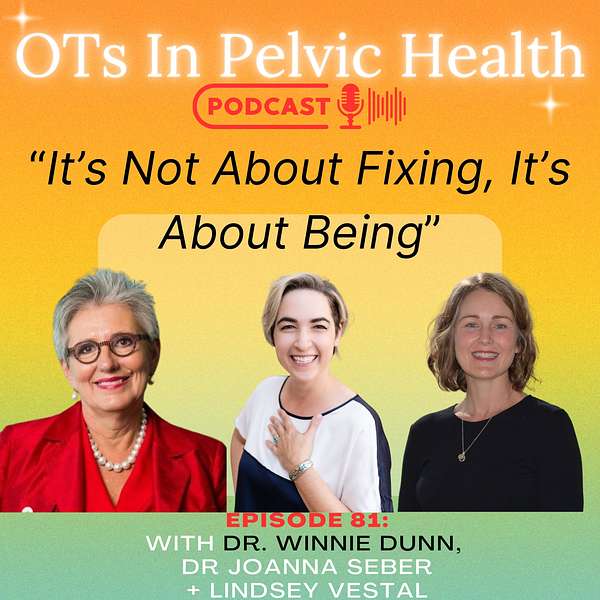
OTs In Pelvic Health
Welcome to the OTs In Pelvic Health Podcast! This show is for occupational therapists who want to become, thrive and excel as pelvic health OTs. Learn from Lindsey Vestal, a Pelvic Health OT for over 10 years and founder the first NYC pelvic health OT practice - The Functional Pelvis. Inside each episode, Lindsey shares what it takes to succeed as a pelvic health OT. From lessons learned, to overcoming imposter syndrome, to continuing education, to treatment ideas, to different populations, to getting your first job, to opening your own practice, Lindsey brings you into the exciting world of OTs in Pelvic Health and the secrets to becoming one.
OTs In Pelvic Health
"It's Not About Fixing, It's About Being" with Dr. Winnie Dunn
- We'd love to welcome you to Pelvic OTPs United - Lindsey's off social media community ($39 a month with no obligation!)
- 3rd annual OTs in Pelvic Health Summit tickets go on sale Feb 1-Feb 28! Grab them before Feb 28 to get early bird discount ($100 off!) and the opportunity to pick your hands-on labs!
- Grab Your FREE AOTA approved CEU pelvic health course here.
____________________________________________________________________________________________
Pelvic OTPs United - Lindsey's off-line interactive community for $39 a month!
Inside Pelvic OTPs United you'll find:
- Weekly group mentoring calls with Lindsey. She's doing this exclusively inside this community. These aren't your boring old Zoom calls where she is a talking head. We interact, we coach, we learn from each other.
- Highly curated forums. The worst is when you post a question on FB just to have it drowned out with 10 other questions that follow it. So, she's got dedicated forums on different populations, different diagnosis, different topics (including business). Hop it, post your specific question, and get the expert advice you need.
More info here. Lindsey would love support you in this quiet corner off social media!
Lindsey Vestal It is such an honor and a privilege to have. Record it by very first co-hosted podcast with another, then Joanna Sieber. Together, Joanna and I interviewed none other than the esteemed Dr. Winnie Dunn. She is a world renowned occupational therapist, an expert in the sensory experience researcher and author of the book Living Sensationally. She is the author of the Sensory Profile Measure. I am so excited for you to hear our interview with her today. She is so incredibly inspiring. Before we do that, I just want to share a little bit about Dr. Joanna Sieber, who joins me in our interview today. Joanna got her master of science in O.T. at UIC in 2009 and returned in 2019 to earn her doctorate of occupational therapy degree. Joanne has extensive clinical experience in pediatric occupational therapy, and her primary areas of interest are family centered care, self-care skills, sexual health, self advocacy and perinatal wellness. She's deeply rooted in the model of human occupation and the intentional relationship model, each borne from her alma mater. I can't wait for you to hear our conversation today.
Intro New and seasoned OTs are finding their calling in Pelvic health. After all, what's more ADL than sex, peeing and poop? But here's the question What does it take to become a successful, fulfilled and thriving O.T. in Pelvic health? How do you go from beginner to seasons and everything in between? Those are the questions and this podcast will give you the answers. We are inspired, OTs. We are out of the box, OTs. We are Pelvic health OTs. I'm your host, Lindsey Vestal, and welcome to the OTs and Pelvic health Podcast.
Lindsey Vestal Joanna, I am really honored to have recorded a podcast with you where we had the opportunity to interview Dr. Winnie Dunn. You were the first person that I've ever co-hosted a podcast with, and I got to tell you, it was so much fun.
Joanna Seber It was Thank you.
Lindsey Vestal For for coming to me with this incredible idea of interviewing Dr. Dunn on the What for Pelvic health podcast. And before we play the interview, I'd love to bring our listeners in a little bit into the conversation. Can you tell me why you came to me with this idea? Why? Why did you want us to interview you? Dr. Winnie Dunn.
Joanna Seber You're like Dr. Wendy Dunn is so inspiring. She the true hero of mine. I really admire her for her truly holistic view of sensory processing, the way she embraces the beauty of difference in all people and the way she really invites us to the core of our profession, the heart, really, of who we are as OTs. And I think she is such an important voice of that clarity in the conversation about sensory processing and sensory integration that can sometimes get a little bit muddled or where we may get a little bit lost in terminology and feel unsure of exactly what it is that we are attempting or offering to our clients.
Lindsey Vestal And in terms of that, you know, I'd really love to understand a little bit better this idea of I hear sensory integration, I hear the term sensory processing, and in my brain I'm going to be really, really transparent with you. Joanna. I'm not sure that I completely understand the differences between the two. And I guess my question to you is, do we need to understand the differences? Are we being picky with semantics in trying to understand the difference between these two very important concepts within our profession?
Joanna Seber Yeah, I love this question, and nobody, myself included, nobody likes an argument about semantics. Of course, we do not want to get lost in that type of a dialog. But what matters so much in this difference and this distinction between whether we are offering errors as I integration or whether we are offering a strength based approach to sensory processing, which is more in line with Dunn's model of sensory processing. The key there really is the client understanding of what it is that we're promising. And even what it is that we believe we are setting out to do. So our goal, our vision and when we're talking about remediation, so integration and even in that that terminology, we hear the idea that there would be an end point of integration happening, right? I'm offering you integration as a goal. You will ultimately experience integration. What does that mean for the process? If we are in an I clinic with specialized equipment and we have specialized training in areas outside? Absolutely. That may be our intention. It may be our goal and we may accomplish that. But that is a really specific scenario. And many of the OTS working in Pelvic health are not in that specific setting. They are not in the space where that's something they can offer and it may not even be something they think the client needs may not be appropriate to offer. So what is it that we're offering if we are not in this area as a clinic? If we are not offering remediation, let's say we have a home based practice and we're seeing a perinatal client and we're supporting the way that that client develops new habits and routines and managing a sense of being overwhelmed maybe by the auditory stimuli or the tactile stimuli of new motherhood or the lack of what was previously really regulating sensory input, like heavy from a rug. And we're off of that heavy exercise for a number of weeks while we're in this more isolated, auditory heavy input experience. How do we support that person to understand what's happening in a nervous system level at the level of the brain when it comes to sensory processing and really to offer themselves grace and self care that's different from changing the brain. Or let's say we're in a school based setting and we're working with a child who's navigating this has been a really common one for me, a sense of discomfort in the shared bathroom where there's unpredictable, loud flashing or really bright fluorescent lights or a really cold toilet seat, and we're trying to figure out how to solve for these environmental triggers at a sensory level that are creating avoidance of the bathroom, promoting withholding, leading to constipation, maybe having then sequential accidents and escalating what's happening in the nervous system. How do we care for that process and create insight not just for the team but for the individual to understand? Is it that I don't want to go to the bathroom or is it that these sensory aspects of the bathroom experience are so noxious to that I need to find a way to care for my. And that is not again, changing. The brain is not changing the nervous system. It really is a strength based approach. How do we look to see how we can empower you to be successful, manipulating or shifting some of those sensory variables, but not remediating your internal sensory integration? And what matters really to me to come back to that promise to the client is kind of the contract that we enter into with any of our any of our clients that is that that trust building exercise of setting a goal and delivering it right. We we decide what it is that we offer together, hopefully in collaboration and then we deliver. And we have a sense of trust that we build that we held to our word and that what we were going to do to get. So the semantics don't matter. But the promise matters. And it also matters in how we feel about ourselves. Am I am I selling something I believe I can deliver? Or am I kind of feeling unsure about these words I'm mixing and we don't have a lot of clarity in in our dialog between O.T. and Clyde and understand what it is that we're tackling and how.
Lindsey Vestal Joanna, that was that was so clear and so beautifully articulated. I really loved how you talked about the postpartum person and the child and how the sensory system and the ability to regulate nervous system comfort and ease is really at the core of our work as pelvic floor therapists, regardless of the age that we are serving. And so thank you for illustrating that. I can I can immediately pictured that postpartum person. I've had that person as a client. I immediately pictured that child. Actually, my daughter had those experiences in the bathroom with the loud flushing and the fluorescent lights, and I think we all can relate to that. So thank you for that incredibly clear and amazing depiction. I have one last question for you, which is, if you were to think about the pelvic floor therapist, would you give us a quick example of what a CI or sensory integration intervention would look like versus a sensory processing integration? And maybe we can use a postpartum client if you feel comfortable with that or pediatric client to exist to illustrate the difference between the two.
Joanna Seber It's a good question and a challenge. I think if I had to guess or Bet, most of us are actually using a straight face approach to sensory processing. We are pulling in elements of our understanding of sensory processing to support our interventions and we might be sharing little bits even sprinkled throughout our intervention. It could be that you're utilizing a biomechanical approach or a bio psychosocial approach, and then you notice there's an element that includes a sensory part of the sensory system and you bring in that knowledge, but it's really more a sprinkling or peppering, and that is not errors as that that would be. We are utilizing this knowledge to strengthen how both we view the client and how they understand themselves. And we might be utilizing that knowledge to shift the environment so that it is more complex, so that it is an even different foreign company. It might be so that it's more alerting or energizing. We might be working with a client postpartum who's navigating depression. And part of that postpartum depression and often the accompanying anxiety may be isolation in the home. And so the lack of fresh air, coolness to the face of briskness to movement, that could happen with a walk outside. That's really a sensory experience that we might recommend. And just telling the person to walk for that aspect of exercise is an incomplete intervention. Right. But what we offer as holistic practitioners is that sensory knowledge as well. So when we invite the client to view that walk in light of self-care at a sensory level, we invite them to see sometimes we can do exercise like something we make ourselves do. And from a state of depression, postpartum, that's hard, right? To add to the list of things that we're failing to do or didn't do right. And we don't want to do that. But what if we could shift the lens to be How can we care for ourselves? How can you show yourself love in this moment, in this hour and seeing the walk not just as physical exercise and all the emotional weight that can go with exercise goals, but offering the space for your body to experience a learning, stimulating in a positive way sensory stimuli that can be a different thing entirely and can be a radical shift. Right? In noticing look what's happening to my brain in this. Someone in the cool air with movement, with proprioception and invites us to see. Ourselves really as a dynamic system. And the depression isn't happening to us, but our brain is responding to all of these things. And in my experience with clients, people are really curious about themselves or they want to know what's happening inside of my brain, what's happening such that this isn't just a passive, helpless experience for me. How can I increase my understanding and be a powerful tool? So we make sensory understanding, a tool. And I think that that is so beautiful. We need to shift away from our mediation especially. I've never really connected with remediation. I have not worked primarily in injury rehabilitation, but I work mostly with people with intellectual disabilities or developmental disabilities. I've dabbled more in perinatal clients since becoming a mom myself and I love the OTU angle that is not about fixing and is about connecting, is about understanding, is about really seeing. What do we mean by self-care at a sensory level. And that is complex, but it's also opening a whole lens to view the world in what are all of the sensory offerings that are happening to this moment and how can I make shifts in those to change the way my brain is functioning and my body feels and then my emotional experience is impacted?
Lindsey Vestal Joanna, thank you so much for taking the time to to not only help us frame the conversation that our listeners are about to hear, but thank you for bringing this exceptional idea. It was it was an incredible privilege to be able to spend that time with Dr. Dunn and just to be able to further understand how, you know, this classically pediatric approach, stuff that we had in our textbooks and at school, how it really can find its way and spread it throughout all occupational therapy specialties Pelvic health include it. So it was such a privilege to share this conversation with you, and I'm really excited about sharing our conversation with Dr. Dunn with our listeners.
Joanna Seber Thank you so much, Linsey, that it was like a once in a lifetime experience to get to collaborate with you, to speak with her.
Lindsey Vestal Fantastic. All right, let's cue up the interview. Welcome Winnie, to the OTs and Pelvic health podcast. I am joined by my colleague and friend Joanna Seber, and we are co-hosting together today, which we are so excited about. We're honored that you're here. Thank you for for taking some time to chat with us about your your work and your just the incredible legacy that you've given us as professionals.
Winnie Dunn Well, you're welcome to do it. So there you go. I love.
Lindsey Vestal It. So I'm just going to we're going to get right into the conversation cause we're so excited to have you. And I'd love to just kind of start off with asking you any why do you describe your model as a strengths based approach to sensory processing?
Winnie Dunn You know, that that idea came to me a long time ago when I did my first studies with kids with autism, you know, because that was an obvious group that had differences in the way they process sensory input. And I would give a talk and people would come up to me and they'd say, My daughter does that. My husband does that, you know? And it just dawned on me that, you know, when we do research, we always try to pick a vulnerable group because it makes it easy to see phenomena. And so one of the things I think is so great is that all these people that have conditions that we have served historically, they're showing us the way by having a more intense version of sensitivity, by having a more intense version of seeking whatever it is they show us the sort of bigger picture of that, that part, that sensory pattern. And in doing that. It informs all the rest of us that don't have a particular condition or one that our culture has decided to diagnose. We learn about ourselves, you know? And so it occurred to me that it's really disrespectful to act like only people with conditions have particular sensory patterns, when in fact it is part of who each of us is. You know, it's our way of interfacing with the world. It's our way of knowing how to navigate. So I call it strength based because I want us to think about all the people. You know, I think in the next generation of O.T., we have to stop acting like people have a ticket to get in, you know, like they have to have particular referrals or they have to have, you know, like a valuable service people will pay for, you know, so. So strength based to me means all the people, you know, it means that we we don't look at a person's sensory pattern as something wrong with them. We look at it as part of who they are. And when we understand who they are. Better. When families understand who their children are, when spouses understand each other, we can be more respectful to each other's way of being, you know, without any judgment. You know, I had a I had a woman say to me once she understood her husband was an avoider. She did not she felt like she was taking care of him when she let him go in the back room and be alone when he got home from work. And prior to that, she thought she was being neglected. And subsequent to understanding that about herself and her husband, she felt really empowered that she was caring for him by giving him 30 minutes to be by himself. You know, that's what sensory processing is about. It's about our humanity. It's not about a deficit or something that we have to fix. In fact, you know, there are studies that adults with autism have the same patterns they had when they were children, you know, many of whom got therapy and special ed and every other thing. And so, you know, I think it's something we can learn from, like personality psychology and temperament, psychology, that that the way it shows up when you're 30 is different than the way it shows up when you're eight. But those underlying characteristics are always there. You know, a seeker is going to try food without even considering whether it's icky or not. They're going to put it in her mouth and then they're going to go, a sensor is going to ask ten questions, you know, is it spicy? Did you, you know, is it soggy on the inside? You know, they might still eat it, but their approach to the problem of deciding to eat it is very different. And so I think that we have to if we think bigger about what we have to consider, how every piece of knowledge we have affects all the people, the grocery store, the restaurant, the the, the park, every place. And so strength both to me means that we see ourselves as experts on living, not experts on disability.
Joanna Seber Ask a follow up on that. We need speaking of it, to get in, I wonder what you think about the value of a diagnosis like sensory processing disorder belonging in the DSM.
Winnie Dunn I, I don't think it does. Of all the people that say that. No, that that's what I think. And I just think we need in a postmodern way of thinking, we have to quit labeling everyone because they have something that's different then we have. Pretty much, you know. All the other kids that I've served. You know, they have some other diagnosis, too. I think we need to look at sensory processing as a tool to help us understand how that person can be the most successful in their everyday life and in knowing that we make families feel competent, you know? You know, a mom feels more competent if she understands that her baby's crying for a reason, you know, because the onesie is uncomfortable or, you know, like it gives a concrete thing that they can do right away. You know, it gives. Friends and family a way to talk differently. You know, you can say, well, you know, Tom's in the other room for a minute, you know. He just needs to gather himself to be back, you know, instead of What's the matter with Tom? Doesn't he like us? You know, all those layers of judgment we put on people in my best world. Sensory processing would be just like saying somebody has brown eyes or, you know, they're so. So, you know, so many inches tall or they're shy, you know, just their characteristics without having this laden meaning about them, that is. Making people feel less than, you know, sensory processing knowledge can help people feel more than. I know why my child runs when we get to the park. I know why my child is reticent to get into the sandbox. I know why my husband is so vociferous all the time. You know it's not a judgment anymore. My husband mostly is a bystander and he throws it back at me many times in a in a month, you know? You know, I, you know, I'm a bystander. Like when he does something bystander ish, like leave his shoes everywhere, you know? But that's the way it should be. You know, we should be teasing each other about it and in a loving way, we should be pointing out, yeah, of course you did that. You're a seeker. So I just feel like. We can do better than we've been doing. And it's also about our personal identity as A.T., you know? You know, you have knowledge that anyone could benefit from. You know, it doesn't it doesn't have to be this narrow band that we've created in health care and education.
Joanna Seber Lindsey and I have have chatted about the great value of sharing sensory processing, self-compassion with perinatal clients and new moms. Even the flip side of why is the baby crying? Why does the sound of the baby crying make mom feel like a terrible person who will go to work if.
Winnie Dunn They know that, you know, I have the TV on and the radio on and they turn it off. They feel they feel competent, you know, like that very, very exact thing can be turned to, yeah, he's sensitive to sound. You know, I need to turn it down or. Yeah. He only likes me to hold them for a minute and then he's good. You know, like, just that little tweak can make a mom feel so much better so fast.
Joanna Seber Absolutely. We've also shared with you that Pelvic health coaches are working with both pediatric and adult clients, incorporating a lot of the concepts from your work. We wonder what is one thing you wish every practicing O.T. knew about the sensory system across the lifespan?
Winnie Dunn I wish everybody knew that it was part of who they are and not. Something to mess with in a negative way. I wish people said, Well, let's get a baseline, you know, which sensory systems help you in this situation, Which ones help you in this situation, instead of always seeing like intense sensory experiences as negative, just say, gosh, you hear every sound. How can we tap into that? You know, I, I wrote a chapter with some colleagues I think it's in I think it's similar to this background. And we had a self advocate as one of our our authors. And he talks about this friend of his that is a sound technician now because of his highly sensitive auditory system. And, you know, that's what I love. I love that because that's what happens. You know, people become fabric designers because of their high sensitivity to tactile experiences. You know, people become acrobats because of their, you know, their sensation of a stimulus, proprioceptive input and how they can use it to their advantage. I think all of us have successful lives if we understand that about ourselves and each other. Your self-compassion, Joanna, is such a great word to use, especially with that population of new mothers. They our culture gives them so many reasons to feel like they're doing it wrong. And I think we have a chance to show them how they're doing it right.
Lindsey Vestal I love that. I love thinking about it as a superpower as Yes. That we can lean into. And actually, it's it's our sense of creative self and it's something that we feel actually really good at doing because it is part of who we are.
Winnie Dunn You know and I would, you know, I used to I used to talk about it as an Uber strength, You know, even the things that we would think are bad become really Uber strengths. They become superpowers because we have to pay more attention to them. We have to be more mindful about them. We have to understand all of their qualities because we notice them all, you know? So instead of like trying to make it quieter all the time, you know, if the person is really drawn to sound music, for example, then we, we find what kind of music? Like, that's where OTs are so good to have it. We're so good at at activity analysis and breaking things down. Like it might not be that we have to have silence. It might be that there are certain sounds that are okay and other other sounds that aren't. And that's to me where OTs have a super power. We understand how to dial it up and dial it down without like going all or none all the time. And I don't think people, other people on the team think about that part as much as we do.
Lindsey Vestal Winnie your work in creating that sensory profile is such an incredible gift to the profession and so many Pelvic health Occupational therapist utilize this tool. We're so curious how has the sensory profile evolved since its inception, and what impact do you hope it will have on the field of occupational therapy?
Winnie Dunn Wow. You know, I don't know if you know this, but the way it started, I had I had my first grant from American Occupational Therapy Foundation for $8,000. And it was to look at the the use of consultation as a strategy for delivering services. Now, this is back in the 80s when the idea that we wouldn't be touching only the children in a segregated place was unheard of. So it was, you know, controversial. But in order to show the validation of the that we were picking kids that had something that was different than their peers. We gathered the the eight therapists or the data collectors. We gathered children from their neighborhoods where the schools where they worked, they they each we gathered all the sensory questions that people were asking in hospitals and clinics and everywhere we could find. There were a few articles that had some items, you know, the people would ask, but we gather them all up. And then over the summer, before the school year started, they gave them to a three year old or four year old, up to ten in each of their communities. And so we use and I analyzed it and came up with a mean and standard deviation while they were collecting the intervention data. And so while they were doing all that, I decided that I would publish the 64 kids that were in that study, too, to sort of point out that eight year olds do this and six year olds do this so that people know, because at that point it's only for kids, mostly in segregated places. And so they started thinking that eight year olds can hop on one foot or that they can't do this or that because they never see like the actual everyday eight year old. And when I published that paper, just to show people we're on the right track, you know, we're asking good questions. I like like five therapists that I never met before, wrote or called or whatever to say, this is really helpful. If you do more stuff about this, let me know. I'll help you collect data. So that was this humble beginning where my job was to do an intervention study. But in order to show that we picked kids that had differences, we collected all this stuff. And that's what became the sensory profile. I mean, that collection of items became the sensory profile. And as I told you earlier, you know, we started out, as everyone does, testing kids that had differences, ADHD and autism and intellectual disabilities. And so we had there's a lot of studies out there now. There's probably about 100 that say put any diagnosis and is different than the normal, the typical population. They're like like, I think we should be done with that. We know there's differences. And so over the years, you know, of course, then people said that we didn't have one for adolescents, we didn't have one for adults, we didn't have one for babies. We didn't have one for toddlers. So expanding the age range so that it's available across the age range was a big thing, too. But I think now I think one of the funniest things to me was when I had the 1000 1100 kids on the original sensory profile, I didn't understand the things that today we talk about seeking, avoiding sensitivity and registration and. So I. I had to, like, think for weeks and weeks when I did a factor analysis about why I thought it would be like the auditory things would fall together, the visual things would fall together. But they don't. Not that those aren't important, but the brain is interested in how the information gets processed, not what the information is. And so that deep thinking that I had to do, because the findings weren't what I expected, is what led to us understanding, seeking and avoiding and sensitivity and registration and. Now. It's like every day is language when we talk about stuff. And it was. Unclear to me even what it was back then. So one of the things, you know, I want people to hear is that we have to be willing. If disparate information comes along to think deeply about why that information is happening, you know, we can't dismiss. A mother that says something that doesn't match all the other mothers we've met with. You know, we can't dismiss something that we don't understand. We have to stop and say, wow, that is really interesting. You know, we have to continue to be curious. So when I did the school Companion, I was testing teacher. You know, I was asking teachers, well, the teachers don't think the way parents do teaching. You know, they have they have a whole body of knowledge they're using. So when the factor analysis didn't show up with those four patterns in the same way, I had to think about like what teachers only care about children learning. So everything they say is about whether the kids can pay attention, whether they're on task, all those education things. So now we're here and now we're working on an interception scale because that's become popular in the mental health world. And I think it's going to be really helpful for those few you pelvic health because that's huge deal with toileting and in your period and all those kinds of things, you know, that internal sensation of what's happening. But I think what, what where we are today is that we're very clear that it's about everyone. It's it's not a it's not. Those tests aren't just for people that are in clinics and places where something vulnerable is happening to someone. They're for everybody. And I'm really I'm really proud of that. I don't I've gotten criticized for it not being kind of clinical. It's just like everyday words that families would say. But I'm proud of that because I think it exposes everyone to how smart of teeth are. You know, one of my main reasons at the beginning was like when Pearson Publishing, which has been other other companies, you know, it gives the therapist credibility, you know, the psychologist at their table. It's like, yeah, I know, I know Pearson, I know the Psychological Corporation. This must be it must be an important thing. You know, early on, that was really that really mattered. And now we're just part of everything. In fact, you know, the cool thing for me is that people from other disciplines are coming to get our information. They're using it because just like we've used psychologist information and business information and developmental information from other disciplines, we are mature enough as a discipline now that people are using our information to support their ideas. And I think that's how mature disciplines evolve. The funniest thing that happened to me lately related to this question is they built a brand new airport in Kansas City, and I was here like three weeks after it opened, like literally three weeks ago and two weeks before, you know, IATA came. I was on a trip. I was going somewhere with my husband. And we walk in the building and there's this huge sign on the wall with a door and you can see it's dark inside and it says Fence. It's a sensory room on the wall. And I walked in to make sure it wasn't like a like an empty Newfoundland room, you know, where no one cares what anyone's particular patterns are. But, you know, it's a place for people to get away. And here's this brand new building. I live in the city where it was built. I don't know any of the architects. I don't know any of the designers. They don't know anyone that made the decision. But somehow all this knowledge that you and I have worked on all these years is in the ethos of our culture. You know, they knew that it was smart to include that in their public place, you know, like so when you say, what's the evolution? That's how knowledge is best used is at that population level where there's no judgment. They're just they just have a room in there. If you need to get away, you can go there. There's there's no, you know, people with autism come here. You know, there's none of that, you know, And and so anybody, anybody that needs to have a breath can go in that room and get away from the bustle and. I think I think a lot of the work that OT did led to that becoming part of the everyday conversations that people have when they build public structures. Just like Ada helped us understand that curb cuts and providing space for people to sit and all that was important and now it's just our ordinary. So that room being there in my city was kind of a marker event. But it's not about it's not about me. It's not about us. It's about the fact that teams work hard to make sure people saw this was important. And now people say, yes, it is by putting it in a public place. That's a long answer to a short question.
Joanna Seber No, but jumping on that, I wonder if you feel any need to protect that domain or sets or processing for us and receive any threat of encroachment from other professionals who are. And you.
Winnie Dunn Know, Joanna I know I don't think like that. I you know, once you create knowledge and you put it like in journals and the place, you know, the appropriate places we put things. Once you do that, you really don't have any control over it. And, you know, I would say to you, there's some OTs using this knowledge appropriately, just like there are people in other disciplines using it inappropriately. And I have no control over that. You know, I can say that's not how I would do it. You know, some of my colleagues would say, I know the person that created that and that's not what she would do like. But that's as far as you can go. You know, you have to knowledge evolves in its own rhythm and we ride the stream of that, but we're not in charge of it. We're not creating the the flow or we're participating in the flow and. You know, I don't like when people use information inappropriately. You know, when people say things about the brain that, you know, they might be shallowly true but not actually true. You know, to support their ideas. But, you know, we don't have any control over that. We all we can do is put out the best information we can. One of the reasons I wrote that public book Living sensationally was to create a way for people to see that it's about everyone. You know, that was my positive way of contributing that that idea is that this isn't about disability. It isn't about fixing. It's about being. And so, you know, that's an example of what I would do about it is make sure people have accurate information. Like when I review journal articles, I I'll point that out to the authors, you know. Have you considered you have your ideas could have a bigger impact if you talked about them like this? You know, I think that there's always going to be bad actors, you know, and we just have to be better. You know, we just have to be better. And I think mostly people know that the sensory knowledge comes from O.T. because I go to so many O.T. resources to get it. So I think that's really good. Sometimes that's not true, but I think that's true in this case. Do you guys have a different experience than that?
Joanna Seber I know there's a really common kind of one discourse around how do we protect our domain? How do we ensure that we aren't lost kind of to PCE or to speech? And particularly, this is one area that is unique to us. And are we doing what we can to ensure it sounds possessive in in a way. But but you you had a great role in creating so much of this content. Is it important then for us as OTs in that in that lineage to be guardians of it or stewards of it?
Winnie Dunn Well, I think the way you are good stewards is by being excellent, you know, by by being compelling, by being indispensable, you know. You know, that's why, for example, I'm sure you get criticisms in public health about being more like P.T.. And so it just to me, the call is to be more about life and participation and satisfaction and quality. That's what attracts people. You know, we have you know, we have to live by attraction. And and I think that for a long time during my formative years as a collective, were afraid, you know, we were afraid not to get on the biomechanical train with rehab and and musculoskeletal things. You know, we were afraid to get on the train of independent living. You know, we had a chance in the 70s to to get to get on that path. And we were just too young and afraid to do it, you know? But that is a way more consistent philosophy to what we say it is. And I think that the way that we we rise up by being so good at it that people wouldn't consider any other options, You know, and I think we're you know, I think we're mature enough to do that now. You know, we have to look at the developmental trajectory of any discipline and give ourselves some grief on that. But I think that we we just have to be so, you know, like I really you know, there's nothing worse than saying I need to I need to figure out how to help my child go potty. And they keep talking about exercises, you know, like to a family, that doesn't make sense. You know, we in our best selves are talking about going potty, you know, like we're right on it. We don't direct. We're proximal to the thing they say they need and want. And the more we do that, the more indispensable we become. That, to me, that's how we do it. Not by making restrictions or, you know, if somebody if somebody on your team uses the knowledge or an incorrect way, you know, we have a chance to have them do it better. You know, all the years I worked in public education, I never had a teacher say to me, thanks. I got everything I need from you. I don't need you anymore. Like, they're like they got to the point where they would think I could help them with everything. Things that I didn't know anything about, you know, because they. They saw that I was resourceful and that I was willing to listen. And I used words they used and I. I talked about the exact thing they, you know, like seat work or whatever it was. We talked about that and I embellished it with what I knew. So I never had anybody say. Okay. I think I have everything I need from you. Thanks. And I think that, you know, that's what being indispensable is. You know, when the budget cuts come, I want the teachers to say, don't get rid of the O.T.. You know, that's what makes us strong and powerful, not by being, you know, protected and guarded. And you guys are embarking on an a new area. It's the same. You know, I'm sure I'm sure there's some of those same trials for you. But you have to ask yourself, like, what makes me look indispensable? What makes me so good at this that a person will make a referral and tell their friends or whatever, you know, whatever the path of communication are, because you did something for them that they didn't think they got from anyone else.
Lindsey Vestal Yeah. Yeah. I think I think that is incredibly important. I, I love that. Whitney. How, how do you envision the future of sensory processing research and its implications for OT?
Winnie Dunn I want I want I want OTs to be coaching with grocery store owners about how to organize the products, to be in support of different patterns of sensory processing. Like, you know, if, if, if the grocery store overwhelms you, here's a path you can take. You know, here's the here's a little section of the store with smaller numbers of items. If you need to have a miniature store experience here, you know, here's here's a path you could use if you want more stimulation. You know, we Brits the vegetables. So get over there. I mean, that's I'm being silly, but I'm really not. You know, I want us to be thinking about our impact at a big level, you know, like. You and I. I've been thinking about Pelvic health because we knew I was going to talk to you guys, but, like, what would be the biggest way you could have an impact on public health? You know, it would be that every every Ob-Gyn makes a pre birth referral so that you can prepare them the mother for, you know, if this happens, you know, they don't know what's going to happen. But you can pre, you know, preset all of that. We did a project where we went in before, I think it was it was breast cancer treatment. We went in and did a home visit with the family, with the women beforehand. And, you know, they were doing fine. You know, their lives are fine. You know, they they were nervous about having surgery, all that. But but because we did that, they knew to ask for help quicker, you know, So so to me, that's a thing that we should be doing is, is moving ourselves towards you might you might have. You might notice different sensations. And here are some ways that you can notice those things. And here are some ways that you know that we can help you if that happens. So they don't get afraid. You know, that fear makes everything so much bigger. You know, we have to we have to think about how we can use our knowledge in service to mindfulness, because that's what sensory processing is. It's mindfulness. You know, like if you know something's coming, you know all the literature on pain. If people know how to characterize their pain, experience it. It's different for them immediately. But at a bigger level for our profession, you know, I wouldn't I want us to do a big study where we interview regular people about all, you know, like find out what their sensory patterns are and ask them, how do you manage this? You know, you told me in this assessment that you have that you see touch and you are sensitive to sound like Tell me what you're doing in your everyday life that you told me that seeking touch. Well, they're going to tell you things like, you know, I. I feel out of all the clothing when I'm at the store and I. I like to make bread because I get to need the dough and I'm like, we need to look at all the ways that people have intuitively figured out how to use their sensory patterns. And, you know, we need to do that even with the people we're serving. What are you already doing? You know, now that we know that you have that seeking quality, what you know, when do you drive your family crazy with it and when do you get what you need for yourself? You know, like, I think the strategies that people think of in their everyday life, we could use for the people that aren't figuring it out without our help, you know, And there's a huge resource of people out there that have many stories to tell. You know, when I was writing, let me since actually people would tell me these stories and I'd be just like, my gosh, you know, this man that he bought a. It was called a silent garage door opener, and he put it in and it was still too noisy, so he put more rubber gaskets on. So I'm talking to him and I said, you know, I didn't know you could buy a silent garage door opener. You know, that's fascinating. But I need you to know that other people. Like the sound of the garage door because it tells them their daughter's home. Or it tells them they've got the house closed up for the night. And he was just like, What? But like, think of all that knowledge out there, all the people that have figured out strategies for themselves and like including the populations that you're serving. Like what strategies have people thought of before that we could offer or we could suggest to the people we're serving currently? I think we don't tap into that. I've done a few projects where I've. Evaluated everyone in the family, the parents and the children. And then we talk about how to manage the constellation of sensory patterns that are in their family. I think that things teams in it, not just families, but teams, how they can distribute the work that's in service to the different patterns that people have. And my experience is that once people know their own sensory patterns, there they are a wealth of information about what they're doing because we've increased their mindfulness. I do that a lot. Joanna You said earlier that you work with people with developmental disabilities or intellectual disabilities. You know, one of the first things I do when I serve like an agency or something that's serving that population is I have all the workers take the sensory profile and we talk about all the things they do, you know, to to manage themselves, to drive each other crazy, you know, And then it becomes part of the ethos that they discuss. So then when they're seeing a client, they notice sensory, They they know that sensory ways of explaining the behavior is another choice. It sort of expands their choices about how they can think about a problem. It doesn't mean that sensory processing is always the underlying feature, but it's a contributing factor that's easy to manage. You know, it's parents are like, You mean like I can just turn the lights down, you know, like, you know, they think that a miracle has happened because this one thing that we, you know, we say, well, what could you do? Like it sounds like, you know, he's very sensitive, you know, in your house. I mean, what are some of the things you can do? And they say things, you know, they'll say like, I'll close the blinds or whatever. They, you know, whatever they think of. And then they think that they're like. In charge of everything that like, I have five more ideas. And I tried that, but it didn't work, so I'm going to do this other thing. So we create all this resourcefulness for them. So I would like I would like us to embed this information into the routines of everyone, you know, the men and women that you're serving can then gain insight for themselves that they share with grandma and grandpa. They share with their spouse, they share with other people they work with, you know, and it spreads and spreads you. I talked to Leavenworth, Kansas, is close by, and that's where all the the Army people get trained if they're in leadership. And so I did a whole year of teaching all the spouses about sensory processing. They all you know, they all have jobs themselves. But you wouldn't believe the questions that came up, you know, like in their offices. And, you know, it's just like expands and expands because it's easy to grab on to. And I think that's why lots of people want to use it, because it does explain behavior in a way that we didn't have before. So those are the things I would like people to start doing.
Joanna Seber Those are such incredible ideas. Yeah. It gets you so excited about our future as a profession. Yeah. Much growth for. For us as a community. I wonder what you think about current trends in sensory processing within our profession, in clinical practice especially.
Winnie Dunn You know, I'm not I'm sure you can tell from my talking that I'm all about the people's lives. And so I'm not so interested in person factor solutions. I feel like it sends a message that I don't think we want to send. And I don't think that anybody trying to send it in a malicious way. But I had a little girl I served many, many years ago. She had cerebral palsy and she was really bright. And that was in the 70s during the trend when we were as always, we're playing with language, you know, now we have different ideas about how to refer to someone, but the trend right then was people who are experiencing X, people are experiencing, you know, brain brain damage, people are experiencing whatever. So people were saying that to her, you know, people who are experiencing cerebral palsy. She'd read it somewhere online or wherever. She found stuff. And she she told her mom, you know, I think I'm done experiencing this.
Joanna Seber I experienced it.
Winnie Dunn With cerebral palsy. But I think that that speaks to this whole idea of when we focus on person factors, we lose track of the person's life and we can't just give lip service to the person's life. That really has to stay at the center of everything we do. It just has to stay right in the center all the time. And I think coaches are smart enough to do that. It's just easy to fall back on more procedural or specific methods and strategies that makes us feel fancy as bowties. You know, it's not fancy to go grocery shopping with someone, although to me it's sublime, you know, seeing, helping somebody manage that situation, which is complicated. So I think that I think that our trends need to focus more on the hard work of seeing the therapeutic opportunities in a person's life instead of using our special strategies to try to effect change.
Joanna Seber I think that that definitely resonates with my clinical experience I've used often with with families, even a story I got from you.
Winnie Dunn Oh good.
Joanna Seber Yeah from one of your your conference presentations, you spoke about a child on the periphery of the playground. Chaos. Who's taking it all in and and seeing the beauty of that child's experience and fast forwarding to that child as an adolescent. And what opportunity for kind of self-regulation, impulse control and consideration of risk that that child can bring to the the peer group. I've shared that many times with with with families, especially when the child has a diagnosis of ASD. And there's the the proposal. You know, we should work on social skills for the child to perform social in the way that everyone else and.
Winnie Dunn Frankly it's not their right.
Joanna Seber Much of what's been so empowering to me is to say, you know, when you created the sensory profile, which is what I'm reporting on, and, you know, she gave me this example, What I'm seeing is your child do the exact same thing. You know, find his or her way of of participating in the world. And let's look at the ways that it's beautiful and intuitive and creative and solutions focused for this person.
Winnie Dunn And that is everything when you do that.
Joanna Seber But I also have in my teaching, many of my students will ask me really consistently, but why not remediate? Why not change the social behaviors so that the child participates just like everyone else? Why wouldn't we do that? I wonder what you would say to them.
Winnie Dunn Well, I might. If I knew the students, I would find something that's, you know, essentially them and and say, do you want me to change that about you? You know, do you want me to change that? You need a quiet place to study or do you want me to find a quiet place for you? You know, like and we all have that choice, you guys. I mean, we all have that choice. You know, we might want to do something really badly because our friends do it and we want to do it with them, and we're willing to do the work to do it. I it took me eight months to learn how to do art and Chondrocytes and I, which is a yoga pose. It's called Flying Half Moon Pose. I was in a class with people that were dancers, and they just went right into it. You. And I'm like, But I mean, I made a cognitive decision that I wanted to learn how to do it. And so, like, every single day for eight months, like literally every single day, I put my butt cheek on the wall and I got in the position so that I could get the proprioception and the body image of it because it was something important to me to do. You know, it felt good when I did it. So we have to always say people have a choice about what they want to spend their energy doing. You know, I'm never going to jump out of a plane because, you know, I can have a full experience of living, you know. But that set aside. We got to be respectful of other people. Why do we want everybody to be the same? It would be horrible. It would be really horrible. And the amount of energy we spend trying to make somebody be like everybody else is at the loss of what we could be doing to help them be more creative, to help them be more resourceful, to help them find words for how to explain where they are with other people. You know, like, I need to leave the room now. You know, teach my kids. I got it. I got to go collect myself. I need some quiet for a moment. Teaching just that little skill is a social skill that informs everyone you know, without it being like this big thing where they have to be like everybody else. We don't want everybody to be the loud party person either. We don't want everybody to be any certain way. So I think that sometimes we impose some of those things on people that have frank conditions like autism that we would not impose on ourselves. If I could give you an example. It's it's a silly one, but it's a it's a good one to me if we think about. I went to a workshop and the woman that was a friend of mine, he was he was starting a card company. So we were going to all make the cards. It was like a little card kit that you can make, like invitations, you know, back when that wasn't such a trend. And since I'm not, I kind of could figure out by looking at the card what to do. You know, all the stuff was on the table and one of the cards had a stamp that you put you put a stamp on it and to make a design. And so I just picked up the stamp and I stamp one of the cards, you know, to make my card and the person running the table. She said, Are you a stepper? You know, And I was like, Hey, you know, it's like, am I, you know, do identify as a stamper, you know? Well, and one man next to her was like a Stamper. And they went on about how they bought their supplies. And when they did their stamping and how she did it in the morning so she could bring it up at nine color with the kid that, you know, on and on. And so it was clear I wasn't a Stamper. Right. But we call that a hobby for those two women, even though they were being pretty obsessive about this thing called stamping. And I, I know some people that listen to this will be stampers, and that's okay. But like, why do we then label it as an obsession or a narrow interest or, you know, all those bad words that we would say about a person with autism that is equally passionate about trains or space or physics or math. You know, if we get to call it a hobby, it's a hobby, right? And so this idea of trying to make everybody be like everyone else betrays the essential nature of who that person is. And I would never, ever recommend for somebody to do that. Now, if the guy, the guy with autism said he wanted to do, like learn to dance or something, then I'm all in and we would figure out a way to dance with the characteristics that he has. So I just I try to get people to think about what it would feel like if we did it to them. And I think that we're in an era where we just don't need to do that anymore. You know, we know enough things. I think stuff advocates are telling us, you know, they're telling us we have we have some great skills because of these characteristics. Quit trying to mess with them. That's what I would say about myself. You know, like don't mess with those things. I'm happy to learn and adapt on certain features, but. You know. Don't make me be quiet, because that isn't a good match for me. If I'm being loud, you know, like, I can be quiet, but it takes a lot of effort. And I'm I'll do it in places where, you know, I feel like it's respectful to the people around me, but it isn't who I am. I don't want you to stop. Caring about who I am. So, yeah, just tell him to stop doing that.
Joanna Seber I think it takes so much courage to bring that message to the interprofessional table sometimes. Yeah, but has such value.
Winnie Dunn Well. And if the you know, if the parents are there, if it's a if it's a young person and the parents are there, I want you to think about I want everyone to think about like, how does it make that person, that parent, feel like? Reports that we write, it's just like stabs in the heart of the family. And it's like if somebody talked about your family member like that, you would be just as emotionally upset by it. Like, how can we say things? You know, Thomas can pay attention when bah bah bah bah bah bah bah. You know, it might result in us understanding that he can't pay attention very often, but it's much more respectful to the family to say it that way. I had a mom say to me one time, you know, about a bad report, a really negative report about her daughter. He she said they don't even know her. She's the funniest person in my family. You know, like they didn't even take the time to know who she is. Maybe we should make them read a report and put their names in it and see how it makes people. I don't know. We've got to stop. Courage is okay. Right? Courage is okay.
Lindsey Vestal Winnie, this has been incredibly delightful. We are so appreciative of your time. And having this conversation today has given us so much to think about and reflect on. So we're so grateful for all that you can continue to do for our profession.
Winnie Dunn Thank you. I'm so grateful that, that you guys asked because, you know, we're not going to make progress together if we don't talk to each other about it. Amazing. Thank you again.
Outro Thanks for listening to another episode of OTs and Pelvic health. If you haven't already, hop on onto Facebook and join my group OTs for Pelvic health, where we have thousands of OTs at all stages of their pelvic health career journey. This is such an incredibly supportive community where I go live each and every week. If you love this episode, please take a screenshot of this episode on your phone and posted to IG Facebook or wherever you post your stuff and be sure to tag me and let me know why you like this episode. This will help me to create in the future what you want to hear more of. Thanks again for listening to the OTs and Pelvic health podcast.
