Bite-Sized Business Law
Looking for the latest in legal business news?
Get a breakdown of the top stories in business law from industry leaders on the front lines with Bite-Sized Business Law. Host Amy Martella takes a closer look at the latest corporate happenings through interviews with the attorneys, legal experts, public figures, and scholars behind the news to distill business law’s biggest stories into bite-sized portions.
This is your chance to go further into the world of business law and stay up to date with legal cases and industry trends.
Corporations impact us all, leading changes that extend far beyond business to shape the economy, public policy, technology, and beyond. Looking at the big picture, Amy discusses not only the underlying issues in business ethics and legal cases leading the biggest stories but also sparks thought-provoking discussions on where the law should be headed.
Amy is the Executive Director of the Corporate Law Center at Fordham University School of Law. Her background ranges from big law to government to tech startups, allowing her to offer an insider’s perspective of the issues that shape corporate actions, large and small. Covering crypto regulation to securities fraud, AI’s impact to Elon Musk’s pay package, Bite-Sized Business Law covers it all with guests of varying viewpoints to provide the nuanced analysis needed to tackle complex problems.
Whether you're looking for the latest in legal insight on intellectual property, mergers and acquisitions, business ethics or legal cases in the business law world, you’ll find it here. Enjoying a thoughtful perspective on the news stories of the moment, Bite-Sized Business Law examines big issues and delivers them in small doses.
Bite-Sized Business Law is a project by the Corporate Law Center at Fordham Law. The Center serves as a hub for scholars, professionals, policymakers, and students to engage in the study, discussion, and debate of current issues in corporate law. The Center focuses on aspects of corporate law, corporate compliance, antitrust law, and securities regulation. Through initiatives like the Mergers and Acquisitions seminar and the Securities Litigation and Arbitration Clinic, students actively engage in real-world research and cases, bridging the gap between classroom learning and practical application in the legal field.
Bite-Sized Business Law
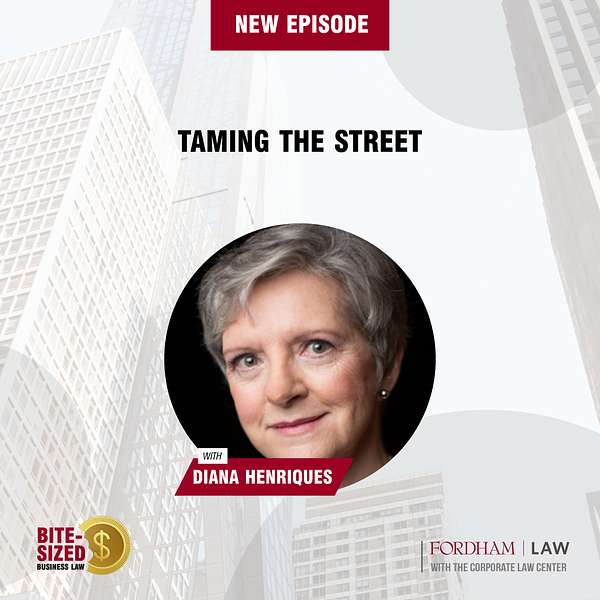
Diana Henriques on Taming the Street
What does capitalism owe to the common good? This is the question raised by Taming the Street: The Old Guard, the New Deal, and FDR’s Fight to Regulate American Capitalism, a riveting new book from award-winning financial journalist and New York Times bestselling author Diana Henriques. Those who saw The Wizard of Lies and The Monster of Wall Street will recognize Diana, whose research and writings formed the basis for both shows. Her latest offering details how President Franklin D. Roosevelt (FDR) battled to regulate Wall Street in the wake of the 1929 stock market crash, ultimately making the finance world safer for retail investors and average Americans. In today’s episode, Diana takes us back to a time when America’s financial landscape was ruled by the titans of vast wealth, largely unrestrained by government, and walks us through a pivotal moment in history: the creation of the SEC. Tuning in, you’ll gain insight into Diana’s motivations for covering this topic, how she believes we should regulate emerging financial industries like crypto, and why Taming the Street is increasingly essential reading as inequality once again reaches Great Depression levels. For a truly fascinating discussion about America’s financial past (and future) with a central cultural voice in reporting white-collar crime and corporate corruption, you won’t want to miss this episode!
Key Points From This Episode:
• A look at Diana’s career path into journalism, which she calls “a lifelong goal.”
• Insight into her decision to take on the New Deal in Taming the Street.
• Why this book becomes more critical as the pendulum swings further toward deregulation.
• What life was like for the American working class in the lead-up to the Great Depression.
• Now illegal stock market practices that were common in the 1920s.
• Bill Douglas, Dick Whitney, and other central characters Diana introduces us to in her book.
• The “bedside meeting” with FDR that forms one of the most poignant parts of this story.
• Unpacking Diana’s description of FDR’s “moral Pole Star.”
• Why the health of America’s democracy depends on the fairness of America’s economy.
• Diana’s take on the Silicon Valley Bank collapse and current financial reform battles.
• Her hope to bring awareness to the safety of the banking system today, thanks to FDR.
• Recommendations for regulating emerging financial industries like cryptocurrency.
Links Mentioned in Today’s Episode: