Wine Guide with Cork & Fizz - Wine education for beginners and enthusiasts
Interested in learning about wine, but not sure where to start? You’re in the right place!
Here at the Cork & Fizz Guide to Wine, you’ll have the opportunity to dive into the world of wine in a fun and approachable way.
Hi! I'm Hailey, wine enthusiast turned wine educator and founder of Cork & Fizz. I’m here to answer all your wine questions, anything from “what the heck is an orange wine?” to “is natural wine really better for me?”
I’ll also cover topics such as wine tasting, pairing food and wine, how to shop for wine, and so much more!
You’ll also get to hear from experts in the wine industry like winemakers and experienced sommeliers.
Whether you’re a casual wine sipper or a total cork dork like myself, this podcast is for you!
Want to learn even more about wine? Come follow me on Instagram @corkandfizz and check out my website, www.corkandfizz.com to book a private tasting or join my virtual tasting club, the Cork Crew!
How to do a wine tasting for beginners.
What are the basics of wine?
What type of wine should a beginner drink?
What wine goes with which food?
Wine information for beginners.
What is the best way to learn about wine?
This is a wine education podcast
Wine Guide with Cork & Fizz - Wine education for beginners and enthusiasts
Greek Wine: A Hidden Gem - A Wine Region Miniseries
Ep 53
Even as a wine enthusiast myself, I sometimes find myself drinking the same wines all the time.
Lately it’s been a lot of California and Washington wine and while they are absolutely delicious, when Mr. Cork & Fizz suggested going wine shopping for something new, I didn't hesitate to say yes!
So, it was that conversation that inspired me to dig deep into Greek wine and to share this inspiration with you, so that if you were looking for something new to try, then maybe you would be inspired to try some Greek wine as well!
I’m digging into the history of Greek wine as well as 5 must try Greek wines, from the Assyrtiko which is known for its bone-dry, high-acid, and sometimes salty style to the aromatic Moschofilero - a white wine meant to be enjoyed young, with its floral aromas to the Barolo of Greece: Xinomavro!
You’ll also learn about the unique kouloura technique of growing grapes to protect the vines from the powerful sea winds and the unique geographical location of Greece and how that impacts the flavors of the wine.
After you listen in, I hope you are inspired to go out and try a bottle of wine from Greece! If you do, head over to instagram (@corkandfizz) and let me know what you tried and what you loved about the wine!
Resources:
Wine growing method kouloura
https://winesofgreece.org/articles/the-santorini-kouloura/
What is an Orange Wine? https://www.corkandfizz.com/wine-blog/guide-to-wine-podcast-episode-18
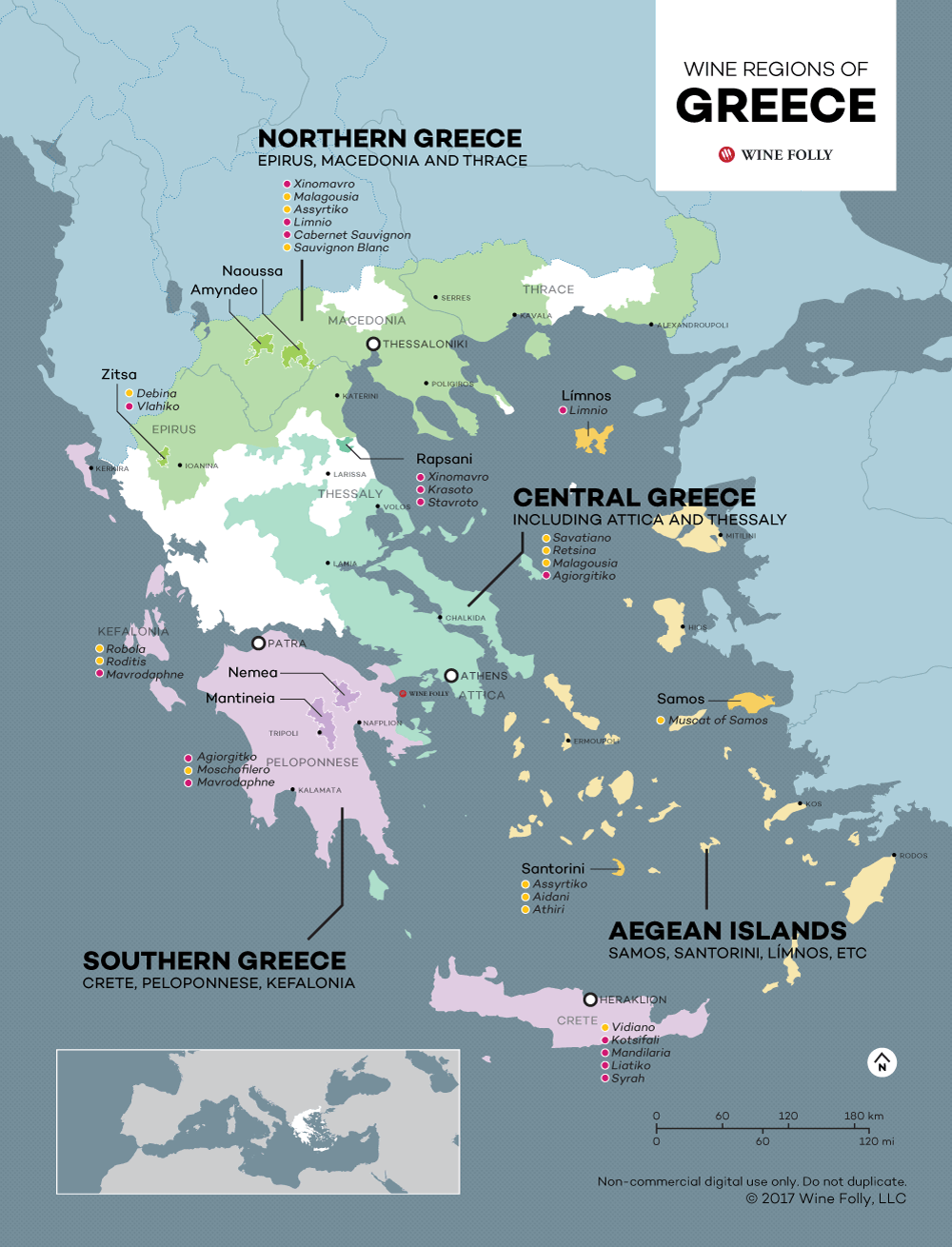
Wine Folly Map of Greece Wine Regions
https://media.winefolly.com/Greek-wine-Greece-map-wine-folly.png
Episode Highlights:
- Introduction and history of Greek wine
- Geography and climate of Greek wine
- The unique geography of Greece which has over 200 indigenous grape varietals
- 4 different wine regions of Greece
- What grapes are grown in each region
- Assyrtiko - description and characteristics
- Moschofilero - description and characteristics
- Roditis - description and characteristics
- Agiorgitiko - description and characteristics
- Xinomavro - description and characteristics
What did you think of the episode? Text me!
Don't Forget to Download my Free Wine Tasting Guide! - https://www.corkandfizz.com/free-wine-tasting-guide
Connect with me:
Cork and Fizz - https://www.corkandfizz.com/
Instagram - https://www.instagram.com/corkandfizz/
Facebook - https://www.facebook.com/corkandfizz/
Email - hailey@corkandfizz.com
Welcome to another episode of the Cork and Fizz Guide to Wine Podcast. If this is your first episode, welcome. So glad you're here. If you've been a listener for a while, welcome back. It's actually been a little while for me. It feels like in recording the podcast, you've been getting a new episode every week, but I've been out the last few weeks fighting off this annoying head cold. It's just not wanting to go away. So if you if it sounds a little different, that's because my voice just isn't completely back yet, but we're feeling a lot better. And I've sounded I'm sounding the best now that I've sounded in the last few weeks. So just stick with me. We're gonna get through this, but I wanted to make sure I got this podcast out to you because it's one that I've been thinking about for a little bit. It was actually inspired by, my husband, wildly enough, actually expressed interest in going wine shopping recently. And I I know. Right? Yeah. My job was on the floor too. I was like, who are you, and what have you done with the real mister Korkin' Fizz? Because the thing is, we have plenty of wine at home. Listen. I'm I'm part of a few wine clubs, and we obviously collect wine as we go. And I have a little makeshift cellar and a few wine fridges. But we used to, him and I, used to go out to wine shops almost every week or weekend. They'd have free or low cost tastings, and we try lots of unique and fun wines and usually come home with a new bottle or 2. And I didn't realize until he'd said this, his, like he's like, maybe we do need to go wine shopping, but we have gotten in a bit of a rut. We tend to drink a lot of the same thing. We've been drinking a lot of California wine and a lot of Washington wine, and I love those. Don't get me wrong. But, you know, like, our fun, like, random unique Croatian wine or something that we've never heard of from Italy. Right? Like, I feel like we just haven't done that in a while. So, in case you're wondering, even wine experts can end up in a rut of drinking the same thing. It's very easy to do. But all of this inspired me to put together this podcast so I could help you choose a new wine to try. And I figured what better way to do that than by talking about Greek wine because Greek wine is one of those where you're gonna find so many local indigenous varieties to Greece that you've never seen from anywhere else. And in fact, I'm hoping to do more episodes like this where I introduce you to new wines you've never heard of, or you weren't sure what they were just by looking at the label. So like I said, this week, we're gonna start off with Wines of Greece. Now I don't know about you, but I've always wanted to visit Greece. It's still on my bucket list. I honestly I blame movies like Mamma Mia or Sisterhood of the Traveling Pants. I think maybe was it the first or the second one? But for just showing off how beautiful it is there, like the white houses and the blue roofs and the seaside and just everything looks so fresh and bright, and I really wanna visit Greece. And it's funny because I I really like my relationship with the water is a is a complicated one. I don't like swimming. I'm really bad at swimming. Whenever I did do swim lessons as a kid, but when we had to practice treading water, I was basically fighting for my life. Like, I cannot tread water for longer than, like, a minute, and I sink. I swear I don't float. I can't do it. And I'm terrified of swimming anywhere where I can't see the bottom, so I stick to pools for the most part. I also get seasick on almost every boat. But here's the thing, I love being near water. Just as long as I'm on land and the water is next to me, like, there's something just really calming, and it's so absolutely beautiful to look out into the blue waters. And I feel like in Greece that would be, like, the epitome of that, of just, like, always seeing the beautiful blue waters. Anyway, that's what we're talking about. We're talking about Greece. We're talking about the wines from here, but you know we're gonna start off with a little bit of history. I am a wine history nerd after all. We're gonna talk a little bit about the geography there and the climate. I think you'll be a little surprised by what I have to say about this. And then, of course, I have 5 wines in particular that I wanna introduce you to at the end of this episode, and, hopefully, you can choose at least one of those. If not, I mean, you might as well just go out and get them all. But choose one of those to try this week as a fun new wine that you are trying. I don't know. I'm trying to think of better word, but, something to help you get out of your rut if you're similar to me in drinking a lot of the same wines recently. Alright. So let's start from the beginning. You know I love a little history, and Greece has a lot of wine history. So it's unknown when precisely the first wine was made, but we do know that grapevines were first domesticated in Greece in 8 1,000 BC. From there, they were spread across the Mediterranean as the Greeks expanded trade and they expanded their empire. There are some, pieces of evidence that show this expansion. We have seen things like carbonized grape seeds, residue of resonated wine wine in jars and stoppers, and we'll talk more about that later. Amphora stamped with hieroglyphics, noting where grapes were grown to make the first wine, which kinda sounds like the first ever wine label. Pretty cool. Right? Imagine if all of our wine labels were in hieroglyphics. I mean, would they be that much harder to read? I'm I'm not I'm not convinced. Maybe pictures would actually be better. There were also drinking vessels painted with wine making scenes found in tombs. And so all of this shows us that they definitely expanded the world of wine from just Greece, during this time. Now trading in wine allowed for Greek's influence on ethics and politics to spread, especially because of the social relationships that wine encouraged. Now the ancient Greeks believed that wine was gifted to men from Dionysus, and Dionysus is the god of the grape harvest. He's the god of wine making, orchards, and fruit, vegetation, fertility, insanity, you know, kinda connected to wine, ritual madness, religious ecstasy, festivity, and theater in ancient Greek religion and a myth. The Romans also had a god of wine, Bacchus, so both of these believed that wine was brought to us from the gods. So you can imagine, this belief, quickly established wine as a symbol of worthiness. I mean, something coming from the gods, that's gotta be, like, very important. Right? So it was considered a luxurious blessing. It also wove its way into the fabric of religious ceremonies, which is why you see, you know, at church, the blood of Jesus is red wine and not beer. Right? Wine was written about many times by the famous philosophers. You have Homer, Plato, Aristotle, and Apocrates, just to name a few. They wrote of its virtue and its beneficial effects, and it's also believed at that time that wine led to increased thought, health, and creativity. Now here's the thing, and I thought this was very, very interesting because what we're imagining now, right, wine doesn't necessarily lead to health. It could lead to creativity, but if you drink too much, I feel like your creativity probably drops down. The Greeks never drank the wine straight. That would be absolutely barbaric. I can't believe we're doing it these days. They actually always diluted the wine. It was usually 3 parts water to 2 parts wine. And not only were they diluted, but the wines at the time were also flavored with things other than grapes. Some of this was intentional, some of it was unintentional. So an example of the unintentional, Greeks used resin, which is harvested tree sap to coat the inside of a porous amphora. And remember amphora are like these large clay pots that they would store the wine, and this was before they had barrels. And the the resin on the inside would help eventually seal the container. So they needed to do this so that oxygen couldn't get inside. However, that alcohol in the wine would dissolve the resin, and it would cause the wine to taste strongly of pine. Now this style of wine is actually still made today, not on accident anymore. Right? We have oak barrels, and we have bottles, and we have other ways of, treating our wine. But I feel like this is an ode to the history, and just something special from Greece. People have very strong opinions about this, though. I have yet to try one myself, but I've heard it is very, very strong of pine, but it's called restina, restina, kinda similar to the, resin that we're talking about. So that was kind of an unintentional, but intentionally, they would actually flavor the wine sometimes with flower oils. It was believed that proper aromas were necessary to restore the body to its natural harmony. So floral so floral aromas were deemed good for the brain. So they added these to the wine because, you know, wine was also deemed great for the health. Put some floral aromas in there. You got your perfect medicine. You'll be feeling better in no time. I wish that was the case. Actually, I haven't had a lot of wine recently because of this darn cold because we have learned better. Alcohol does not help your cold feel that much better. Now although the Greeks were a major influence in the beginning of winemaking, they have had a difficult climb into the modern world of fine wine. Right? Like, it's again that story of, like, this is where winemaking began. But when we, today, think about fine wine and the best wines in the world, we tend to think of France or Italy before we think of a place like Greece. A couple reasons for this, you have the fall of the Byzantine Empire and the occupation of the Ottoman Turks. You have the during that time then when the Ottoman Turks came in, there were structures and taxes that prevented significant wine industry. There was a necessary goal of subsidence, not sophistication, so wine was deemed unnecessary. Then, of course, you have that little bug, phylloxera, even when they started to be able to get their stuff together. It lasted several decades in Greece and destroyed their vineyards. Then, of course, you have the 2 world wars followed by a Greek civil war. So it just took a little while for Greece to kinda come back from their early times as being the place where winemaking began. Now today, there are over 700 wineries in Greece. There are a handful of well organized large firms, but a lot of newer small family run estates are coming up as well. And just as many, many countries outside of the US, many of these wineries don't make enough. And just like you've heard me say about a lot of other countries, many of these wineries don't make enough to export, so you'll only see a lot of the wines in Greece. Another reason another reason why I need to go visit Greece. So there was your little mini history lesson. Hope it didn't bore you. I just find it so fascinating to think about how winemaking began and and what it was like. Now let's move to talk a little bit about the geography and the climate of Greece and why it's such a great place to make wine. And remember, geography and climate are both, our geography and climate are both aspects of what we call in the wine world terroir, and that's your fancy word. Remember, if you're around a wine snob, you just go ahead and smell that wine and tell them, I can really or give it a sip as well probably. I can really taste the terroir in this and sound like a wine snob in no time. So Greece has very peculiar geography. Now I don't know about you, but I already knew the Greek. There were a lot of Greek islands. How many do you think there are? Because I was amazed when I found out. There are over 4,000. Yeah. I said 4,000. That's 3 zeros after the 4. 4000 Greek islands. Plus, along with the islands, which I think I always think about the island area of Greece, Greek geography is also made up of a bunch of mountains. Look up a topography map of Greece and you'll be very amazed. So this unique geography is a major reason why there are so many different indigenous. Remember, indigenous means the grape is local to that area. It wasn't brought in from anywhere else. So there are so many different indigenous grape varieties, over 200 to be exact, because each area is so closed off from the next. So they couldn't take wine grapes from one region to the next region, they just had the grapes that were indigenous to their region. Now in terms of wine regions, Greece is made up of 4 general regions. So starting off, you have up in the north, Northern Greece. This is different regions like Epirus. Let me say that again. These are different regions like Ipirus, Macedonia, and Thrace. Then you have Central Greece. This includes Attica and Sicily. Oh, actually, scratch that, Liz. I wanted to say the grape varieties as well. Okay. So like I said, there were 4 wine regions. 1st, you have Northern Greece. This is made up of the smaller regions of Epirus, Macedonia, and Thrace. Up here you will find a lot of Casina Mavro, Malagucia, Assertico, Cabernet Sauvignon, and Sauvignon Blanc. Then in central Greece, and don't worry, we're gonna talk more about these grape varieties that I'm talking about especially the ones that don't sound familiar. We'll be talking about them just after this. So, coming down, further south, you have central Greece, which is actually includes Athens, surprisingly enough. You're like, that's not central. It is based off if you're looking at a map. This includes Attica and Sicily. They grow a lot of Savatiano, Restina. Remember? We talked about that. Malagousia and Eriotico. Then you have the, larger islands of Southern Greece. So this includes the island of Crete, Peloponnese, and Kefalonia. This is where you will find the smaller really well known region of Nemea in Greece as well. That's a well known wine region. And here, they grow a lot of Arethiko, Moschofilero, and Mafrodaphne, I believe is how you say that. And then finally, you have all those little tiny islands. Remember I said there are, like, over 4,000 of them. Many of them belong to the wine region that we would consider Aegean Islands. This is Samos, Santorini, Limnos, and here you have a lot of Assyrtiko, which is probably, I think, the grape that I would say Greece is most famous for. And then also a couple other white grapes, that are lesser known like Aydani and Athiri. So, again, those are kind of the 4 larger regions, and then you have kinda smaller regions within there that, are a little more well known as well. I highly recommend looking up a map. Wine Folly has a great map of Greece that shows all of these and also tells you a little bit more about the grape varieties that are grown in each of the regions. If you're a visual learner like me, I love listening to the podcast, but it also helps to kinda have a visual to look at. Go look up go look up a wine Folly map of Greece, and I think that will help, while you're listening to this. Now before we get to the grape varieties, let's talk a little bit about the climate in Greece. So Greece is very well adapted for grape growing. They are literally on the Mediterranean, so they're definitely a Mediterranean climate. They typically only get rain during the winter, which is the best time for rain because the grapes are dormant. They the grapevines actually kinda look dead, but they're not. They're kinda just like, they're sleeping. The worst times for rain are spring, which is when the buds break and fall harvest. So if we can avoid rain during that time, that is a good thing. They also receive bountiful sunlight here, and extra sunlight that reflects off the sea, which sometimes can actually be too much sun and too much heat, and this could cause the grapes to ripen too quickly, leading to kinda really simple monochromatic flavors in the wine. So to prevent this, some vineyards are actually planted on north facing slopes away from the equator. If you've been listening for for a while, you've probably heard me say that generally in most areas, if you hear that the the grapes are grown on slopes facing the equator, that's a good thing because they get the right amount of sunlight. Here in Greece, they actually have to decrease the amount of sunlight in some areas, so they plant them on the opposite facing slopes. They also receive a nice cool maritime breeze, it locks in the acidity, That breeze can also prevent pests and mildew, and it keeps the temperature moderated. Now, of course, along with a nice cool maritime breeze, just nice and easy, they can also get some strong sea winds. And due to these strong sea winds, grape growers, especially in Santorini, one of those smaller islands in the south, they've developed a special training method called calura. The vines are trained in a circular method. With this, training method, the vines are trained in a circular method close to the ground, and they basically resemble wreaths or baskets. Each vine is called a Stephani, which is Greek for crown. And, the grapes lie in the center of the Stephani protected from the wind. And by keeping them close to the ground, they won't be able to be knocked over or the wind isn't gonna be able to get to these grapes. It's kinda cool. If you can, again, this is one of those visuals. I'll try to link a photo in the show notes, that you can take a look at this. Otherwise, just look up kouloura, k o u l o u r a, grapevines in Greece, and I'm sure you'll find some pictures. Just do a Google search. Okay. So, again, got some history. We got some geography and climate. I always like to kinda give us a little background. Now let's talk about 5 wines that I think you need to try from Greece. Now before we mentioned there are over 200 indigenous grapes to explore from Greece, we are only hitting on 5 of those right now. I chose these 5 because I have tasted each of these, so I can kinda speak from experience. I also feel like these are some of the most widely available outside of Greece. I'd hate to set you up and be like, yeah. I have this great amazing wine, and then you can never find it. So my hope is that each of these 5 wines, you should, hopefully, fingers crossed, be able to find it near you at some point. So we're gonna start with the white wines, and we're gonna start with what I what I think is Greece's most famous wine, which is Assyrtiko. And this I think this looks like how it's said. This is a s s y r t I k o, Assyrtiko. Now I say that this is Greece's most famous wine, but I didn't realize until I was putting these notes together for the podcast, Assyrtiko isn't even in the top five for most common grape planted in Greece. So it's famous, but not necessarily common. There are less than 5 1,000 acres planted with this grape and most of that is in Greece. So that's 5,000 acres planted across the entire world. And most of it is in these tiny little islands of Greece, specifically Santorini, which is where it originated. You can also find it in other areas of Greece like Macedonia in the North and Sicily in Central Greece. Now many Assertico vineyards are planted using that technique that I told you about, that calura, where they're in a circle on the ground. And that's because, again, they're in the south of Greece in those little islands where they can potentially get those strong winds. One thing that Assyrtiko is very well known for is a bone dry super high acid style of wine that it makes, And it can even be a bit salty. Think like the ocean. So on the nose, you might get things like salinity, that, like, salty kind of ocean air smell, pear, white flowers, passion fruit, and flint. And, again, flint is kind of that minerality, that smell of, like, the the smell that you get when you walk by a waterfall or the smell of the pavement after it's just rained. Structure wise, we talked about that high, high acidity. Like, Assyrtiko is one of those where, like, you almost have to have have some cheese or something with it because it is just so tongue tingling and and so acidic. It is usually quite light, sometimes medium bodied, but usually light bodied, medium alcohol, and, again, bone dry. There isn't gonna be any sugar in there. I would relate this to an albarino, from Spain or a dry riesling. Now there's one exception to this where I'm talking about it's very high acid. It's like a very tart lemonade. Right? There's one exception to this and that is a syrtiko wines that are labeled Niteri, and this is n y k t e r I. If you see this on the label of an Assyrtico now most wine, Assyrtico wines are labeled with the grape variety Assyrtico, so they make it easy to find. So if it says Assyrtico and it says Niteri, this term means that the wines were oaked, so they have a fuller body and a richer taste to the wine. So it could be a good option if you're not a fan, quite a fan. It's still gonna have high acidity, but it's gonna be balanced out a little bit with that the oak that gives it that fuller body. This wine is a perfect food pairing to any seafood dish or Greece's famous tomato and feta salad, which again is why I think it's such a popular wine even if it's not the most common wine. So that's your first one, Assyrtico. The next wine, again, we're still in the white wine territory, is called Moschofilero. It is spelled m o s chofiler0. And, again, look for these names on the bottle itself. Most Greek wines are labeled by their grape variety. Moscofidero originated in the region of Peloponnese, and remember, this is the what we called southern Greece. This is kind of like a large almost island. It's it is technically connected, but it looks like a large island, in south, southwestern Greece. So. Mosco Filano is an incredibly aromatic white wine and is typically meant to be drunk young. It's fruity, it's floral, and it's sometimes combined with a touch of sweetness, which I think makes it the perfect varietal for, fans of Moscato de Asti to explore. This comes from experience as well here. My mom was a lover of Moscato de Asti, and I remember I recommended a Mosco Filero for her to try, and I think she did enjoy that one. But you gotta make sure you find a sweet one. So on the nose, aroma wise, you're gonna get things like pear, peach, green melon, potpourri. It's really got that floral note going on. Some almond and maybe even fruit cocktail. Structure wise, it could be off dry, AKA slightly sweet, or dry. It just depends on the producer. Medium plus acidity, medium bodied, and low to medium alcohol. So one trick, if the bottle itself doesn't say if it's off dry, dry, sweet, or whatnot, check the alcohol level. If it is under 12 percent, so 11 point something or even under that, it is likely that it has a little bit of sweetness. If it's it's 12% or over, it is likely a dry aka no sugar in that wine. If you find a slightly sweet version, I think it's similar to, like, a Moscato dei Osti or even maybe a Gewurztraminer. If it is a dry version, it's gonna be more similar to a Viognier. Again, it's just got a lot of this floral aromatic note to it. Now while most of these now while most wines of this varietal of Mosco Filero are meant to be drunk young, a bottle from the right producer can be aged to develop really irresistible flavors. There's this perfect combination of nectarine and apricot along with toasted hazelnut or almond notes. So don't stray away from an aged mosco filero if it's a good producer and they've aged it correctly. Now interestingly enough Mosco Filero we typically consider it a white or it creates a white wine, but it is a pink skinned grape similar to pinot grigio. So it can make rose, or maybe you'd call it an orange wine as well. But I'm gonna talk a little bit about this the difference between the orange and rose wine in with our 3rd grape variety that I wanna talk about which is Roditis. Now, Sorry, Liz. Alright. So our 3rd grape variety of Roditis is similar to Mosco Filero and that it is a pink skinned grape, and it's often used to make rose or some might call them orange wine. Now you're probably like, Haley, in the orange wine episode, you said orange wine and rose are different. What do you mean that they can be the same thing here? This is where it gets a little confusing. So remember, an orange wine is a wine that has been made using white grapes, but with an red wine method. Meaning that typically when you make a white wine, you bring the grapes in, you press them, you get the juice, and you get the skins out of there. You only want the juice. With an orange wine you put those grapes in contact with the skins. Right? And that's how we get an orange wine. The thing is it's generally called an orange wine when they are white grapes or what we might consider green grapes as well. So they don't have any sort of pigment in the grape skin and so there's chemical reactions that end up causing that orange color. The thing with the pink skinned grape which actually falls in between so when we think about grape varieties so when we think about grape varieties, we it's funny because we call them white and red generally, but in the wine world, you'll actually hear them more likely referred to as a white variety of grape or a black variety of grape. So our red grapes are kind of considered there the red grapes are considered black grapes. And there's actually a category in the middle called gray grapes, and that's what Pinot Grigio actually stands for. It's Pinot and then Grigio means gray, so it's a gray pinot, and it's somewhere in the middle. It means that they are they have got kind of a pinkish color to their skin, so they're not quite a white grape and they're not quite a red or black grape. So when we go to make a wine using that orange wine method, but we use the pink skins, it acts somewhat like a white grape and somewhat like a red grape. Hopefully, this made sense, but that is why with these pink skinned grapes, this happens with Pinot Grigio, this happens with that Moscofidero we were talking about, and this new grape that I'm talking about, Roditis, where if we bring the grapes in, we have or we harvest the grapes, we press them, and we leave them in contact with the skins for a little bit, they're not going to look orange, they're going to look pink, and so they could create a rose. And remember, a rose is made with red or black grapes that we bring in, press, and then either have them on the skins for a very, very short amount of time or don't have them on the skins hardly at all, and it's just the contact that they get from being pressed. That's why in this scenario with pink or what we call gray grapes, oh, no. Rose and an orange wine could be kind of the same thing. Okay. Okay. Back to Roditis. This grape is often considered to make a wine called like, that they would consider a daily wine. It's used to kinda make common white wines in Greece. It's one of the most abundant grape varieties. However, if it's done right, it has this really lovely citrus and mineral notes, and then it can also be light to medium bodied, and again, that refreshing acidity. From all my research, wines made from Roditis are really terroir driven, so that means it depends on where the grapes are grown, what type of wine you're going to get. The best wines come from areas of higher altitudes. Because in the lowlands on the opposite side of the spectrum, these lowlands are fertile and they are prone to overcropping and overproduction. Anytime you hear overproduction that means you're gonna get kind of simple unexciting wine. So definitely recommend. I've had great Roditas, so I highly recommend trying this grape, but just pay attention to where it's from. Okay. Moving on to our red grapes. So our first one, these are also, like, where we start moving away from where how I say it looks the same as how it's spelled. This first one is aeritico, and I'll say it again slower. Hopefully, it helps with the pronunciation of this. So when you're looking at it, there are 2 g's, and I'm actually pronouncing those g's like y's. So it's agiorgi tik0. So it looks like Right? Now instead of saying the g sound for the g, I'm saying the y sound like you. So it's gonna be hold one second. So it's gonna be so it's gonna be a. You know, it sounds funny. Just just when you're looking at it, imagine saying a y instead of a g. This is Greece's most planted red varietal, and it comes from one of the most famous regions of Nemea, which is located in the northeastern quadrant of Peloponnese. I think it's Peloponnese. Now with this one, you can sometimes find that the wine will be labeled just by the region of Nemea, n e m e a, instead of the grape varietal as well, Airritico. On the nose, you get aromas of blackberry, chocolate, nutmeg, and leather. These wines are medium to full bodied, medium acidity, medium to high tannin, and lower alcohol. In general, I would compare this to maybe a Merlot or a Malbec, just not as much alcohol generally. And something fun about this wine is that legend states that after the Greek hero, Hercules, slayed the Nemean lion. It was the local Nemean wine made from aortico that he consumed. So just think, you could drink the blood of Hercules. This is sometimes what it is referred to, instead of Eurytiko. Now for my local friends, if you're in the Seattle area, you're looking for a spot to try these delicious wines and some tasty food, one of my favorite Greek restaurants here is called Omega, AZurik. It's located in Capitol Hill. Highly recommend. You can find a lot of these wines and a lot of great Greek food. And finally, our last red wine and our last recommended wine here out of the 5 is called Casino Mavro. This is hailed as the Barolo of Greece, and it's one of the country's most important red wines. It's a rattle that's grown primarily in the northern region of Nassau and Amedeo, where the climate is continental, and it actually looks very green. If you look up pictures of Nassau, I think you wouldn't believe that it's in Greece because it just looks nothing like the islands that you're so used to seeing. They also have colder winters here and lots and lots of rain. Now, again, this is one where when I'm saying it, I bet you couldn't guess how it is spelled. This grape, Casino Mavro, is xinomavro. So the ending is fine, Mavro. That makes sense. Right? The the beginning when you're saying the x, it's easiest to try to say this if you think that it starts with, like, casino, k a s I n o. That's how I've taught myself how to say this. I just kinda say it a little quicker. So it's just casina mavero. Hopefully, that helps in, the pronunciation when you're when you're looking for this wine. On the nose, you get some fruit like black cherry and plum, but you get a lot of spice. You've got, like, licorice, allspice, and then some kind of herbal or savory notes with, like, tomato and olive as well. Structure wise, super high tannin. That's kind of why we think about Barolo here. Medium plus acidity, medium to full bodied with a medium alcohol. This is similar again. So Barolo is made from a grape called Nebbiolo in Italy. So it's got kind of a Nebbiolo structure, but a little bit of a hint of sangiovese taste. So if you like Italian wine, you would probably like Sinomavro. Now this wine is something that's really special about this as well. Is it isn't it is that it is an affordable wine worth selling. So if you want to try to age some wine, this is a great wine to go out and get. You can buy a bottle for under $30 and age it for a few years, and this is gonna come out really wonderfully, and you don't have to spend a $100 on a bottle. One of my favorites that I'd recommend comes from the producer of Apostolos Dimopoulos. Again, I'll note this in the show notes, so you can find it there. The vineyards in this region are grown primarily on limestone rich clay soils, gives the wine this additional structure and bold fruit flavor, AKA perfect wines to age. And, again, this region is in, or this wine is in the region of NAOUSSA, n a o u s s a. Another recommendation for my Seattle friends, sorry for those outside of the area, I'll try to jot down whenever I'm traveling if I find a good spot, but I do know Seattle pretty well. So there is a great wine shop called the Shop Agora to find a lot of these wines. Again, I think it's in Capitol Hill. I don't know why all these places are in, like, one area. But find the Shop Agora. You can find a lot of these wines, and they have a lot of great snacks, as well. I'm thinking, like, a jar of olives or a pack of sun dried kalamata figs would go really well with these. Now, of course, we could go on and on with different Greek varieties, but I'm gonna stop there. Do yourself a favor and go out and find one of these bottles to try. So as a reminder, our 3 wines we talked about. So we have our white our our purely white variety, which is Assyrtico, our gray or pink varieties of Mosco Filero and Rodites, and our 2 reds, Ayrtico and Casina Mavro. Now go out, get yourself a bottle, and try it, and imagine yourself either on the shores of Santorini or in the mountains in Nassau while you're drinking it. And then let me know what region should I explore next. Alright. I hope you enjoyed this episode of the cork and fizz guide to wine podcast. If you loved it, I would so appreciate if you could take a quick second, rate it, and if you wanna be do a bonus, leave a review. Don't forget to subscribe so you never miss an episode. I release new episodes every Wednesday. Now in next week's episode, we are celebrating 1 whole year of the Cork and Fizz Guide to Wine podcast. Like, how has it been a whole year? I'll be sharing the top 5 listened to episodes along with my favorite 5 episodes. Will they be the same? Who knows? I'll also be sharing some behind the scene facts and where I see this podcast going in the future. Thanks again for listening. And if you wanna learn more about wine, come follow me at corknfizz on Instagram. And to try more wines just like these Greek wines, be sure to sign up for my virtual tasting club, the corkcrew. Use code wine 101 to get your 1st month absolutely free. Cheers.