Unprofessionalism
Professional performance is exhausting. Maintaining the mask. Editing ourselves. Pretending we know when we don't.
This podcast is about people who dropped the performance. And what happened next.
Each episode features someone who broke professional conventions and found something better on the other side: the executive who disclosed grief in a corporate setting and found it opened new ways of relating; the coach who realised her authority came from integrity, not compliance; the designer who ignored the 'approved tools' and saved thousands of hours.
Conversations circle around three questions:
- What does it cost us to perform professionalism instead of showing up as ourselves?
- How do we create spaces where people can bring their full attention and humanity to work?
- When is the “unprofessional” move actually the most responsible one?
If you feel the tension between who you are and who you're expected to be at work, this podcast shows you what happens when people stop managing that tension and just stop performing.
Hosted by Dr Myriam Hadnes—behavioural economist and founder of workshops.work. New episode every week.
Unprofessionalism
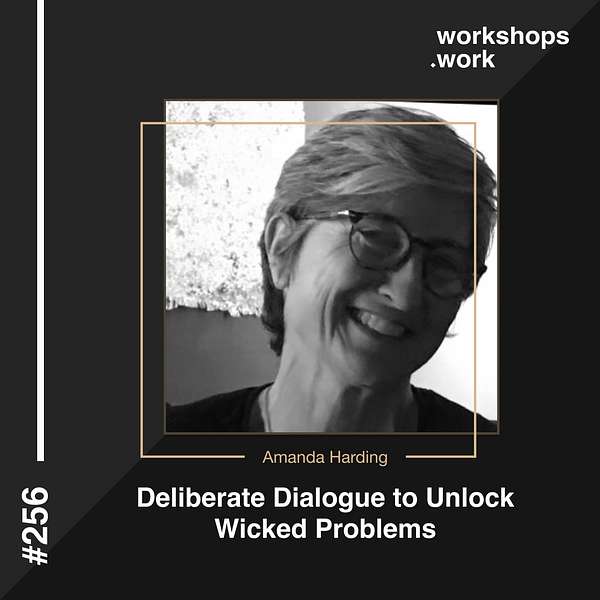
256 - Deliberate Dialogue to Unlock Wicked Problems with Amanda Harding
Use Left/Right to seek, Home/End to jump to start or end. Hold shift to jump forward or backward.
Dialogue is a form of sense-making in motion. Thoughts become words become ideas, and ideas then enter reality splintering into fresh, new routes of discussion – a map begins to form, ready to be navigated.
Although, that map might not always have the right people reading it, it may even have dead-ends along the way, or the wrong starting point entirely. This is where Amanda Harding comes in! As a Curator of Conversation, she designs a third space for deliberate dialogue to be held between a blend of actors, so that entangled, wicked problems can be unravelled with purpose, made malleable, and actionable.
As you’d guess, mine and Amanda’s own dialogue surfaced some big, juicy themes, considerations and musings for the facilitation process.
Find out about:
- Why dialogue can fail when it lacks the right blend of participants – often, those with conflicting opinions have the best conversations
- The importance of making power dynamics explicit to achieve inclusive participation
- How tension can be embraced and managed within a space by ensuring all participants can constructively engage
- How to craft questions, or conversation-starters, for impactful dialogue
- Why dialogue can achieve alignment on a higher common ground, in contrast to a shared consensus, which can lead to diluted, compromised ambitions
Don’t miss the next episode: subscribe to the show with your favourite podcast player.
Links:
Watch the video recording of this episode on YouTube.
Connect to Amanda Harding:
Any thoughts? Share them with us!
✨✨✨
If you miss the "workshops work" podcast, join us on Substack, where Myriam builds a Podcast Club with monthly gatherings around old episodes: https://myriamhadnes.substack.com/
